
Husband and Wife Living Lavishly in Jakarta Caught Stealing Rp87 Billion from Bank
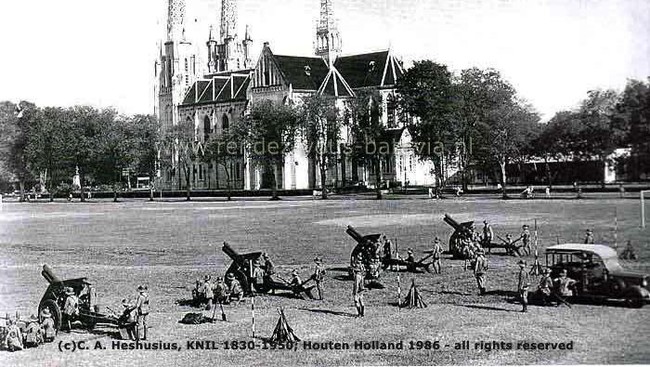
The lavish lifestyle of a married couple in Batavia (present-day Jakarta) in the early 20th century concealed a great secret. Behind the parties and luxury they enjoyed daily, the couple was found to have embezzled a fantastic sum of bank customers’ money, equivalent to around Rp87 billion in today’s value.
The perpetrator was A.M. Sonneveld, a former KNIL officer who later worked as an official at the largest private bank of the time, Nederlandsch-Indie Escompto Maatschappij. His social standing and employment meant almost no one suspected the source of his wealth.
Suspicion only arose after the bank discovered irregular transactions during an internal audit. The investigation revealed embezzlement of customer funds on a massive scale, implicating Sonneveld as the main culprit.
Media coverage appeared in early September 1913. At the start of the month, most newspapers in the Dutch East Indies reported on the unlawful acts of a bank employee in Batavia. Upon reading further, the employee was identified as A.M. Sonneveld.
The Deli Courant daily (5 September 1913), for instance, wrote that the 45-year-old man had been proven to have stolen 122,000 guilders of customers’ money.
The proof came after Bank Escompto conducted an internal investigation into suspicious transactions. From this, it emerged that Sonneveld had been playing dirty tricks.
In 1913, 122,000 guilders could buy 73 kg of gold, as the price per gram was 1.67 guilders. Converted to the present day, 73 kg of gold is equivalent to Rp87 billion (at Rp1.2 million per gram of gold).
Meanwhile, Sonneveld had already learned that the bank was beginning to uncover his dirty dealings. So, long before being named a suspect, he and his wife fled the city. The police declared the pair fugitives and circulated physical descriptions of them in numerous newspapers and public places.
A report in the Sumatra Post (6 September 1913) described Sonneveld in detail: brown-skinned, of Dutch blood, with scars on his right cheek and knee, aged 45.
Fortunately, the dissemination of information shed light on the couple’s flight. It was discovered that he had travelled to Bandung by train from Meester Cornelis (now Jatinegara).
“Police detected that he hired a car from Meester Cornelis and went to a hotel in Bandung,” the Deli Courant reporter wrote.
In Bandung, the two did not stay put and continued their journey to Surabaya by train. The Bataviaasch Nieuwsblad daily (7 September 1913) reported that during the train journey, Sonneveld met a friend who asked about the purpose of his trip.
The fugitive from Batavia told his friend he would travel to Hong Kong upon arriving in Surabaya. His excuse was that the trip was a comparative study visit to the Hong Kong branch of Bank Escompto. His friend, however, knew it was pure bluster.
He therefore reported the story to the police. The Dutch East Indies police promptly contacted the Hong Kong authorities. Sonneveld’s and his wife’s journey thus came to an end.
Shortly after setting foot on Hong Kong soil, the couple were arrested by police and extradited to the Dutch East Indies. A bag containing the remainder of the stolen money was also seized.
Upon arrival in Indonesia, the two were immediately put on trial. In court, Sonneveld admitted to stealing customers’ money to satisfy his desire for a luxurious life. His wife, who knew of her husband’s actions and tried to cover them up, was also charged.
Sonneveld was sentenced to five years in prison, while his wife had to spend three months behind bars. The Sonneveld case was subsequently recorded in history as the largest theft of the 1910s.
Source: jawawa.id (https://jawawa.id/newsitem/husband-and-wife-living-lavishly-in-jakarta-caught-stealing-rp87-billion-from-bank-1784451068)
Originally published by CNBC Indonesia (https://www.cnbcindonesia.com/market/20260719110203-17-751941/suami-istri-hidup-mewah-di-jakarta-ketahuan-curi-uang-di-bank-rp87-m), translated from Indonesian