
Hundreds of UII Students March on Yogyakarta's Zero Kilometre Point, Voicing Criticism
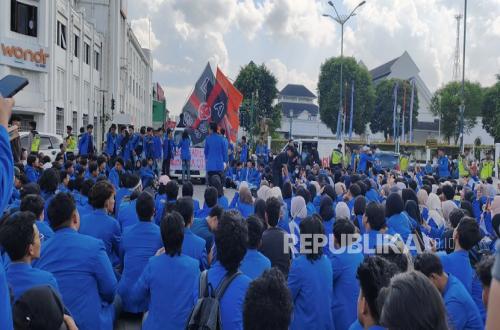
The atmosphere around Malioboro to Yogyakarta’s Zero Kilometre Point looked markedly different on Monday afternoon (15/6/2026). Hundreds of Universitas Islam Indonesia (UII) students wearing blue university jackets packed the area to voice their unease over the state of the nation, which they deemed far from well. The crowd, drawn from UII’s Faculty of Law and Faculty of Business and Economics, held a protest titled ‘Towards a Bankrupt Indonesia’. They conducted a long march from the Kotabaru area to the DIY Regional Legislative Council (DPRD) office and continued their action at Zero Kilometre Point.
Chairman of the UII Faculty of Law Student Representative Council, Muhammad Radin Nabil Akbar, stated the protest highlighted various issues ranging from economic conditions, rising prices of basic necessities, the weakening rupiah exchange rate, to police reform and militarism in the civilian domain. At least six demands were voiced to the government. ‘In this action we are bringing six demands, but we are focused on the economy. As our headline suggests, towards a bankrupt Indonesia. One of the things we are raising is the weakening rupiah exchange rate. This ultimately has a domino effect, leading to rising fuel prices,’ he said on Monday (15/6/2026).
The first demand called for the total cessation of MBG and the Koperasi Desa Merah Putih or KOPDES programme. The second demanded a reduction in fuel and staple food prices. The third urged the government to improve fiscal policy and state financial governance. The fourth demanded clarity on the reform process of the Indonesian National Police and a revision of the Police Law. The fifth called for an end to militarism in the civilian sphere. The sixth demanded an improvement in the government’s communication patterns and an acknowledgement of all its mistakes.
‘One of the problems that frequently arises in the public sphere is the way statements are delivered by state officials, which is often perceived as a confrontational communication style, dismissive of criticism, or even blaming other parties for a problem that emerges. This kind of approach is not solution-oriented; it tends to protect the institution’s image and widen the gap between the government and the people. Therefore, the demand to change the communication pattern to be more open, transparent, and accountable is indeed very urgent,’ he said. He continued that the public does not only need statements that appear to calm the situation or a clear party to blame; concrete steps are required to solve the problems. The government is asked to stop being defensive, admit if there are mistakes, and focus on solutions and healthy public dialogue. ‘Constructive communication practices for the sake of creating public trust and restoring the legitimacy of government institutions,’ he stated.