
Hundreds of Trillions in Agrinas Debt
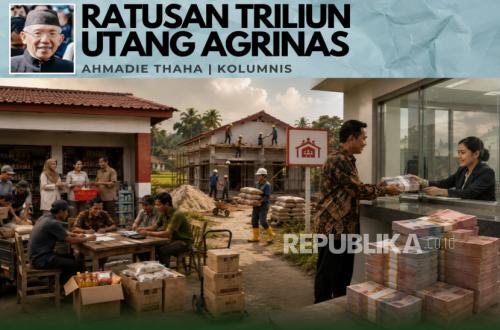
The cooperative has not yet had time to generate a profit, but its targeted debt already has a figure that makes calculators sweat: Rp240 trillion. Even more interesting is where that enormous sum first flows. The answer: PT Agrinas Pangan Nusantara.
Mentioning the name Agrinas is certainly not the same as accusing the company of corruption. Such an accusation requires evidence, not conjecture stitched together into a conclusion. But precisely because the value is extraordinarily large and Agrinas’s position is so strategic, the public has a very reasonable basis to ask for one thing: open all its windows.
According to Minister of Finance Regulation No. 15 of 2026, financing for the Koperasi Desa/Kelurahan Merah Putih (KDMP) takes the form of bank credit extended to Agrinas to accelerate the construction of outlets, warehouses and various supporting facilities. In practice, Agrinas is the main actor in the physical works on the ground.
The debt ceiling per cooperative, according to the finance minister’s regulation, is a maximum of Rp3 billion, borrowed from state-owned banks. If the final target is around 80,000 cooperatives, a rough calculation of the debt does indeed bring us to the figure of Rp240 trillion. This is no longer small change that can be kept in a cashier’s drawer.
With money of that magnitude, the oversight spotlight should be switched on as brightly as possible. Not because Agrinas is already presumed guilty, but because money that is too large always demands transparency that is equally large.
The question is actually simple. What is the money being spent on? How much has actually been turned into buildings? What is the price of one outlet unit? Who are the contractors and suppliers? How are vendors selected? What are the costs of materials, labour, vehicles, logistics, management and other components?
And the simplest question of all: what is the fair price? These questions are not an attack on Agrinas. Quite the opposite. For a company that works cleanly, openness is the best shield. It deprives accusations of any footing.
The problem is that doubt has already taken root. Take the BBC News Indonesia investigation, for example. It found a number of problems in the implementation of the KDMP programme under Agrinas, such as outlet locations deemed unusual, cooperatives that were not yet operating, and even units that eventually closed.
There has also been scrutiny of procurement, mentoring and the project implementation pattern involving many institutions. Journalistic findings are certainly not court rulings. But such findings also do not deserve to be treated like dust that can simply be swept under the carpet. They are precisely an alarm for the state to examine matters earlier.
The commotion grew after the DKI Jakarta branch of GMNI reported alleged irregularities in the KDMP project to the Attorney General’s Office in May 2026. The complainant cited potential state losses of Rp112 trillion.
That figure must be put in its proper place. It is the complainant’s claim, not the result of a state audit, nor a legally proven loss figure.
For that reason, what we need is not a social media trial. We do not need new judges in the comments section. What is needed is an examination.
If there is a mark-up, conduct an audit. If buildings do not meet specifications, please inspect them. If prices are unreasonable, open the documents. If vendors were selected without proper procedures, explain. If everything turns out to be reasonable and in accordance with the rules, announce the results of the examination. Simple. Clear. No need for verbal sleight of hand.