
Hundreds of Students Rally at NTB Governor's Office, Demand Free Nutritious Meal Programme Be Halted
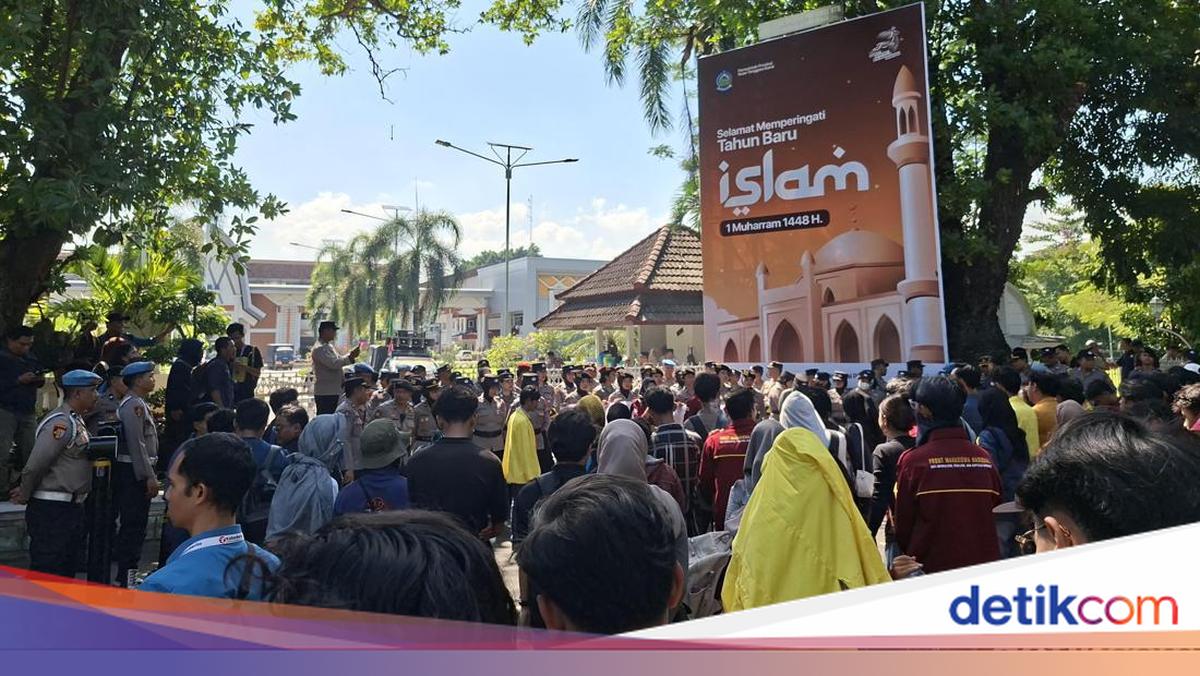
Hundreds of students from the NTB People’s Representative Student Alliance staged a demonstration in front of the West Nusa Tenggara (NTB) Governor’s Office on Thursday (18/6/2026). The crowd urged the government to conduct a total evaluation of the Free Nutritious Meal (MBG) programme, arguing it is placing a burden on state finances.
Tensions flared during the protest as demonstrators pushed against police lines while speakers took turns voicing the grievances of ordinary people, who they claimed are increasingly marginalised by government policies in Bumi Gora.
A representative from the Social and Political Ministry of the University of Mataram Student Executive Board, Hanan Wahyuda, stated that the protesters were highlighting chaotic national policies as well as the education crisis and sexual violence in the NTB region.
“We demand the government stop policies that sacrifice education, health, and social protection in the name of budget efficiency. We also ask that this MBG programme be evaluated because it has already heavily burdened state funds,” Hanan asserted during the rally.
Broadly, the demonstrators brought two main clusters of issues: a poor report card on national policies and a bleak picture of social and educational problems in NTB.
On the national cluster, Hanan detailed several new regulations deemed chaotic in implementation and threatening to democracy. One of these concerned the rollout of the MBG programme in the regions. “We demand that the MBG programme not burden teachers, harm the education sector, or disrupt school governance,” Hanan declared.
Beyond MBG, the students demanded an end to the commercialisation of education and the high cost of Single Tuition Fees (UKT). These policies, they argued, are increasingly pushing the children of labourers, farmers, fishermen, and the poor away from university.
The students also voiced their rejection of the National Police Bill and urged full respect for Constitutional Court rulings in every legislative process. In their view, the expansion of security apparatus roles into civilian spheres under President Prabowo’s administration threatens civilian supremacy.
In the economic sector, the crowd criticised the policy of raising non-subsidised fuel prices amid difficult economic conditions for the public. “Economic policy should truly side with workers, farmers, fishermen, students, and the poor,” he added.
Turning to local issues, the students highlighted NTB’s condition, which they described as being in a state of emergency regarding dilapidated schools. Another crucial issue raised was the prevalence of sexual violence in both formal and informal educational settings.
Five main demands were delegated to the NTB Provincial Government, including requests to improve educational facilities and teacher welfare in remote areas, and to genuinely reduce the number of out-of-school children through concrete action rather than merely manipulating data on paper.
Furthermore, the students urged the NTB Provincial Government to guarantee equal access to education without regional disparities. The government also has an obligation to build an effective protection and recovery system for victims of sexual violence against women and children.
“We urge the regional government, educational institutions, and law enforcement to build an effective protection system so that cases of sexual violence in NTB do not continue to recur and claim new victims,” said Hanan.
The Head of the NTB MBG Task Force, Fathul Gani, expressed appreciation for the students’ criticism. He viewed the input as important guidance for improving the MBG programme going forward.
“If there were no input or criticism, it would be like having no guardrails. We appreciate criticism, as long as it does not disrupt public order during the protest,” Fathul stated.
The Assistant to the NTB Regional Secretary also regarded criticism from students, the public, and the media as a healthy form of external oversight for government programmes. “So we are open to an evaluation,” he concluded.