
Humans, the Strategic Capital
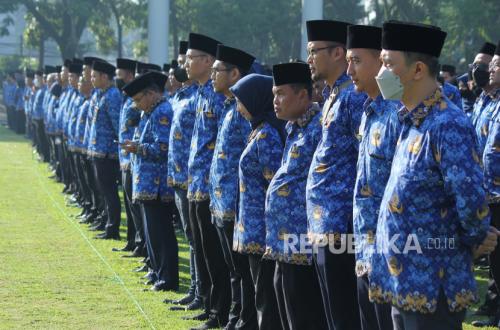
Local governments are on the brink of an unavoidable major transformation. Public issues are becoming increasingly complex, and societal demands on the government are rising. Citizens desire services that are fast, easy, transparent, and high-quality. Living in an increasingly digital environment, their standards for government service are easily compared with their experiences in the private sector and technology industries.
On the other hand, governments face increasingly visible limitations. Fiscal capacity is tightening, while development needs continue to rise. The scope of authority also faces various constraints, as more policies require alignment with the central government.
At the same time, we must face strategic issues such as poverty, unemployment, inequality, climate change, food security, the quality of education and health, and various increasingly interconnected social problems.
Amidst this situation, the world is also experiencing very rapid technological change. Digitalisation and Artificial Intelligence (AI) are changing how humans work, make decisions, and access services.
All these challenges culminently in one important question: How can local governments produce better performance and services when problems are becoming more complex, demands are higher, and resources and operational space are increasingly limited?
The answer is not simply to increase budgets, add more employees, or build new applications. The answer lies in the ability to perform strategic adaptation.
Natural history provides a powerful lesson on the importance of adaptability. More than 60 million years ago, dinosaurs were one of the groups of animals that dominated life on Earth. They existed in giant sizes as the rulers of the ecosystem of their time. However, a large asteroid struck the Earth in the region now known as the Yucatán Peninsula, Mexico. The impact triggered drastic global environmental changes: dust and material thrown into the atmosphere reduced sunlight, disrupted photosynthesis, altered food chains, and caused mass extinction. The dinosaurs eventually went extinct and disappeared.
What is interesting is not just how the dinosaurs went extinct, but why some forms of life were able to survive while others were not. Although environmental conditions changed drastically, certain groups of smaller, seemingly weaker animals that possessed the ability to adapt to rapidly changing environments managed to survive.
The important lesson is not that the large lost or the strong went extinct. The lesson is that when the environment changes drastically, strength and size are not enough to guarantee future survival. This analogy can be directly applied to bureaucracy; the message is highly relevant. Therefore, the greatest challenge for government is not merely how to maintain what has been possessed, but how to ensure the organisation is able to adapt before change leads to its extinction.
Governments essentially always work under conditions of limitation. There is never enough budget to fund all the needs of the community. There is no number of employees capable of resolving all issues. There is not enough time to work on all agendas simultaneously. Therefore, the government must be able to choose; this is the essence of strategic management in government.
Strategy is not merely a document containing visions, missions, programmes, and indicators. Strategy is the ability to read change, determine direction, choose priorities, allocate resources, execute choices, measure results, and then make adjustments when the environment changes. Because of the limited nature of all resources, the ability to choose becomes increasingly important.
Decentralisation provides space for regions to manage government according to the characteristics and needs of their territory. However, in its development, that space is becoming increasingly limited. This situation demands that local governments become more adaptive. When authority cannot be used entirely freely and fiscal resources are limited, local governments must be increasingly creative in seeking solutions.
When facing resource constraints, technology offers new opportunities. Digitalisation can simplify processes, accelerate services, reduce administrative work, improve data management, and increase transparency. AI even opens even greater opportunities. This technology can help analyse data, find patterns, organise information, automate routine tasks, and support decision-making. However, governments must be careful not to fall into the trap of “technology for technology’s sake.”
Using AI and digitalisation does not automatically make the bureaucracy smarter. Digitalisation is not merely moving manual work to a computer screen. Digitalisation is a change in how the government works to be simpler, faster, more precise, and more beneficial.
AI will take over increasingly more routine tasks. Therefore, the value of Civil Servants (ASN) in the future lies not primarily in their ability to perform tasks that can be done by machines, but in abilities that require judgement, creativity, empathy, integrity, communication, leadership, and problem-solving.
Civil servants must evolve into problem solvers; they must be able to read data, understand technology, think critically, work across sectors, communicate with the community, make decisions, and continuously update their knowledge. This is why the development of human resources for the apparatus is no longer a supporting agenda. The development of Civil Servants must become a core strategy of government.
In strategic management, an organisation possesses resources that determine its ability to achieve goals. In the context of…