
Humans Replaced: Robot Sets New World Record
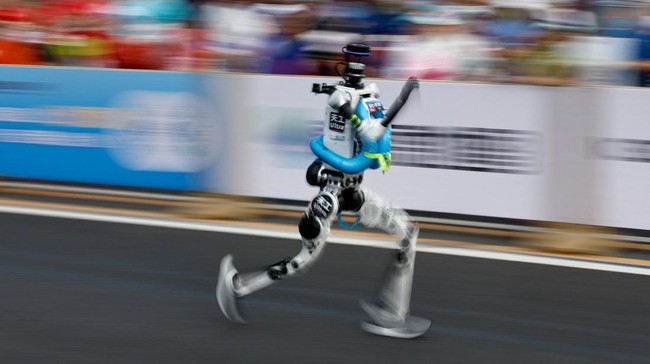
A humanoid robot made in China has run 100 metres in 9.39 seconds during the preliminary round at the World Humanoid Robot Games in Beijing on Saturday (22/8) last week. The time surprisingly surpassed the men’s world record held by Jamaican sprinting legend Usain Bolt.
The robot, named Tiangong Ultra and developed by the Beijing Humanoid Robot Innovation Center, won the preliminary round at the opening of the second edition of the robot competition, according to the organisers. Tiangong Ultra overtook a robot named Lightning, made by smartphone manufacturer Honor, just before the finish line after initially trailing at the start of the race. Lightning crossed the finish line in 9.47 seconds, also faster than Bolt’s record of 9.58 seconds at the 2009 World Athletics Championships in Berlin.
Despite their speed, the two robots did not yet possess the elegant style and control of Bolt. Both crashed into thick mats prepared to stop their momentum. Tiangong Ultra staggered heavily and was thrown to the side of the track, forcing spectators to move quickly to avoid it. Meanwhile, Lightning fell hard to the ground and had to be stretchered out of the arena.
Nevertheless, the results marked a rapid improvement compared with last year’s inaugural edition, when Tiangong Ultra won the 100-metre race with a time of 21.50 seconds. Tiangong had previously won the world’s first humanoid robot half-marathon held in Beijing last year.
Earlier on Saturday morning, Chinese state media reported that Lightning had recorded a time of 9.32 seconds for the 100 metres in a preparation trial, with a peak speed of 14.5 metres per second. Lightning also won this year’s humanoid half-marathon competition with a time of 50 minutes 26 seconds, faster than the elite men’s world record pace.
When running in the half-marathon event, Lightning was 169 cm tall with a leg length of 95 cm. Researchers then extended its legs by 10 cm to 1.05 metres ahead of the Robot Games competition, according to a report by state television CCTV.
The 100-metre race was one of 51 events contested at the games, which also included football, dancing, and industrial task contests.
China continues to promote the development of humanoid robots as a new strategic industry. Policymakers and companies are betting that advances in artificial intelligence and hardware will accelerate the use of robots in manufacturing, logistics, and consumer applications.
Investor enthusiasm for the sector was evident earlier this week when shares of Unitree, China’s most prominent humanoid robot maker, surged more than fivefold on its trading debut on the Shanghai stock exchange on Wednesday. The surge gave the company a market value of around US$50 billion.
This year’s Robot Games were attended by 2,056 robots from 666 teams from 16 countries and six continents, a sharp increase from 280 teams at the inaugural event. The competition, held at the National Speed Skating Oval in Beijing, ran until Wednesday.