
Humans’ Closest Relatives Were Cared for Before Being Speared to Death
Jakarta, CNBC Indonesia — In a cave in the mountains of northern Iraq, bones tell a story of two seemingly contrasting things: lethal violence and compassion. The discovery suggests that Neanderthals, humans’ closest relatives, also had empathy, concern and a willingness to care for one another—qualities long thought to be uniquely human. The report was cited on Friday (16 October 2026).
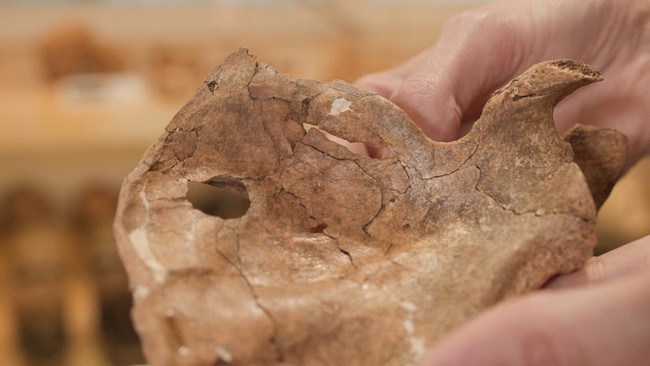
The skeleton, named Shanidar A, was found in Shanidar Cave in Iraq’s Kurdistan Region, buried 7.5 metres beneath rock and soil. It is estimated to be about 75,000 years old. A perfectly round, 15-millimetre hole in the left shoulder blade is evidence of a sharp object that entered from the front, pierced the lung and exited through the back.
Based on the shape of the hole, researchers concluded that the weapon was a sharpened wooden spear, rather than one with a stone tip. It was thrust downwards with great force, penetrating the chest and lung before passing through the shoulder blade. Death is thought to have followed quickly.
“The wound indicates a direct attack. Whether it was a hunt that went wrong or a conflict between groups cannot be determined. But what is clear is that death came quickly,” said Emma Pomeroy, a researcher at the University of Cambridge who led the study.
More moving than the manner of death, however, is what happened after another serious injury about a year earlier. Shanidar A’s front teeth were broken and missing, apparently as a result of a heavy blow to the face. One tooth was cracked and displaced, while another had shifted position. The injury was not fatal, but it would have made eating and drinking difficult, and possibly speaking too.
“This means that for months, other people gave him softened food, looked after him and allowed him to rest. Without that help, he would not have survived,” Pomeroy explained.
The individual’s body was also deliberately placed in the same spot as those of four other Neanderthals, hidden behind a large stone pillar in the deepest part of the cave. All were buried within a relatively short period, as if the place had served as a sacred resting place for their group.
The finding reinforces a point that has long been debated: Neanderthals were not simply crude and unintelligent prehistoric beings. They had strong social bonds, could care for vulnerable group members and buried those they loved.
“We see both sides at once—violence and care—in the same individual. Those are not qualities possessed only by modern humans. Neanderthals, like us, were capable of both good and bad,” Pomeroy said.