
Human Rights Ministry to Deploy 200 Human Rights Activators in Villages Across Indonesia
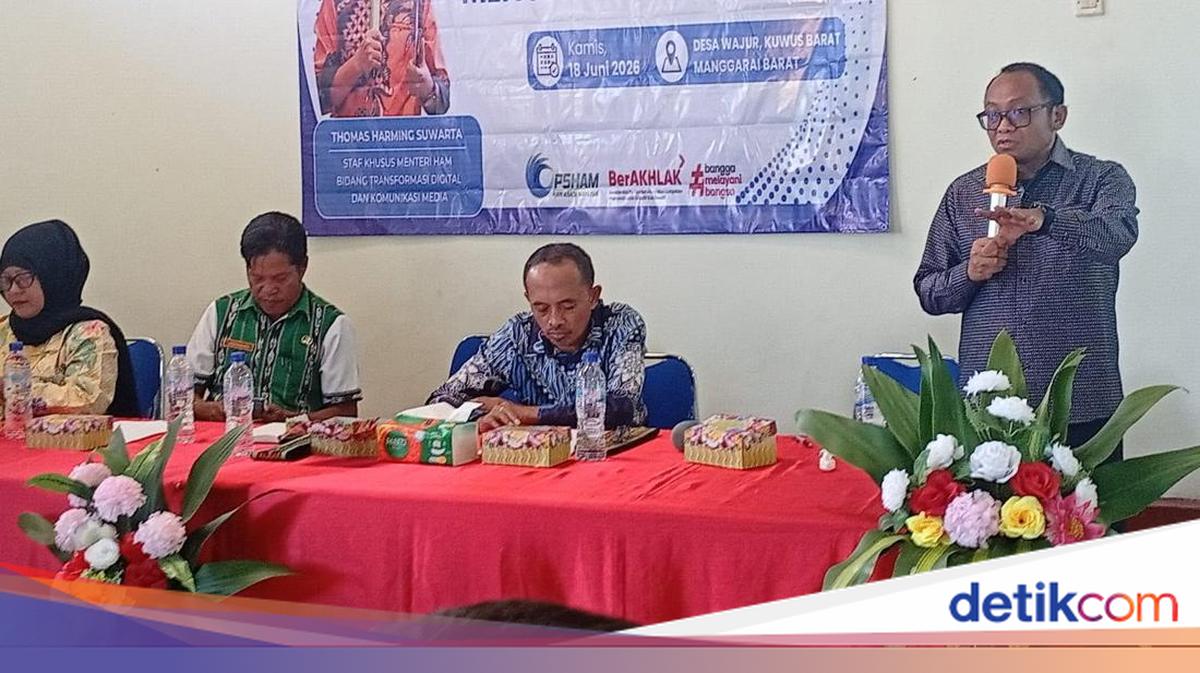
Special Staff to the Minister of Human Rights for Digital Transformation and Media Communication, Thomas Harming Suwarta, has emphasised the crucial role of villages in building a human rights civilisation in Indonesia. Thomas stated that villages and all their apparatus must become the driving force of human rights development.
He made the remarks whilst providing a briefing on strengthening human rights capacity for communities, titled ‘Towards a Village Society with a Human Rights Civilisation’, in three villages in the Greater Manggarai region, East Nusa Tenggara Province. The three villages are Wajur Village in West Kuwus District, West Manggarai Regency; Iteng Village in Satarmese District, Manggarai Regency; and West Satar Punda Village in North Lamba Leda District, East Manggarai Regency.
According to Thomas, human rights development at the village level is important and strategic, coinciding with the national development agenda that places rural communities as the primary target, such as the presence of the Red and White Village Cooperative, People’s Schools, Fishermen’s Villages, Free Nutritious Meals, Free Health Checks and various other programmes.
‘A developed nation is one that places villages and hamlets as the spearhead of development; in the same context, villages should also become the driving force of human rights development,’ Thomas told reporters on Thursday (25/6/2026).
Thomas said the Ministry of Human Rights is preparing a special agenda to build a human rights civilisation in villages by deploying human rights activators in villages throughout Indonesia.
‘This year we are recruiting 200 Human Rights Activators at the village and sub-district level who will later become the spearhead of human rights development. In any case, the presence of human rights activators in all villages across Indonesia will ensure the presence of aspects of respect, protection, promotion, enforcement and fulfilment of human rights,’ Thomas continued.
He assessed that the better the community’s understanding of human rights, the more it helps minimise human rights violations, starting from the domestic sphere within the family to social life within the community.
According to him, many people in villages throughout Indonesia experience numerous human rights-related issues, ranging from the right to life, the right to work, education, health and a sense of security, including the right to the environment and the right to development. This also includes vulnerable groups, violence against children and women, and land conflicts that require the state’s direct attention.
‘Placing villages as the driving force of human rights development is a strategic step that helps ground human rights values, making them more easily accessible to the wider community and, in turn, also helps advance comprehensive national development,’ Thomas explained.
The presence of human rights briefings at the village level, Thomas said, besides increasing knowledge and building community awareness about human rights, is also intended to encourage village apparatus to ensure human rights values serve as the foundation in formulating the direction of development at the village level.
‘In the village there is a development consultation forum; it is hoped that the agendas or policies presented are also based on the foundation of human rights values and principles,’ Thomas concluded.