
Human Rights Minister: State Budget Management Focused on Strengthening Human Rights Services
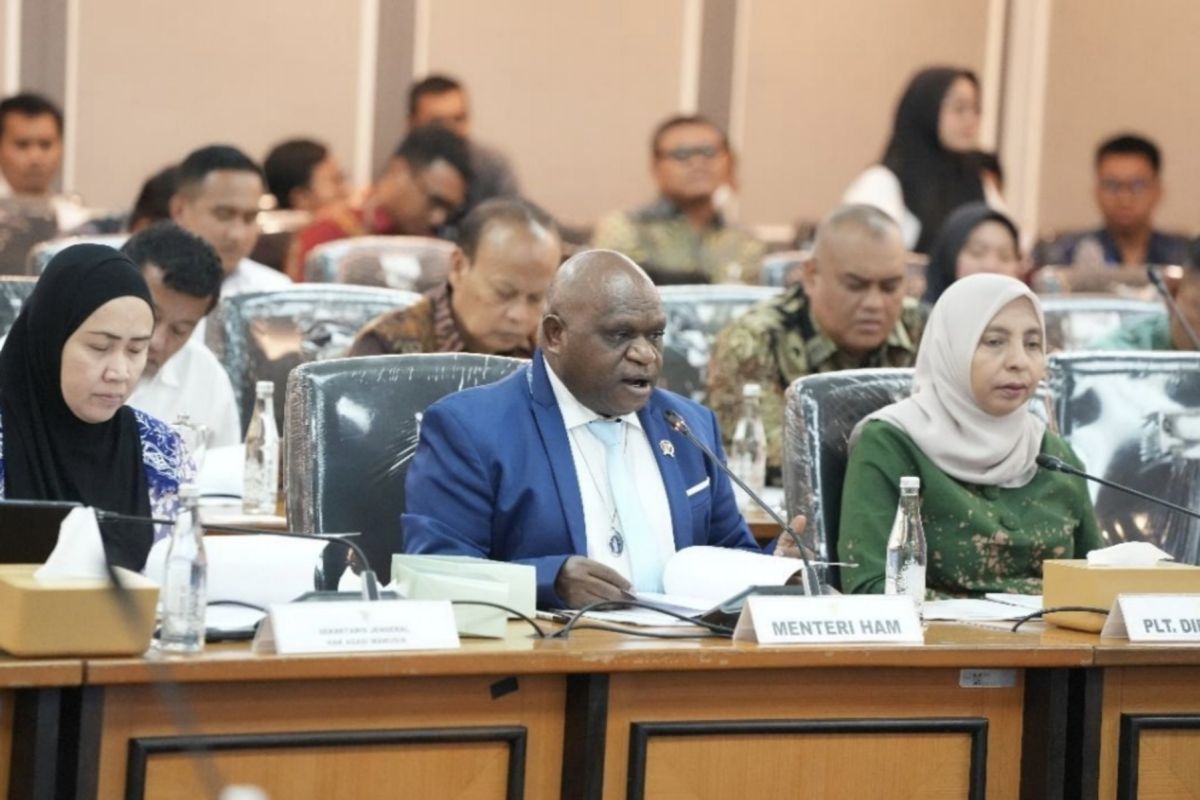
Human Rights Minister Natalius Pigai has stressed that his ministry’s budget management is focused on supervision, monitoring, and programme implementation to ensure every use of the state budget (APBN) provides tangible benefits to the public and strengthens human rights protection services. Pigai stated in Jakarta on Thursday that the Ministry of Human Rights continues to maintain budgetary discipline despite still facing adjustments as a newly established ministry. Additionally, the Ministry of Human Rights is strengthening internal oversight, conducting periodic evaluations of work units, and digitalising complaint services so that public access to human rights services becomes faster and more transparent. “We are the only ministry that has strictly, seriously, professionally, honestly, impartially, and with an anti-corruption stance maintained and supervised this over the past year. Although part of the budget is to support national priority programmes, we are more focused on monitoring, supervision, driving effectiveness, execution, and implementation so that it is achieved properly and correctly,” Pigai said following a working meeting with Commission XIII of the Indonesian House of Representatives (DPR RI) at the Parliament Complex in Jakarta on Wednesday. He affirmed that all input from the DPR RI would become part of strengthening the ministry’s task execution to align with President Prabowo Subianto’s Asta Cita vision. “All instructions, suggestions, and input will be implemented,” he said. During the meeting discussing the Central Government Financial Report for the 2025 State Budget, Commission XIII of the DPR RI appreciated the budget realisation and performance achievements of the relatively newly formed Ministry of Human Rights. Deputy Chairman of Commission XIII Sugiat Santoso expressed hope that synergy between the DPR RI and the Ministry of Human Rights would grow stronger in delivering human rights protection to the public. “Hopefully, this can become an increasingly progressive collaboration on how to uphold human rights in Indonesia,” Sugiat said. He also expressed hope that the Ministry of Human Rights would be more progressive in carrying out its mandate, including strengthening the functions of receiving public complaints, mediation, and advocacy. “In line with President Prabowo Subianto’s Asta Cita, we hope the Ministry of Human Rights will be able to receive complaints from the public, mediate, advocate, and ensure the public prevails in every complaint they make,” he stated. Commission XIII member Rieke Diah Pitaloka also appreciated the high budget realisation of the Ministry of Human Rights but cautioned that absorption achievements must be accompanied by improved public service quality. According to her, the ministry’s success must be measured by the speed of complaint resolution, strengthening human rights compliance in governance, the effectiveness of cross-ministerial and local government coordination, and the protection of vulnerable groups. Several other Commission XIII members also provided notes for more effective programme implementation. Anwar Sadad requested that synchronisation between budget realisation and physical programme achievements be maintained, while Tonny Nesar encouraged strengthening programmes in frontier, outermost, and disadvantaged regions. Anisah Syakur appreciated budget planning amid efficiency policies, and Meity Rahmatia urged continued institutional reform so that human rights protection services become faster, more accessible, and their benefits felt by the public.