
Human Rights Awareness Grows in Bangunharjo: Residents No Longer Bring 'Pocket Money' to Service Counters
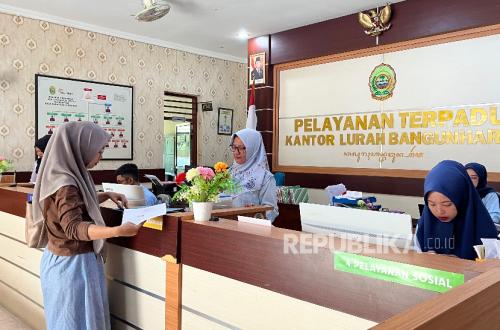
For years, Hari Pujiyanto (36) harboured a persistent worry. The resident of Dusun Wojo, Bangunharjo Village, Bantul Regency, Special Region of Yogyakarta, often wondered whether his affairs would proceed smoothly without having to pay extra money when dealing with village officials.
On Tuesday (28/7/2026), Hari visited the Bangunharjo Village Office to process several documents required by PT Taspen. Upon arrival, he was immediately greeted by an officer at the entrance and asked about the purpose of his visit.
After filling in the guest book, Hari did not have to wait long. As there happened to be no queue, his documents were promptly checked and processed by the officer. The village head was also present, allowing the required documents to be signed and stamped on the spot.
In a single visit, the document processing was completed. Hari could then proceed to the next administrative stage without having to return to the village office.
“For processing these documents, there is no need to leave them or go back and forth. So, it is very good. I am very pleased with this service,” Hari said when met by Republika at the Bangunharjo Village Office.
Fast and straightforward service is something Hari considers important. Moreover, his home is quite far from the village office. He therefore feels helped because a single visit settles the matter. He does not need to repeat the journey simply because documents have not been processed or the required official is not present.
Hari admitted that this was not his first time accessing services at Bangunharjo Village. As a native resident, he has handled various administrative needs at the office for approximately ten years. From processing marriage documents, business needs, to applying for assistance, all administrative processes have been conducted through the village.
However, from these various experiences, one change Hari has felt most strongly in current services is the absence of illegal levies. “The most noticeable thing is that there is no illegal levy here. So once it is done, it is done. There are no additional charges for this or that. That is very helpful for us ordinary citizens,” Hari said.
For Hari, public services should be accessible without citizens having to provide additional money beyond official provisions. Government officials are tasked with serving the public, so administrative processing should not become a space for requesting compensation.
“They are already paid by us and serve us for free. We are very happy about that. So, we are no longer afraid to handle matters at the village office. There is no longer any thought of, ‘Oh, I will be asked for this or that.’ That is gone now,” he said.
Hari described the change in simple terms. Residents no longer need to come to the village office carrying the worry that they must spend money for their affairs to be processed more quickly.
“Bluntly speaking, there is no need to bring pocket money. It is processed as long as the cover letter is complete. My experience has also been smooth here. There is no obstruction,” Hari said.
Hari’s statement indirectly shows that the problem of illegal levies remains one of the experiences embedded in public memory when dealing with administrative services. He admitted to having experienced or known of practices that amounted to unofficial charges in administrative processing around a dozen years ago.
Hari no longer remembers the incident in detail. Nonetheless, that past experience makes the current service a point of comparison. For Hari, fast service without levies and without making things difficult for residents is a tangible change. “So at the service desk, there is no differentiation, whether related to priority or minority status. There is none,” he said.
Although he considers services at Bangunharjo Village to be much improved, Hari hopes that the quality of officers can be maintained and even enhanced. According to him, good service is not only measured by the speed of administrative processing. Every resident should also receive equal treatment regardless of economic condition, appearance, or social background.
“I ask that what is already good be maintained. In the future, it can also be improved, such as queues that do not pick and choose. All residents should be served equally, whether rich or poor, without being judged by appearance,” Hari said.
He also hopes that no resident receives special treatment merely because of position, appearance, or particular economic background. “It should not be that someone is seen and thought, ‘Oh, they used to be prioritised.’ Everyone should be served directly like this. I am very pleased,” he said.
Hari stated that equal service is also an important part of building respect for citizens’ rights. Residents who come to handle administrative matters should receive the same opportunity as long as they follow procedures and complete the requirements.
On the other hand, he believes that awareness of maintaining good service is not solely the government’s responsibility. The public also needs to respect service offices and follow applicable rules. “As residents, we respect the office. When we come, we still wear long trousers like this. That is our own awareness,” he said.
Hari also appreciated the presence of officials, whom he considered fairly complete and active in the office. According to him, the presence of village officials allows administrative processes to run more quickly because each stage can be immediately checked and followed up.
Hari observed that several village officials were in their respective work rooms. Officers handling governance and public order were also present, allowing residents to directly obtain services according to their needs.
Source: jawawa.id (https://jawawa.id/newsitem/human-rights-awareness-grows-in-bangunharjo-residents-no-longer-bring-pocket-money-to-service-counters-1786931478)
Originally published by Republika (https://news.republika.co.id/berita/tjphfp484/kesadaran-ham-warga-bangunharjo-yang-tumbuh-tak-lagi-bawa-uang-saku-di-loket-pelayanan), translated from Indonesian