
Human Life Threatened with Chaos as Earth Faces Total Paralysis from Solar Storms
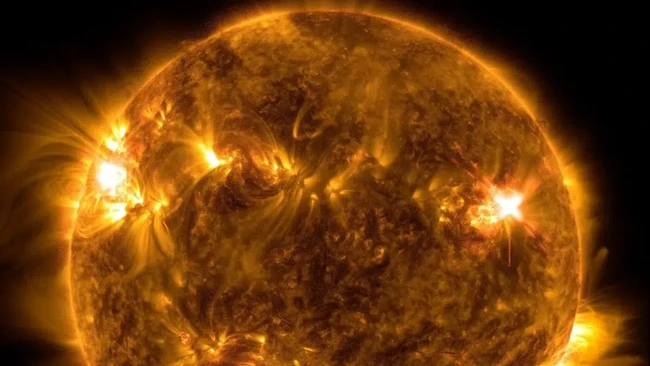
A new study warns that the destructive power of an extreme solar storm, the kind that occurs once every thousand years, has been grossly underestimated, posing a far greater threat to modern technology than previously thought. The research, led by NASA’s Goddard Space Flight Center and published in the journal Nature, challenges decades-old assumptions about the Earth’s magnetic defences.
For years, scientists believed there was a limit to the amount of solar energy the Earth’s ionosphere could absorb. However, an analysis of over a million data points on solar wind revealed no statistical evidence of such a ceiling. This means that the stronger the eruption from the Sun, the greater the potential disruption on Earth, with no predictable upper boundary. The previous miscalculation stemmed from measurements taken by satellites positioned far from Earth at the Lagrange point L1, where the solar wind energy has already weakened. Data from satellites orbiting closer to our planet painted a starkly different picture.
“We usually assume that the true value is around the measured number. But probability theory shows the value tends to be skewed to one side, which is why the space weather risk appears to have been underestimated,” said Nithin Sivadas, the study’s lead author. Should a once-in-a-millennium solar storm strike, the consequences would be devastating. Power grids could be crippled by geomagnetically induced currents overloading large transformers, potentially causing blackouts lasting months across vast regions. The resulting expansion of the atmosphere would increase drag on low-orbit satellites, causing them to lose altitude rapidly and risk premature failure, while high radiation levels could fry their onboard electronics. Furthermore, GPS and communication signals could be disrupted or lost entirely, paralysing aviation, shipping, banking systems, and the internet.
The researchers stress that this finding does not predict an imminent catastrophe, but as society becomes increasingly dependent on vulnerable technology, risk calculations must be updated and infrastructure hardened proactively. The historical benchmark for such an event is the 1859 Carrington Event, a solar storm so powerful it caused telegraph systems across Europe and the United States to fail completely and made the aurora borealis visible as far south as Cuba and Hawaii. If a similar event, with a force now understood to be potentially much greater, were to occur today, the financial losses could run into the thousands of trillions of rupiah.