
Human Capital: The Key Driver of Sompo Insurance’s Business Excellence and Sustainability
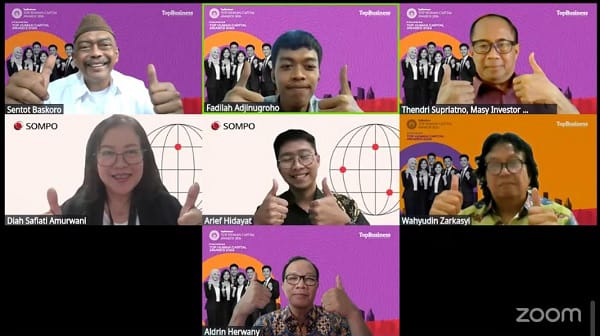
Jakarta, TopBusiness — Sustainable business growth requires human resources to be managed through careful planning, measurement and alignment with corporate strategy. PT Sompo Insurance Indonesia applies this principle by positioning Human Capital (HC) as a strategic business partner, covering workforce planning, competency development, talent management and efforts to increase employee engagement.
For Sompo Insurance Indonesia, Human Capital management is not merely an administrative function. HC is involved from the business-planning stage, including budget preparation, workforce planning and the development of prospective leaders, to ensure the organisation’s continuity.
“Human resources are part of the company’s strategy. Sompo therefore regards its people as an important and inseparable part of its corporate strategy,” said Diah Safiati Amurwani, Head of HR at PT Sompo Insurance Indonesia, during an online judging session for the TOP Human Capital Awards 2026 on Thursday (8 October 2026).
This approach has become increasingly important as the Japanese-origin insurance company has grown. Present in Indonesia since 1975, Sompo Insurance Indonesia now has more than 700 employees across around 26 offices. Its services include motor, health, marine cargo, travel, property and engineering insurance, as well as various other general insurance products.
The company also manages around 2.1 million individual policies and 1.4 million corporate policies. This scale of operations requires organisational readiness, a skilled workforce and Human Capital governance capable of supporting business needs while maintaining service quality for customers.
HC integrated with business strategy
Sompo positions Human Capital as a strategic business partner directly involved in planning and implementing corporate strategy. One of its key roles is ensuring that workforce requirements and personnel budgets are aligned with the direction of business growth.
Through workforce planning, the company assesses staffing requirements based on business projections. Headcount is determined not only by operational needs but also with organisational efficiency in mind.
“We are genuinely involved in the company’s budgeting. There is no denying that people or personnel expenses make up a very large part of a company’s budget,” Diah told the judging panel, which included Sentot Baskoro of the Indonesian Greenhouse Gas Association, Universitas Padjadjaran Professor Wahyudin Zarkasyi, Aldrin Herwany of Perbanas Institute Jakarta, and Thendri Supriatno of the Independent Investors Society.
Sompo also uses workforce planning to balance human resource requirements with productivity. Any increase in staffing must therefore be based on a clear need and be relevant to the development of the business.
In addition to workforce planning, HC governance covers recruitment, onboarding, performance management, talent management, succession planning, learning and development, employee engagement and retirement planning.
These processes are designed to ensure that employee management is integrated and continuous. The company also reviews its talent pool and potential successors to ensure that people are ready to fill key positions.
The involvement of directors and senior management is one of the supporting factors. Company leaders play an active role in talent management, succession planning, competency development and improving employee engagement.
Key performance indicators (KPIs) are aligned through each level, from the regional and company levels down to individual teams. The system is intended to ensure that individual achievements contribute directly to corporate objectives.
“KPIs cannot operate in silos, with each department concerned only with its own targets. They are cascaded from the regional level to Sompo Indonesia and then down to each team member. A team member’s success in meeting their KPIs also means success for the company’s KPIs,” Diah said.
Sompo also promotes a growth-oriented culture that emphasises openness, sustainability and structured talent development.
“Sompo is committed to optimising every employee’s potential. The business impact is that our people become the key drivers of the company’s excellence and sustainability,” Diah explained.
Developing talent and professional capabilities
In the insurance industry, employee capabilities are closely linked to the quality of risk management and customer service. Sompo therefore places considerable emphasis on developing technical expertise, leadership abilities, professional certifications and digital literacy.
The company provides self-directed e-learning for employees and LinkedIn Learning for staff at manager level and above. Training also covers soft skills, technical capabilities and leadership through Sompo Global University’s Next Leadership Programme.
For professional capabilities, the company encourages employees to obtain certifications relevant to their roles, including in general insurance, health insurance, sharia insurance, underwriting and risk management. The Human Capital function also supports professional certification in human resources.
These certifications have different levels and requirements. To encourage participation, the company provides a monthly competency allowance to employees who obtain certifications in accordance with the applicable rules.
“We continually improve our capabilities. We actively promote a learning culture; we even push employees a little, telling them that they have to improve their competencies,” Diah said.
Diah said the commitment is supported by a human resource development budget that follows OJK requirements, with a minimum allocation of 3.5% of total employee costs. The size of the budget reflects the view that competency development is a strategic investment in organisational readiness.
Sompo has also developed four main Human Capital pillars: insurance expertise, leadership capability, professional certification, and digital and artificial intelligence (AI) proficiency.
The four pillars are intended to ensure that employees have the capabilities their jobs require, can make effective decisions, meet professional requirements and use technology in their day-to-day work.
For career development, the company uses individual development plans, coaching, mentoring, internal mobility and job rotation. Internal job postings also offer opportunities to move across functions, allowing employees to broaden their experience and develop skills in other areas.
To improve the quality of interaction between leaders and employees, Sompo has adopted the Boss to Coach principle and the CFC approach (Care, Feedback and Clarity). These encourage managers not only to direct work but also to support employees, provide feedback and give clarity on team members’ development.
Employee experience and sustainable governance
Alongside capability and performance, Sompo considers employee engagement an important part of Human Capital governance. Since 2017, the company has taken part in the Gallup Engagement Survey to assess employee engagement and inform reviews of its human resource policies.
The company also reviews its organisational structure, management span of control, remuneration and benefits. To evaluate compensation, Sompo has participated in the Annual Salary Survey with Towers Watson since 2014.
Attention to employee experience goes hand in hand with efforts to retain staff. Diah said the company’s voluntary separation rate was 7.76% in 2024, falling to 6.9% in 2025.
For the company, employee experience is linked to organisational culture, development opportunities, performance clarity and leadership support. Its values — accountability, agility, collaboration, development and integrity — underpin this approach.
Accountability and integrity, for example, are relevant to the nature of insurance, which involves managing the transfer of customer risk. Agility and collaboration are needed to respond to changing market needs, product developments and operational demands.
Human Capital also contributes to the implementation of ISO 27001 on information security and ISO 37001 on anti-bribery management systems. Although neither standard focuses specifically on HR, HC’s involvement helps the company maintain more orderly and well-documented processes.
The business and governance approach has accompanied the company’s performance. Diah said Sompo Insurance Indonesia recorded asset growth of 12.8%, a 9.7% increase in profit after tax and a risk-based capital (RBC) ratio of 240%.
For Sompo, these business results need to be supported by an organisation that is skilled, adaptable and able to work collaboratively. Human Capital development is therefore intended not only to meet current needs but also to prepare talent for future changes in the industry. “Sompo is committed to optimising every employee’s potential,” Diah said.
The commitment underscores Sompo Insurance Indonesia’s approach to Human Capital management: integrating workforce planning, competency development, talent management and employee experience into its strategy for sustainable business growth.
Source: jawawa.id (https://jawawa.id/newsitem/human-capital-the-key-driver-of-sompo-insurances-business-excellence-and-sustainability-1791553833)
Originally published by topbusiness.id (https://www.topbusiness.id/137822/hc-penggerak-utama-keunggulan-dan-keberlanjutan-bisnis-sompo-insurance.html), translated from Indonesian