
Hubble Telescope Finds Evidence of Ancient Collision That Shaped the Milky Way
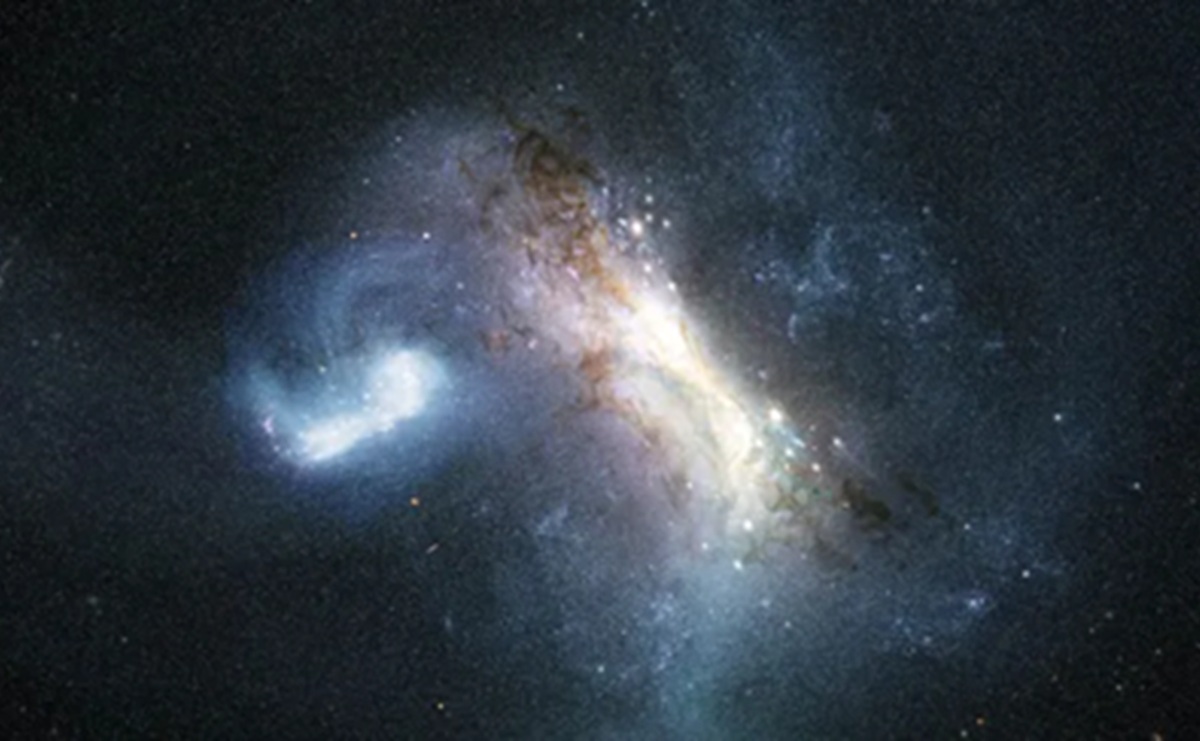
Observations using the Hubble Space Telescope have revealed new evidence about the formation history of the Milky Way. Astronomers have found that the galaxy humanity calls home experienced a large-scale collision and merger with a dwarf galaxy around 11.8 billion years ago.
Galaxy mergers are one of the primary ways a galaxy grows and evolves. However, mapping the Milky Way’s past requires in-depth analysis of the remnants of ancient objects scattered within it.
“Our home is the Milky Way, but we do not know how our home was built,” said Davide Massari of the Astrophysics and Space Science Observatory of Bologna in Italy, who led the study.
“In this paper, we found where the first significant pile of bricks came from: a dwarf galaxy we call LKH,” he added.
The name LKH stands for Low-energy–Kraken–Heracles, referring to three previous studies that examined the idea of galaxy mergers in the early history of the Milky Way.
In this study, the team of scientists identified a population of globular clusters that did not originate from the Milky Way nor from the Gaia-Sausage-Enceladus (GSE) galaxy, another galaxy that collided with the Milky Way around 10 billion years ago. This population is known to have come from the LKH galaxy and merged with the Milky Way 11.8 billion years ago.
“Thanks to the high resolution and depth of Hubble’s imaging, we were able to measure the ages and metal content of these clusters with unprecedented precision,” said Chiara Zerbinati, an astronomer from the University of Bologna who co-authored the study.
“Combined with measurements from the [European Space Agency’s] Gaia mission, this made it possible to distinguish different populations of globular clusters from one another. These are clusters that were born in LKH and tell us when that galaxy was devoured by our galaxy, as well as how massive it was,” Zerbinati explained.
Based on the analysis, the research team calculated that the LKH galaxy had a total mass equivalent to 500 million times the mass of the Sun. Although small by today’s standards, that figure contributed a very large proportion of matter to the Milky Way, which at the time was only two billion years old after the Big Bang.
The discovery, published in the journal Nature Astronomy on 17 August, provides new insights into the evolution of the Milky Way.
“Some previous studies argued that the earliest phases of our galaxy’s evolution were determined by stars born only in our galaxy,” said Massari. “Here, we have shown that stars born in external galaxies also need to be considered.”
Source: jawawa.id (https://jawawa.id/newsitem/hubble-telescope-finds-evidence-of-ancient-collision-that-shaped-the-milky-way-1787115092)
Originally published by Media Indonesia (https://mediaindonesia.com/teknologi/923360/teleskop-hubble-temukan-bukti-tabrakan-purba-yang-mengubah-galaksi-bima-sakti), translated from Indonesian