
Huawei's Zhou Jianjun: Building Grid-Interactive AIDC Solutions to Maximise Tokens per Watt
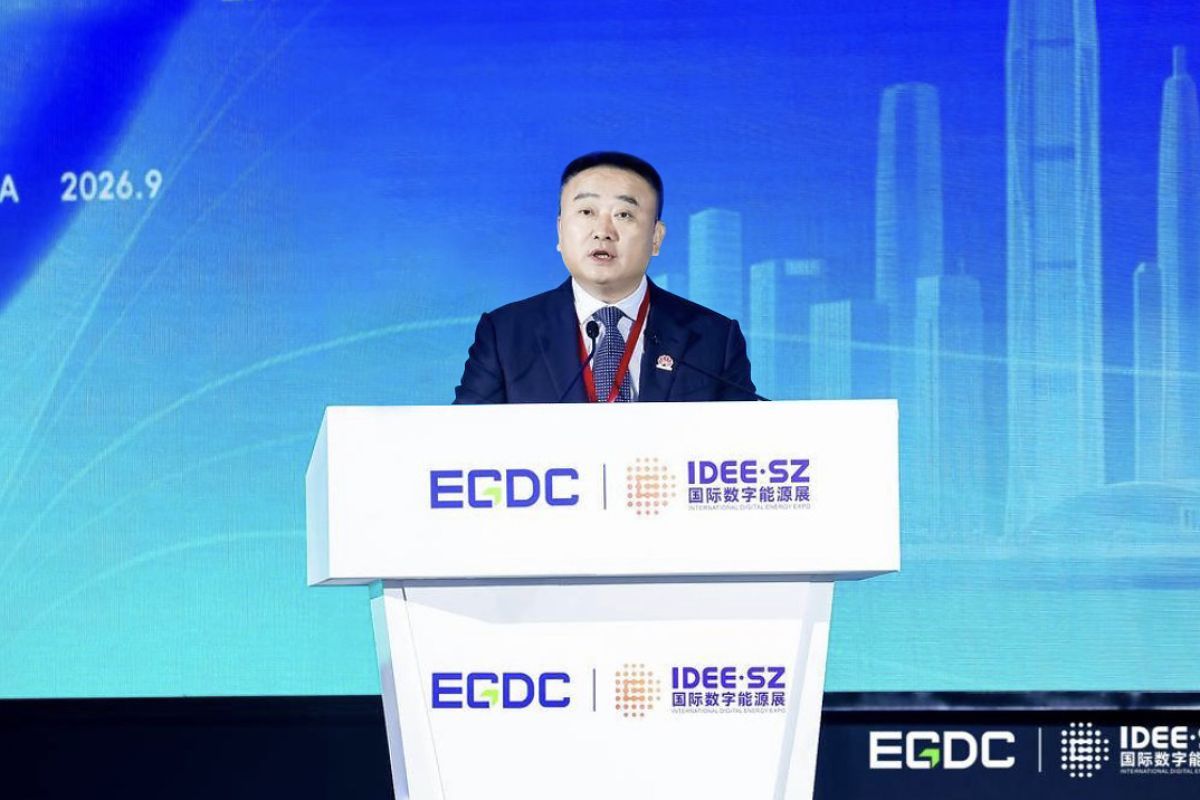
Shenzhen, China — The Green Energy Development Conference & International Digital Energy Expo 2026 has officially opened in Shenzhen. Zhou Jianjun, Vice President of Huawei and President of Global Marketing, Sales and Services at Huawei Digital Power, attended the opening session, where he introduced Huawei’s grid-interactive AI Data Centre (AIDC) solution. This solution addresses emerging challenges in power acquisition, high-density power supply, high-density heat dissipation, and the complex processes of delivery, operation, and maintenance in the AI era by synchronising computing and electricity at a system level to maximise tokens per watt.
The Era of the Token Factory: Highly Integrated Computing and Power
The global AI industry is rapidly transitioning from research and development to large-scale deployment. The rapid evolution of AI models and the surge in AI application requirements are driving exponential growth in token consumption. As the fundamental unit for calling, using, and billing AI services, tokens are becoming increasingly critical. Global technology companies, operators, cloud service providers, and leading energy firms are continuously increasing investments in AI infrastructure. AIDC campuses are expanding from standard megawatt scales to hundreds of megawatts or even gigawatts. Consequently, power acquisition, power supply, and cooling for high-density computing scenarios, alongside delivery, operation, maintenance, and construction speed, have become new challenges in AIDC development.
Zhou Jianjun stated, “Electricity is a fundamental requirement for computing. In the AI era, the processes of powering on and off, as well as load fluctuations in large-scale AIDC campuses, can impact power grid operations.” He emphasised that as renewable energy penetration increases, power grids are also evolving, characterised by weaker local grid strength and increased volatility and uncertainty. Future AIDCs must not only adapt to weak grids and maintain operational stability during fluctuations but also support the grid and serve as vital “grid-friendly” nodes. Therefore, the integration of generation, grid, load, and energy storage is an inevitable choice in AIDC development.
“3+1” Redefining Grid-Interactive AIDC Solutions at a System Level
Huawei proposes a “3+1” system redefinition covering three domains—Watt (electricity), Bit (digital), and Heat (thermal)—alongside a construction model to build grid-interactive AIDC solutions.
The core of this redefinition includes:
Watt (Electricity): From stable power consumption to grid support.
Regarding power generation, grid, and energy storage, Huawei is enhancing the ability of AIDC facilities to adapt to weak grids and large load fluctuations through grid-forming control and energy storage synergy. Huawei has launched the FusionSolar 1000 V grid-forming inverter series, the industry’s first innovation, and the Smart String Grid Forming 1000 V LUTERRA ESS platform, the world’s first innovation, both of which significantly enhance the ability of renewable energy to form the grid. On the load side, Huawei is building an integrated grid-forming energy router based on solid-state transformer (SST) technology. Furthermore, Huawei is the first vendor in the industry to pass the wideband oscillation damping test by the Shanghai Electrical Apparatus Research Institute, driving the evolution of UPS in the AIDC era from merely “reliable power supply” to a “grid-friendly” solution.
Heat (Thermal): From “component reliability” to “system-wide reliability.”
The key to liquid cooling for AIDC is not just cooling capacity, but control; it is not just about the reliability of individual components, but the reliability of the entire system, from the chip to the cooling source. Huawei’s Thermal Management Unit (TMU) and AI-supported MW-capacity liquid cooling systems serve as models for high-reliability cooling system implementation in the AIDC industry.
Bit (Digital): From “passive operation and maintenance” to “proactive recognition.”
Huawei utilises AI capabilities to restructure operations, allowing AIDCs to perform proactive recognition, optimisation, and protection.
Construction Model: From “standard engineering” to “product and prefabrication.”
AIDC will no longer rely solely on traditional engineering methods. Through a product-based, prefabricated, and modular approach, Huawei is moving complexity into the factory, simplifying processes for customers, and accelerating the deployment of computing capacity.
System-Level Innovation for Next-Generation AIDC
Huawei’s grid-interactive AIDC solution is not merely an innovation at the product level, but an integrated solution designed through system-level innovation. Its primary value lies in guaranteeing the stable operation of high-value computing capacity with high reliability, generating more tokens per watt through high energy efficiency, accelerating computing capacity deployment through rapid delivery, and supporting the power grid with grid-friendly characteristics even when the AIDC acts as a large-scale load.
Zhou Jianjun concluded, “AI is opening a new era for industry. Responding to the opportunities arising from the transformation of the AIDC industry, Huawei is integrating digital technology, power electronics, thermal management, and energy storage management, focusing on new power systems and core AIDC fields to build comprehensive capabilities in renewable energy generation, grid formation and connection, and power supply for computing.”
Source: jawawa.id (https://jawawa.id/newsitem/huaweis-zhou-jianjun-building-grid-interactive-aidc-solutions-to-maximise-tokens-per-watt-1789726425)
Originally published by Antara (Indonesian) (https://www.antaranews.com/berita/5747408/zhou-jianjun-dari-huawei-membangun-solusi-aidc-grid-interactive-untuk-memaksimalkan-token-per-watt), translated from Indonesian