
Huawei Named Leader in Gartner’s 2026 Magic Quadrant for Enterprise Wired and Wireless LAN Infrastructure for Fourth Consecutive Year
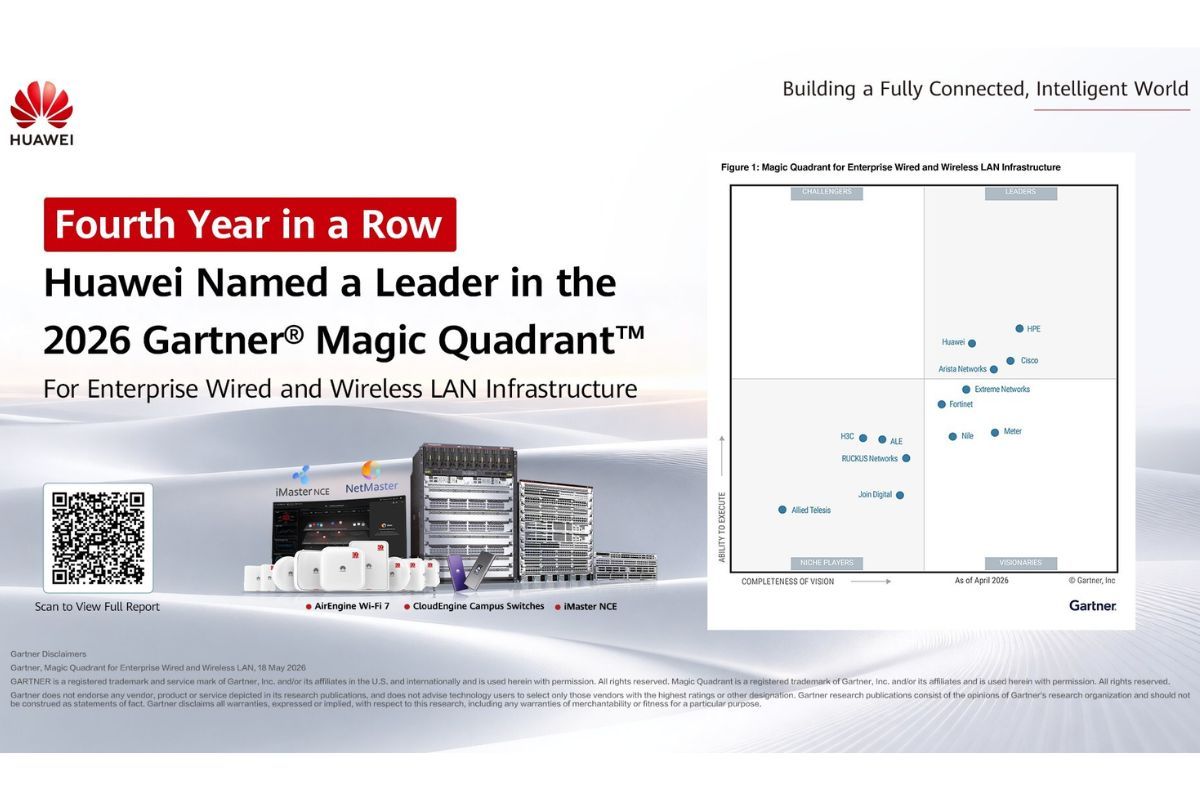
SHENZHEN, CHINA – Huawei has been named a Leader in Gartner’s 2026 Magic Quadrant for Enterprise Wired and Wireless LAN Infrastructure for the fourth consecutive year, remaining the only vendor outside North America in the Leaders quadrant. This recognition reflects the strengths of Huawei’s Xinghe AI Campus solution, particularly in AI-driven operations and maintenance (O&M), security innovations, and other advanced technologies, underscoring its commitment to addressing key customer needs, advancing technological innovation, and building secure, intelligent industrial campus networks.
Responding to global AI trends, Huawei has enhanced its Xinghe AI Campus solution through three core capabilities: ultra-fast wireless connectivity, comprehensive security, and network autonomy. This enables government, finance, education, healthcare, and other sectors to embrace the AI era and drive future growth.
Ultra-fast wireless connectivity: Huawei introduced the AirEngine Wi-Fi 7 Advanced AP, which incorporates Wi-Fi 8 innovations to deliver higher speed and reliability. This product establishes industrial-grade wireless connectivity as the foundation for AI-based services. Through intelligent Coordinated Scheduling and Spatial Reuse (iCSSR) technology – a multi-AP coordination method – Huawei significantly reduces co-channel interference and doubles single-user speed in continuous network scenarios. To address signal instability in mobile environments, Smart Beamforming (SmartBF) adjusts signal direction within milliseconds to maintain optimal device speeds during movement. Huawei’s Advanced Same Frequency Network (ASFN) zero-roaming technology virtualises multiple access points into a single ‘super AP’, ensuring seamless network transitions without packet loss.
Comprehensive security: Huawei’s Xinghe AI Full-Scope Security Campus solution offers a defence system covering asset security, connectivity, space, and privacy.
Asset security: The proliferation of dumb terminals in government, finance, and other industries increases network attack risks. Huawei uses AI-based terminal identification and clustering to automatically recognise dumb terminals with 95% accuracy. Smart Anomaly Detection (SmartAD) technology, based on local switch inference, detects device usage anomalies within seconds and proactively blocks threats to prevent network intrusions.
Connectivity security: Huawei’s exclusive Wi-Fi Shield technology eliminates risks of data packet eavesdropping at the physical network layer. Additionally, an integrated combination of MACsec and Post-Quantum Cryptography (PQC) ensures long-term data transmission security, even as quantum computing advances in the future.
Space security: Huawei’s Wi-Fi Channel State Information (CSI) sensor technology detects space security conditions using a single access point and identifies intrusion activities within seconds.
Privacy security: Conventional methods for detecting hidden recording devices in executive suites, hotel rooms, and other sensitive areas are often ineffective and prone to failure. To address this, Huawei launched the iGuard AP, offering comprehensive detection, precise identification, and 24/7 operation to protect business secrets and individual privacy.
Network autonomy: The Xinghe AI Campus solution also features AI-driven automated O&M. Using iFlow to analyse end-to-end data flows, it identifies user experience quality (QoE) issues within minutes, provides full network path visibility, and monitors user experience in real-time. Supported by AI-driven global decision-making and fault tracking within minutes, around 80% of wireless network disruptions are resolved automatically.
Moving forward, Huawei will continue innovating by understanding customer needs and accelerating the deployment of secure, intelligent AI-driven industrial campus networks. The company will also strengthen ecosystem partnerships to help customers build ‘AI Campuses’ that enhance network efficiency and security while driving collective growth in the AI era.