
Huawei Launches Newest UnifiedBus Computing Architecture for SuperPoD and Clusters
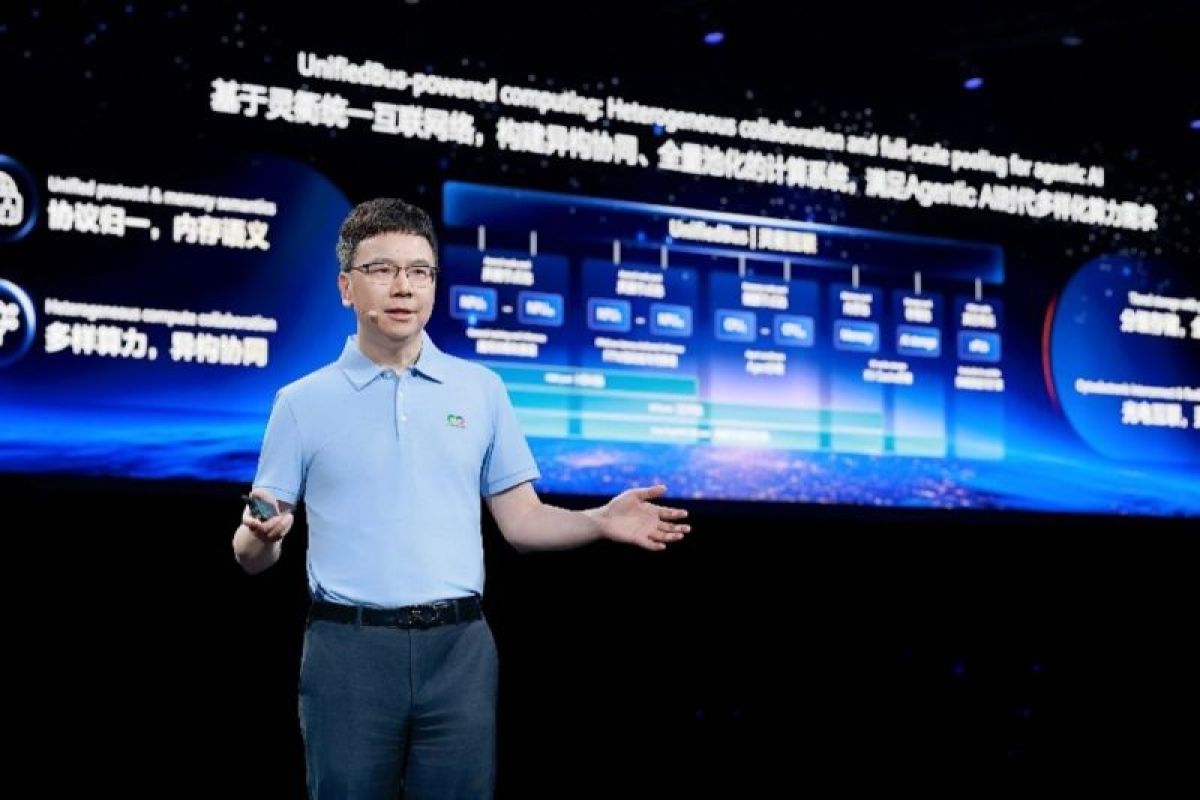
Shanghai, (ANTARA/PRNewswire) - Huawei has revealed the latest details of its UnifiedBus interconnection architecture during a presentation on computing architecture innovation at the HUAWEI CONNECT 2026 event. Yang Chaobin, Executive Director of the Board and CEO of Huawei’s ICT Business Group, introduced a range of UnifiedBus-based computing products and explained the company’s collaboration with the open-source community to drive application innovation among customers, partners, and developers.
In conventional computing architectures, resource utilisation efficiency tends to decrease as cluster scales increase. In a cluster with 100,000 NPUs, for example, AI models only utilise approximately 20% of computing capacity, with much of the remaining capacity idling during data communication. Meanwhile, models with 10 trillion parameters require massive amounts of intermediate data during the training process, far exceeding the memory capacity of a single accelerator in standard architectures. Consequently, interconnection and inter-component communication within clusters have become a primary bottleneck in computing system performance.
According to Yang, Huawei is addressing this challenge with a new computing architecture based on UnifiedBus interconnection technology, allowing clusters and SuperPoDs to operate in an integrated manner. This architecture meets the surging demand for computing power driven by the increasing availability of AI agent applications in the market. The UnifiedBus-based computing system offers four key advantages:
Unified protocol and memory semantics: UnifiedBus merges over 10 interconnection protocols into a single protocol. This approach increases interconnection bandwidth from the 100 GB/s level to the TB/s level and reduces round-trip time (RTT) latency from 7 microseconds to 2 microseconds. UnifiedBus also supports unified global memory addressing within the SuperPoD.
Heterogeneous computing collaboration: UnifiedBus directly connects CPUs, NPUs, memory, and solid-state drives (SSDs), enabling peer-to-peer access between components. The architecture also supports flexible combinations of CPUs and NPUs. Furthermore, it features multi-level hardware acceleration for Transformers, supporting Attention-FFN disaggregation (AFD).
Tiered storage with global pooling: UnifiedBus utilises hybrid storage-based resource pooling to support activation caching. Double Data Rate (DDR) memory can serve as alternative memory for NPUs, reducing latency in search, recommendation, and advertising services. This technology also doubles vector retrieval performance for 100 billion data items with thousands of dimensions. Simultaneously, the HBM capacity requirement per NPU for training 10-trillion-parameter models can be reduced, thereby increasing Model FLOPs Utilisation (MFU) in clusters.
Optoelectronic interconnection and flexible networking: UnifiedBus functions as a global ‘data highway’ with extremely high bandwidth and very low latency, allowing computing capacity to be expanded flexibly.
Yang subsequently introduced Huawei’s latest range of UnifiedBus interconnection products, covering connections within cabinets, between cabinets, and between clusters. This portfolio facilitates the elastic addition of computing capacity, ranging from a single cabinet to a cluster housing one million NPUs.
Within the cabinet, UnifiedBus LinkBlade uses a wireless design to eliminate circuit losses. This technology reduces the requirement for copper cabling in a SuperPoD with 4,096 NPUs by approximately 196 kilometres.
Between cabinets, UnifiedBus LinkDevice features 176 ports with a bandwidth of 1.6 Tbit/s per port and provides full optical interconnection up to 280 Tbit/s. The device is claimed to be the industry’s high-speed bus-protocol-based interconnection device with the highest bandwidth and port count, featuring an RTT latency as low as 2 microseconds.
Between clusters, the UnifiedBus UBG switch offers a fan-out radix capacity of up to 1,024. This capacity supports a SuperCluster with one million NPUs, paving the way for systems capable of handling models with tens of trillions of parameters.
Yang also introduced Huawei’s UnifiedBus-powered agentic AI SuperCluster, consisting of TaiShan 950 and Atlas 960 SuperPoDs, OceanStor M900 memory storage, and Xinghe UBG switches. The cluster supports various types of computing collaboration alongside multi-level resource pooling.
Beyond SuperPoDs, Huawei is applying UnifiedBus technology to individual computing devices. The company is developing a new series of UnifiedBus-based devices supporting one to eight NPUs, as well as Kunpeng and Ascend modules. This solution assists small and medium-sized enterprises in running trillion-parameter AI models locally.
Regarding the ecosystem, Yang stated that Ascend is collaborating with open-source frameworks such as DeepSeek Harness, OpenCode, and openJiuwen to develop agent plugins for fully open-source intelligent management, inference acceleration, and security frameworks.
Yang concluded, “Huawei is committed to innovating at the system level, building a product portfolio as a computing foundation, and encouraging active participation through open source and open systems. We will continue to work with customers, partners, and developers to develop this ecosystem and provide new options for the world to build computing capacity.”