
Huawei Launches Intelligent RAIL 2.0 to Accelerate Digital Transformation in the Global Railway Sector
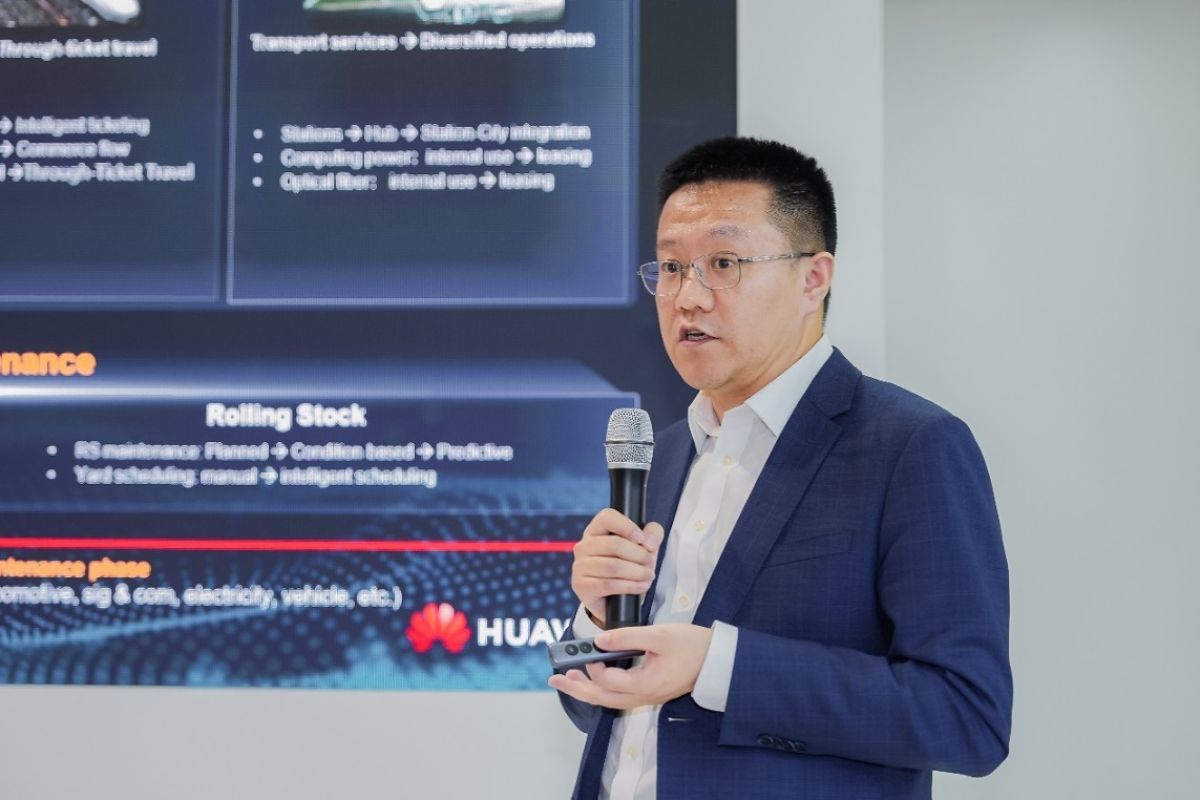
Berlin, (ANTARA/PRNewswire) - Huawei introduced Intelligent RAIL 2.0, a next-generation solution designed to support smart transformation in the global railway industry, during the InnoTrans 2026 event held from 22–25 September. During the launch, Huawei brought together industry associations such as the UIC (International Union of Railways) and UITP (International Association of Public Transport), alongside customers and ecosystem partners from various countries, to discuss the future direction of the railway industry.
Jean-Michel Evanghelou, Director of Digital Systems & Innovation, and Financial Control & Project Operations at UIC, stated that FRMCS will serve as the initial step for railway operators in building a robust digital foundation. He noted that the application of AI will continue to expand and integrate with the core systems of the railway industry, making the standardisation of AI implementation increasingly vital.
Mohamed Mezghansi, Secretary-General of UITP, and Lidia Signor, Head of Multimodal Transport at UITP, were also present at the event. Lidia Signor delivered a presentation titled “Global Metro AI Intelligence and Automation”. In her presentation, she explained that UITP, together with the China Association of Metro (CAMET), has published a research report titled “AI-Driven Smart Rail Transport”. The report reviews the application of AI solutions across various aspects, from the construction to the operation and maintenance of urban railways, contributing to increased operational efficiency and the safety of railway transport systems.
In his presentation, Raymond Zuo, President of the Smart Rail BU at Huawei, stated that the progression towards the era of intelligent technology is driving more stakeholders to integrate digital and smart technologies into core business processes to address long-standing industry challenges. According to him, these changes will be visible across various lines: infrastructure will transition from GSM-R to FRHMCS, equipment maintenance will move towards condition-based and predictive approaches, freight transport will move towards an integrated service-based logistics model covering multimodal transport, and passenger services will move towards a more seamless travel experience. Furthermore, infrastructure development will increasingly utilise digital and smart technologies to enhance safety and operational efficiency.
Drawing on experience implementing innovations with leading customers in various countries, Huawei introduced the “intelligent RAIL” innovation strategy. This strategy leverages digital and smart technologies to enhance four key aspects of railways: reliability (Reliable), automation (Automated), integrated services (Integrated-serviced), and long-term evolution (Long-termed). At the event, Huawei also introduced Intelligent RAIL 2.0, the latest generation comprising 20 scenario-based solutions. These solutions cover three main areas: construction, passenger and freight transport, and the maintenance of facilities and equipment, to address various long-standing industry challenges. Huawei developed these solutions alongside partners with clearly defined roles: Huawei manages the communication and digital platforms, while partners focus on industrial applications. With this approach, solutions can be designed modularly and combined according to customer needs and specific business scenarios.
To date, Huawei has served more than 50 major customers in the railway sector worldwide and over 300 urban rail lines covering more than 180,000 kilometres of track. In addition to being a leading global ICT product provider, Huawei is also positioning itself as a partner in digital transformation in the era of intelligent technology. Moving forward, Huawei will continue its “platform + ecosystem” strategy by strengthening cooperation with global customers and partners, deepening industrial collaboration, following technological developments in the railway sector, and driving the application of cutting-edge technology across various railway scenarios. Through continuous development and innovation of solutions, Huawei aims for global rail transport to move towards a safer, more efficient, and environmentally friendly future.