
Huawei Introduces Next-Generation Stellar AI Network to Support Agentic AI Era with Secure and Intelligent Connectivity
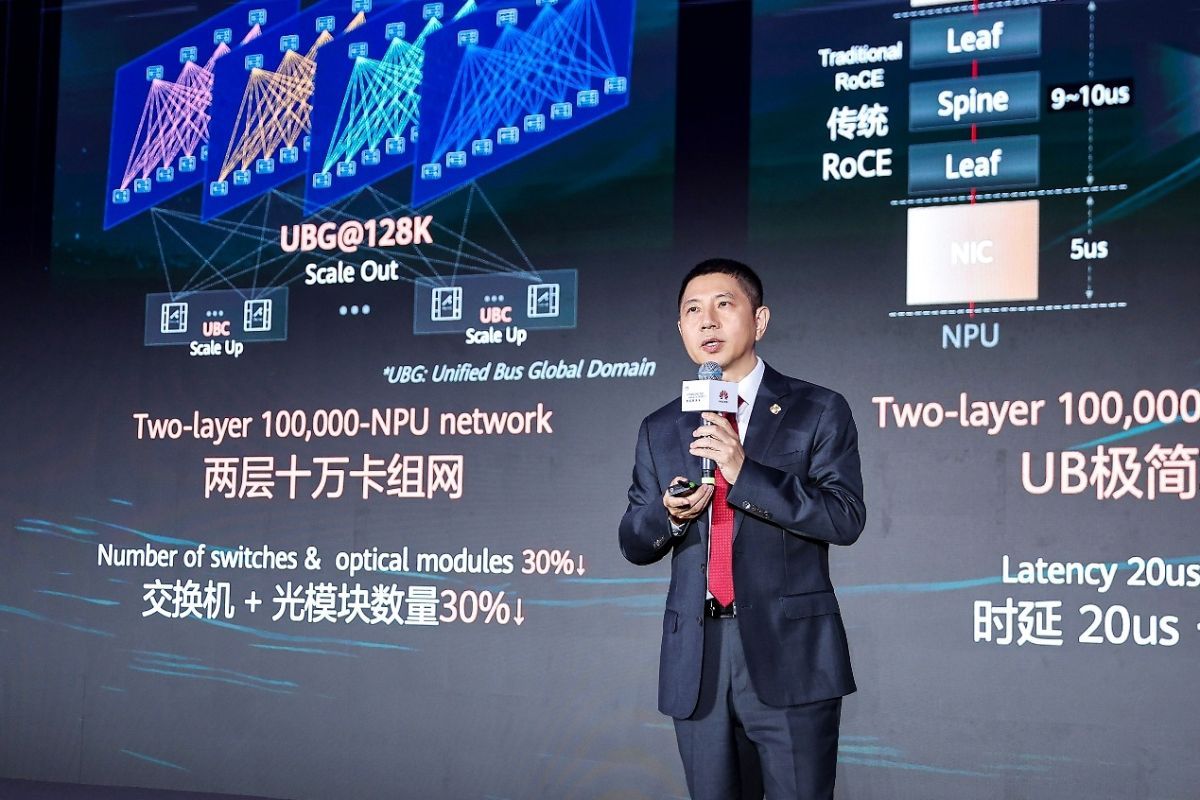
Shanghai, (ANTARA/PRNewswire) - During the HUAWEI CONNECT 2/026 event, Huawei introduced the latest version of its Stellar AI Network Solution, featuring secure and intelligent connectivity. This solution offers several advantages, ranging from more efficient computational processing and lossless data transmission to high-speed application access. With these capabilities, the solution is designed to meet future computing needs while enhancing productivity and maintaining service security in the AI era.
The rapid adoption of AI has driven daily token consumption to surge 260-fold within a single year. To address this demand, the latest version of the Stellar AI Network features three main components: AI Fabric, AI WAN, and AI Campus, aimed at providing intelligent connectivity while strengthening security.
Stellar AI Fabric 2.0
Intelligent Connectivity: To overcome challenges such as surging network costs, slow protocol conversion processes, and traffic retransmission due to link flapping, Huawei introduced the SF9300 series UBG switches. Paired with Ascend A5/A6, these devices form an integrated UBG computing and networking solution for the entire line. The two-layer multi-plane architecture eliminates the core layer, reducing network deployment costs by up to 30%. An integrated protocol also reduces unified latency from 20 μs to 11 μs. Meanwhile, Link-Layer Retransmission (LLR) technology prevents packet loss during link flaps and reduces cluster service downtime by up to 100 hours per year. Huawei also introduced the CloudEngine XH9300-EN NPO switch, developed entirely in-house with three major breakthroughs. First, a centralised light source design reduces interconnection power consumption from 1,000 W to 600 W, lowering cluster electricity costs. Second, an architecture approaching packaged architecture reduces optical-to-electrical conversion latency by 180 ns and reduces single-node latency by up to 26%. Third, a pluggable snap-fit structure allows devices to be replaced directly on-site, reducing fault recovery time from days to hours.
Security: Huawei’s Three-Layer Security Guardrail solution protects systems from hashrate theft, prompt injection, and model poisoning. The Network Guardrail is equipped with an integrated cryptojacking detection model with a detection rate of up to 95%, alongside the ability to block malicious traffic within milliseconds. The Agent Guardrail counters prompt injection attacks with 95% accuracy and latency below 150 ms. Meanwhile, the Host Guardrail monitors malicious processes in real-time with CPU usage below 1%. When implemented at customer sites, this solution identified 415 high-risk vulnerabilities and 322 threat incidents within the first seven days. By utilising AI to protect AI, the solution ensures that token production remains secure.
Stellar AI WAN
Intelligent Connectivity: Cross-regional computing still faces several challenges, ranging from significant efficiency declines and high on-premises costs to expensive private networks. To address this, Huawei’s Stellar AI WAN Solution supports lossless computing power delivery over distances exceeding 1,000 km. The Starnet lossless algorithm eliminates packet loss in long-distance transmission and increases remote computing efficiency to over 95%. The XH computing-network device uses a layerwise model partitioning algorithm to run initial and final layers locally, while the network only transmits high-dimensional vectors. This approach keeps raw data entirely on-premises and reduces initial xPU costs at branches by up to four times. Additionally, computation-communication overlapping technology reduces bandwidth idle time by more than 80% and reduces bandwidth requirements by up to five times.
Security: Huawei’s multi-dimensional WAN defence technology counters new attack vectors, including APT and HNDL. At the device layer, the intrinsic security board blocks intrusions in real-time, tracks threats within minutes with over 95% accuracy, and visualises attack paths up to 100 hops. At the link layer, integrated QKD provides robust quantum security without the need for additional equipment. This technology reduces construction costs by more than 60% and extends transmission distances by up to 80 km. At the network layer, APN6-based data fencing facilitates traffic path control across the network, ensuring sensitive data can circulate securely.
Stellar AI Campus Network
Intelligent Connectivity: The adoption rate of AI agents by corporate clients is expected to approach 50% this year. This situation makes manual operations and maintenance (O&M) no longer sufficient to support 24/7 operations, making fault recovery within minutes a necessity. To meet this challenge, Huawei has enhanced network autonomy across various scenarios covering data, models, and devices. Proprietary network awareness technology collects over 25 types of specialised data with a 100 ms sampling cycle to detect anomalies precisely. The Deep Causal Pruning (DCP) algorithm optimises AI models, reducing inference errors by more than 20% and increasing troubleshooting accuracy to 95%. The iFlow 2.0 distributed simulation technology ensures that inference paths are continuously verified 24/7. With these capabilities, AI-based network operations can be implemented at all levels, while MTTR is slashed to less than five minutes. Meanwhile, quality of service remains maintained for highly critical requirements.
Security: Companies currently face challenges from vulnerable ‘dumb terminals’ susceptible to intrusion and malicious interactions hidden by AI agents. Huawei’s Stellar AI Campus Network Asset Security 2.0 solution…