
Huawei and China Mobile Facilitate Villages in Guangxi to Promote Brown Sugar
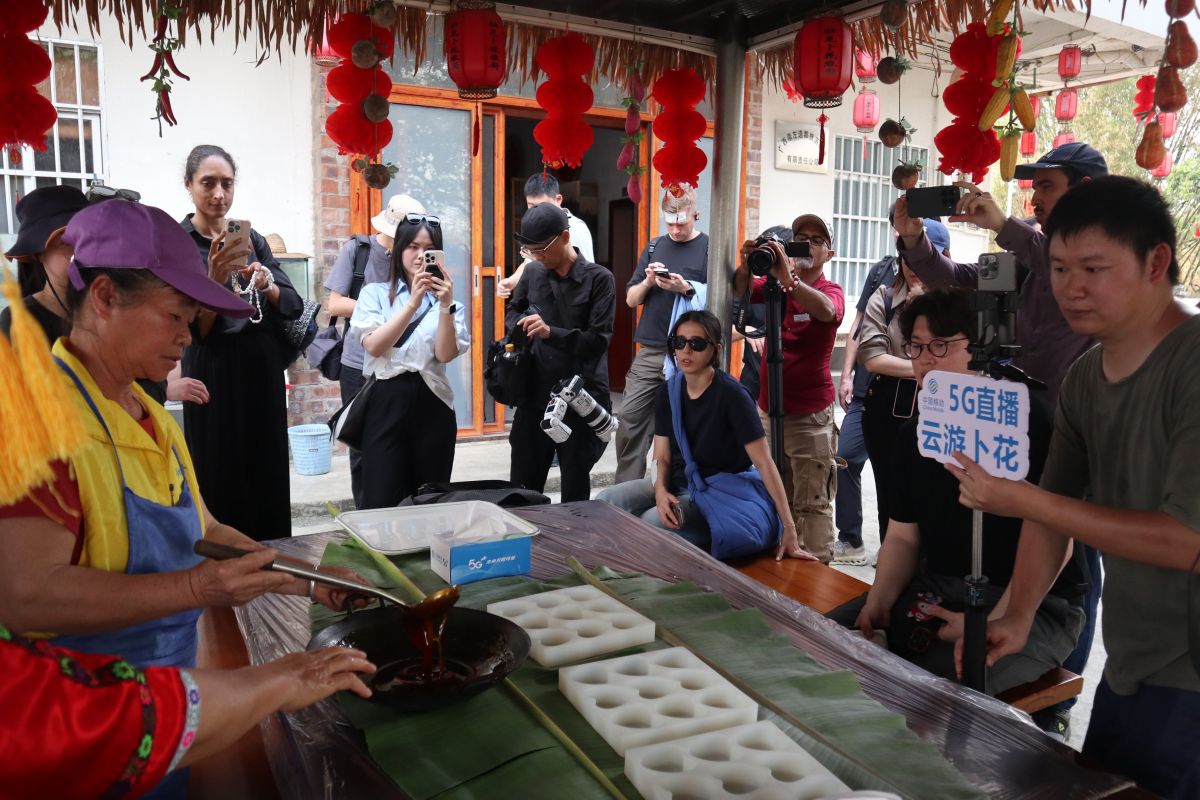
Beijing (ANTARA) - Chinese technology company Huawei, in collaboration with internet service provider China Mobile, has brought 5G network access to communities in villages near the karst mountainous areas of the Guangxi Zhuang Autonomous Region, China, to promote tourism featuring the region’s distinctive brown sugar.
One such village benefiting from this service is Buhua Village, located in Jiangzhou District, Chongzuo County, Guangxi Zhuang Autonomous Region, and known as the “Sugar Capital of China” due to its 266,000 hectares of sugarcane plantations, which contribute about one-third of Guangxi’s total sugar production or one-fifth of China’s national output.
“After 10 years of telecommunications development, even in remote and hard-to-reach areas with only three households, China Mobile has strived to provide internet networks, so rural areas now enjoy high-speed networks of quality comparable to urban residents, laying the foundation for future smart tourism,” said Zhou Peng, General Manager of China Mobile’s Guangxi Chongzuo Branch, in Chongzuo on Thursday (26/3) local time.
By March 2026, according to China Mobile data, 99 percent of rural areas in Chongzuo, located in southern China, have 4G coverage, and 95 percent are within 5G network reach.
“The challenge is the distinctive karst landscape forming conical mountains, karst hills, basins, underground rivers, to giant sinkholes, and there are also some families living in the hinterlands, but we still want to reach them to truly help them escape poverty,” added Zhou Peng.
Previously, around 2017, Buhua Village still relied on sugarcane sales with fluctuating values that did not provide stable income for farmers; the village head at the time then launched a “from farmhouses to homestays” programme, converting ordinary rural houses into accommodations for guests.
In 2017, it is known that China’s central government launched the “Rural Revitalization Strategy,” which includes rural area development programmes after China succeeded in eradicating absolute poverty.
Buhua Village then utilised fast internet networks for selling via live broadcasts and even introduced ancient brown sugar-making methods to the public through social media. The sugar from Buhua Village is famous for its unique texture: “as solid as stone, yet brittle like sand.”
Xinhe Town, where Buhua Village is located, has established 65 e-commerce shops on digital platforms such as JD.com and Douyin. These shops are collectively owned by the village and have trained 27 local “streamers” to date. The two most prominent shops are “First Secretary Studio” and “Zuojiang Premium Selection.”
The peak in 2023 saw online sales revenue exceeding 300,000 RMB (approximately Rp690 million), thereby increasing the village’s collective economic income. Then in 2025, the village’s collective economic income exceeded 500,000 RMB (approximately Rp1.15 billion).
Meanwhile, average household income reached more than 80,000 RMB (approximately Rp184 million), or three times that from traditional sugarcane farming, and per capita annual income for residents increased by 18,000 RMB (approximately Rp41.4 million), leading to more young people choosing to return to the village.
“In addition to building a solid 5G network, we have formed a professional team to provide long-term network support for villages, businesses, and the government. This will ensure the network truly plays its role in enabling development,” stated Zhou Peng.
Source: jawawa.id (https://jawawa.id/newsitem/huawei-and-china-mobile-facilitate-villages-in-guangxi-to-promote-brown-sugar-1774770675)
Originally published by Antara (Indonesian) (https://www.antaranews.com/berita/5499086/huawei-china-mobile-fasilitasi-desa-di-guangxi-promosikan-gula-merah), translated from Indonesian