
HR Technology Becomes Key to Indonesia's Digital Transformation in the AI Era
Indonesia’s digital transformation has long been viewed through the lens of connectivity, with internet users exceeding 220 million people. While cloud adoption is rising across the financial, manufacturing, and retail sectors, and investment in data centres continues to grow, the next chapter of Indonesia’s digital infrastructure—encompassing AI implementation, cyber resilience, and sustainable infrastructure—is now being written. However, from a human perspective, the landscape presents a different set of challenges.
The World Bank’s Human Capital Index ranks Indonesia 96th globally. Currently, fewer than 30 per cent of the Indonesian workforce possess the advanced digital skills necessary to operate effectively in an AI-driven business environment. Furthermore, McKinsey estimates that automation could impact jobs equivalent to approximately 23 million Indonesian workers by 2030. These figures indicate that the challenge of digital transformation is no longer merely about technological access, but about the readiness of people, workforce data, and organisational systems to utilise technology productively.
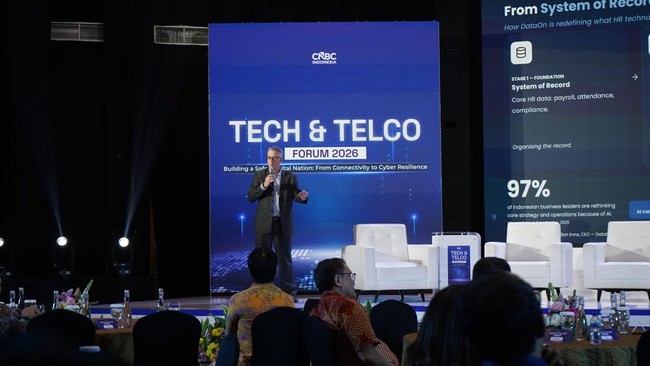
Speaking at the CNBC Indonesia Tech & Telco Forum 2026, DataOn CEO Gordon Enns argued that while Indonesia’s connectivity infrastructure provides a vital digital ‘highway’, the foundation alone is insufficient. The next challenge is ensuring that the ‘drivers’ within organisations possess the necessary capabilities, data, and systems to navigate that highway. This is where HR Technology becomes increasingly relevant. Companies require more than just networks, cloud services, and AI; they need systems capable of providing visibility into the skills, capacity, performance, and requirements of their workforce.
Findings from various 2025 labour studies show that the adoption of digital tools, including AI, is no longer the primary limiting factor in Indonesia. The more fundamental challenge is the ability of organisations and workers to use such technology effectively. The Microsoft Work Trend Index 2025 found that 97 per cent of business leaders in Indonesia are rethinking their core strategies and operations due to AI. The same study reported that 88 per cent of Indonesian workers lack the time or energy to complete their daily tasks—a pressure that AI is intended to alleviate.
The PwC Workforce Hopes and Fears 2025 Indonesia report shows a similar pattern. While 69 per cent of Indonesian workers have used AI in some form over the past year, only 16 per cent use generative AI on a daily basis. Exposure to AI is widespread, but proficiency remains uneven.
Conventional responses to this issue typically involve training programmes, and Indonesia has many such initiatives, including the government’s Prakerja programme. However, training alone cannot close the capability gap within the timeframe required by the digital economy. Training programmes are episodic, whereas the capability gap is continuous. Ultimately, a CEO’s question should not merely be how many employees have completed training, but whether the organisation possesses the required skills, in the right roles, in the right locations, for both today and the next 18 months.
Answering this requires workforce data, which shifts the conversation regarding infrastructure. In many organisations, particularly those in the early stages of HR digitalisation, core processes still rely on manual documents, spreadsheets, or unintegrated systems. Skills inventories are often informal, and performance histories are only partially documented. The fundamental layer of workforce visibility, which should underpin strategies for reskilling, redeployment, and AI-driven productivity, is not yet fully available for most companies.
“Access to AI is becoming more widespread in Indonesia,” said Gordon Enns. “However, the ability to adopt and utilise it effectively still needs to be strengthened. Human resources remain as important as physical infrastructure in the digital economy.”
This situation demands a new perspective on HR Technology. For many Indonesian boards of directors, HR systems have historically been viewed as back-office administration—useful for payroll, attendance, and contract storage—rather than as a strategic business infrastructure. This view is becoming increasingly obsolete as the workforce becomes the critical variable in determining whether a company can capture productivity gains from AI, expand into new markets, and manage compliance risks.