
How Trump and Putin’s back-to-back visits put Beijing at the centre of great-power diplomacy
analysis East Asia
How Trump and Putin’s back-to-back visits put Beijing at the centre of great-power diplomacy
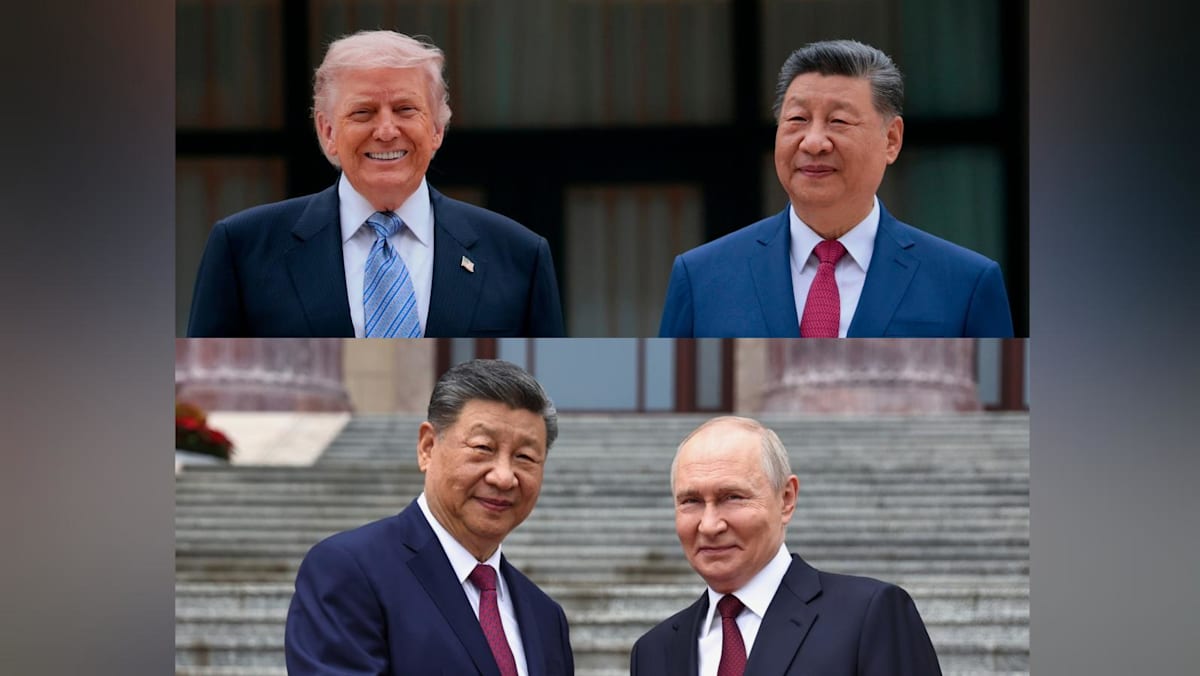
US President Donald Trump and Russian President Vladimir Putin’s back-to-back Beijing visits gave Chinese counterpart Xi Jinping a rare optics win, projecting China as a power both Washington and Moscow have reasons to engage, even as analysts say the stakes differed sharply.
BEIJING: For a moment, it looked like deja vu.
Just days after United States President Donald Trump’s visit with Chinese President Xi Jinping, Russian President Vladimir Putin was greeted with much of the same pomp and ceremony - a 21-gun salute, rows of flag-waving children and chants of “warm welcome” outside the Great Hall of the People on Wednesday (May 20).
But analysts say the similarities ended there: Trump’s trip was about managing tensions in the world’s most consequential rivalry while Putin’s visit, by contrast, was about reaffirming one of China’s most important strategic partnerships.
And unlike Trump’s visit, Putin’s trip concluded with what had been notably absent just days earlier: a formal signing ceremony and a joint statement.
While the timing may not have been entirely of Beijing’s making, the optics were hard to miss: Two of the world’s most closely watched leaders arriving in China within days of each other.
The result was a rare diplomatic double act that made Beijing look like a power Washington and Moscow both had reason to engage.
“The net effect of almost simultaneous hosting of US and Russian leaders probably boosts Xi’s image,” said Michael Clarke, an associate professor at Deakin University’s Centre for Future Defence and National Security.
“It projects (China) as a power that the system’s other great powers seek to court, cooperate or bargain with,” Clarke said.
ONE RED CARPET, TWO DIFFERENT MESSAGES
The timing may have been coincidental, analysts said, but the optics of Trump and Putin’s back-to-back visits were striking.
Philipp Ivanov, founder of geopolitical risk advisory firm GRASP, said Putin’s visit had been tied to the 25th anniversary of the China-Russia Treaty of Good-Neighborliness and Friendly Cooperation, which saw both sides renounce territorial claims along their 4,300km border, paving the way for subsequent negotiations and laying the foundation for closer ties.
Trump’s Beijing trip, by contrast, had been delayed by the Iran war, he noted.
“It does somewhat reinforce the view of China’s centrality and importance,” Ivanov said, adding that Beijing had “played its diplomatic cards very well” in the current environment of heightened geopolitical competition.
The two visits offered Beijing very different kinds of diplomatic dividends, noted analysts.
China and Russia issued a joint communique on deepening strategic coordination, according to Chinese and Russian readouts.
The symbolism ran deeper still: This year marks 30 years since Beijing and Moscow established their strategic partnership.
The two sides also signed a raft of cooperation documents, with Russian state media Sputnik putting the number at 42. Areas covered included trade, technology, media and energy.
Energy was a key focus. Russian officials said Moscow and Beijing had agreed to accelerate implementation of the long-discussed Power of Siberia 2 gas pipeline, which would deliver Russian gas from western Siberia to China via Mongolia.
But the project still appeared short of a finalised commercial deal, with key details such as pricing yet to be settled.
Chinese readouts did not name Power of Siberia 2 directly.
The scale of the Russian delegation also pointed to the practical weight Moscow placed on the visit.
Russian officials said Putin was accompanied by a delegation that included five deputy prime ministers - Denis Manturov, Tatiana Golikova, Alexander Novak, Yury Trutnev and Dmitry Chernyshenko - as well as senior officials and ministers, including Foreign Minister Sergei Lavrov, Finance Minister Anton Siluanov and Economic Development Minister Maxim Reshetnikov.
Putin’s visit appeared more intimate and outcomes-focused, Clarke from Deakin University said, pointing to the “old friends” language used in Chinese coverage, alongside the tea diplomacy, photo opportunities and signed agreements.
The Trump visit, by contrast, was about stabilising a relationship Beijing sees as far more consequential and far more volatile, especially over trade, export controls and Taiwan, noted Ivanov from geopolitical risk consultancy GRASP.
In China’s readout, Xi and Trump agreed to build a relationship based on “constructive strategic stability”, a formulation Beijing said would guide ties over the next three years and beyond.
The US side focused more on concrete deliverables. Trump touted trade and business outcomes, while US officials said both leaders agreed the Strait of Hormuz should remain open and that Iran should not acquire nuclear weapons.
“GREAT-POWER THEATRE”
For Beijing, the two visits also carried a broader message: China can engage Washington at the highest level without loosening its strategic alignment with Moscow.
Ivanov said the Trump meeting was a “pretty serious consequential diplomatic affair”, aimed at taking heat out of tensions while presenting China and the US as equals.
But analysts said the logic behind the two visits differed sharply.
“Trump and Putin’s motives within their relations with Xi and Beijing are quite distinct,” Clarke said.
For Trump, the visit was driven mainly by trade and economic goals, wrapped in what Clarke called “great-power theatre” and symbolism - including formal red-carpet treatment, respect for presidential prestige and suggestions of a possible US-China “G2” channel.
For Putin, it was Russia’s need for diplomatic cover and access to Chinese markets and technology amid relative international isolation.
Ivanov said China’s relationship with the US remains “far more consequential and far more important”, even as Russia remains a critical strategic partner.
Russi