
How to Check DTSEN 2026 Data Details Using NIK to View Social Assistance Deciles
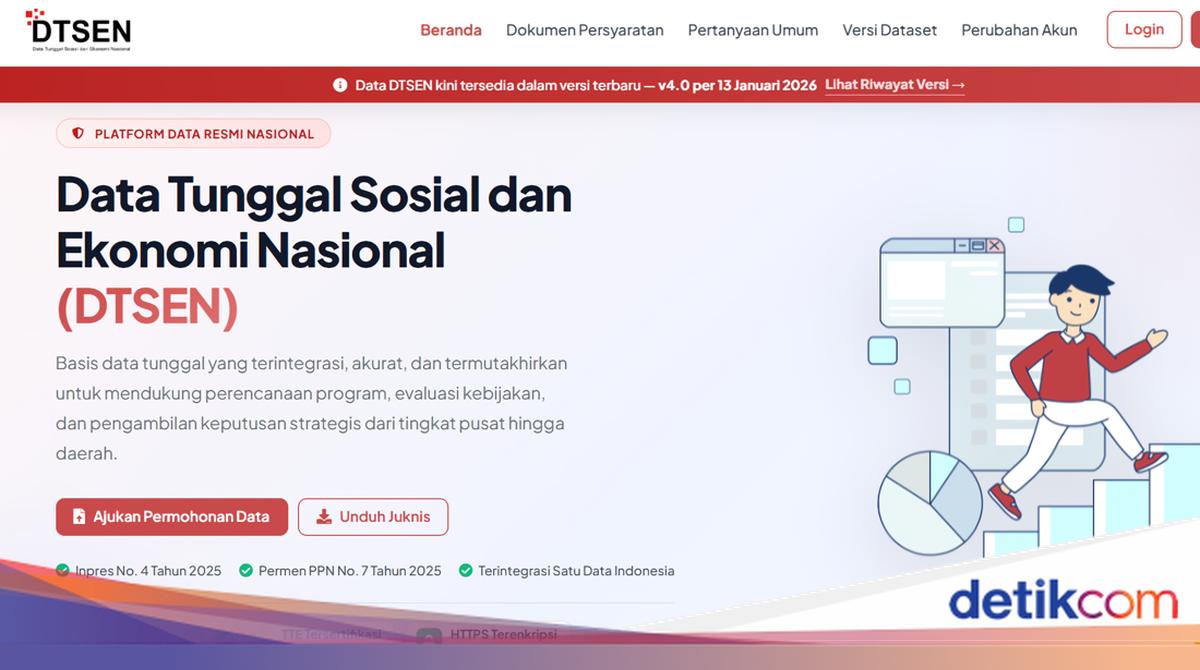
The government continues to update the recipient data for social assistance through DTSEN 2026 to ensure that the distribution of social aid is more precisely targeted. However, many members of the public are still unaware of whether their data is registered and up to date.
Checking DTSEN data can be performed using the NIK (National Identity Number) as a vital step to ensure social assistance membership status. Through this process, citizens can also identify the decile category used by the government to determine aid priorities.
What is DTSEN?
According to its official page, the National Single Social and Economic Data (DTSEN) is a socio-economic database used by the government to support the integration of national development programmes. In accordance with Presidential Instruction Number 4 of 2025 regarding DTSEN, the management of national single social and economic data is carried out in an integrated and accurate manner to achieve measurable and sustainable development goals.
The Presidential Instruction explains that DTSEN serves as the basis for policy, planning, and effective development evaluation. This data is also used to support synergy between ministries, agencies, and local governments.
Furthermore, according to the @pusdatinkesos Instagram account, DTSEN is a single database for individuals and/or families containing the socio-economic conditions of the Indonesian population, which has been matched with population data. DTSEN is built from three main data sources: DTKS, P3KE, and Regsosek, which are then matched with population data and civil records from the Ministry of Home Affairs.
Deciles in DTSEN
Within DTSEN, there are levels of welfare referred to as deciles. According to @pusdatinkesos, a decile is the division of data into ten equal groups based on a specific order. In DTSEN, the deciles are ordered by the level of community welfare.
The determination of deciles is calculated from various socio-economic data, such as housing conditions, electricity capacity, occupation, education level, number of family members, and other information. Decile levels are not determined solely by the appearance of a house, vehicles in the driveway, or an individual’s appearance. Deciles are grouped from the lowest 10% of welfare to the highest 10% of welfare.
According to the official page of Desa Tepus, the decile divisions in DTSEN are as follows:
Decile 1: Extremely poor
Decile 2: Poor
Decile 3: Near poor
Decile 4: Vulnerable to poverty
Decile 5: Modest/Struggling
Decile 6-10: Middle to upper class
Deciles as Criteria for Social Assistance Recipients
Based on the @pusdatinkesos Instagram post, the determination of social assistance beneficiaries is now based on DTSEN. In this system, all Indonesian residents are ranked based on their welfare level from decile 1 to decile 10.
In DTSEN, decile 1 represents the bottom 10% of the population with the lowest welfare level. This continues up to decile 10, which represents the group with the highest welfare level.
Consequently, the distribution of social assistance is prioritised for those in the lowest deciles. It is noted that recipients of the Family Hope Programme (PKH) are prioritised for those in deciles 1 to 4, while recipients of basic food assistance (sembako) and National Health Insurance (JKN) contribution assistance are prioritised for those in deciles 1 to 5.
How to Check DTSEN 2026 Data Details
Checking DTSEN 2026 details can be done easily using the NIK registered on your ID card (KTP). This process helps the public know their social assistance status and view their welfare decile category.
A. How to Check DTSEN 2026 Details via the Ministry of Social Affairs Website
Checking DTSEN data can be done through the official Ministry of Social Affairs (Kemensos) website without needing to create an account first:
Visit https://cekbansos.kemensos.go.id/
Enter the 16-digit NIK as shown on your KTP.
Enter the captcha code (four letters) displayed on the screen.
If the code is unclear, you can refresh the page.
Click the “Cari Data” (Search Data) button.
The system will display detailed DTSEN information, including your family’s decile.
B. How to Check DTSEN 2026 Details via the Cek Bansos Application
The Ministry of Social Affairs provides the Cek Bansos application, available on the Play Store and App Store. Through this app, citizens can view their DTSEN 2026 decile data:
Download the Cek Bansos Kemensos application on your phone.
Once installed, open the app and register an account if you do not already have one.
Complete the required data, such as NIK, Family Card (KK) number, full name, address, email, and phone number.
Upload a photo of your KTP and a selfie holding your KTP.
Verify that all data matches your official records.
Select the account registration menu and wait for the verification process.
Once the account is active, log in using your registered username and password.
Open the “Profil” (Profile) menu to view the family data registered in DTSEN.
In this menu, the detailed DTSEN data regarding your decile group will appear, showing your family’s welfare position according to government records.