
How to check 2026 social assistance decile using NIK KTP on Cek Bansos
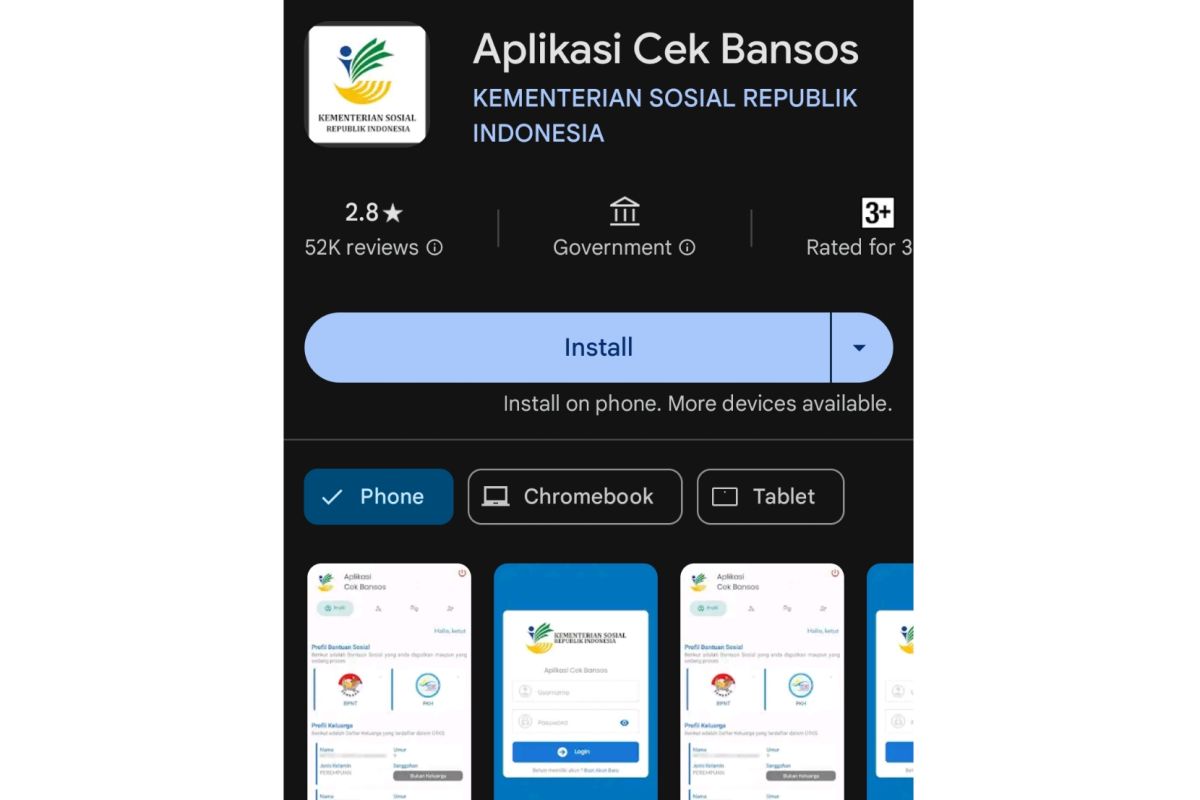
Jakarta (ANTARA) - The public can check their 2026 social assistance recipient status and view their welfare decile using the National Identity Number (NIK) as stated on their KTP.
The check is carried out through the official Cek Bansos website. The data currently used comes from the National Socio-Economic Single Data (DTSEN).
A decile is a grouping of families based on their level of social and economic welfare. The Cek Bansos system has 10 decile groups, starting from decile 1, which represents the bottom 10 percent of families with the lowest welfare level, up to decile 10, which is the group with the highest welfare level.
How to check 2026 social assistance using NIK KTP
The public can check their data independently through the Cek Bansos website. The steps are as follows:
Open the official Cek Bansos website of the Ministry of Social Affairs.
Enter the 16-digit NIK as stated on the KTP.
Enter the captcha code that appears on the screen.
Ensure the NIK and code have been entered correctly.
Click Search Data.
The system will display the search results if the data is found.
The official Cek Bansos website specifically asks users to enter the 16-digit NIK according to their KTP before conducting a search.
Deciles are used to describe a family’s welfare position based on a number of social and economic variables.
The assessment considers individual conditions such as employment and education, housing conditions, electricity capacity, and asset ownership.
The smaller the decile number, the lower the welfare level of the group. Conversely, a higher decile indicates a higher welfare group.
In determining assistance targets, deciles 1 to 4, or the bottom 40 percent, can be proposed as recipients of social assistance under the Family Hope Programme (PKH) and basic food assistance. Meanwhile, decile 5 can be proposed as participants in the Health Insurance Contribution Assistance Beneficiaries (PBI-JK) scheme.
However, being in a particular decile group does not automatically mean a person will definitely receive all types of social assistance. The determination of recipients still follows the applicable provisions and assistance programmes.
Members of the public who feel that their socio-economic data does not match their actual conditions can apply for a data update.
The Ministry of Social Affairs provides a change mechanism through village or sub-district governments and social services offices. Updates can also be made through the Cek Bansos application by submitting data according to actual conditions. The data will then be processed for periodic recalculation.
Statistics Indonesia (BPS) also explained that DTSEN is updated periodically through the integration of administrative data and verification processes so that socio-economic data can become increasingly accurate.
Checking the decile can help the public understand the position of their welfare data within DTSEN. However, the decile result does not guarantee that the third phase of social assistance will be disbursed immediately.
The distribution of assistance still depends on the type of programme, the results of data updates, and the recipient provisions applicable during the distribution period.
Therefore, the public should conduct checks through official channels and not provide their NIK, account details, OTP codes, or personal information to unclear parties.