
How the Rebellion Law Was Used Under Jokowi, from the 212 Rally to Papua
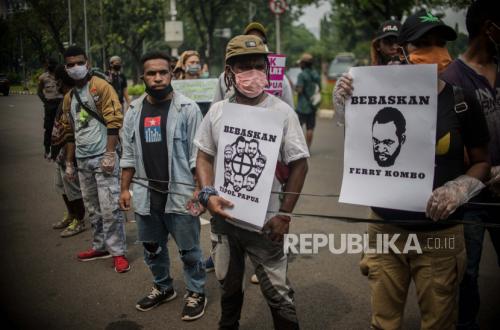
JAKARTA — The use of rebellion-related provisions has again come under public scrutiny following the disclosure of an illegal wiretapping case involving President Joko Widodo, with former National Police chief General Listyo Sigit Prabowo and several other senior police officers named as suspects. The irony is that police have often used these provisions to arrest political figures, activists and groups advocating independence for Papua in recent years.
Under the former Criminal Code, rebellion-related offences were covered, among other provisions, by Articles 104, 106, 107 and 110. Article 106 concerns an intention to separate part of the country, while Article 107 covers an attempt to overthrow the legitimate government. Article 110 addresses criminal conspiracy in connection with several rebellion offences.
A case that attracted considerable public attention took place on 2 December 2016, coinciding with the Aksi Bela Islam III, or 212 Rally, in Jakarta. Police arrested 10 people suspected of conspiring to commit rebellion. Among the names that emerged were former MP Sri Bintang Pamungkas, activists Jamran and Rizal Kobar, musician Ahmad Dhani, Rachmawati Soekarnoputri, Ratna Sarumpaet and retired Major General Kivlan Zen.
Sri Bintang was subsequently detained and charged under Articles 107, 110 and 87 of the Criminal Code. Jamran and Rizal Kobar were also detained, but were accused of violating the Electronic Information and Transactions Law (ITE Law).
Police said there were indications of a conspiracy to take control of parliament. However, not everyone arrested was detained: seven others were released after questioning.
Lawyer Eggi Sudjana came to public attention in connection with an alleged rebellion case after the 2019 presidential election. He was named a suspect following a speech outside Prabowo Subianto’s residence on Jalan Kertanegara, South Jakarta, on 17 April 2019.
During the speech, Eggi called for a people-power movement amid controversy over the 2019 election vote count.
Police accused him under Articles 107 and 110 in conjunction with Article 87 of the Criminal Code, as well as several provisions of Law No. 1/1946 on Criminal Law Regulations. Eggi denied the rebellion allegations, saying his call was part of demands for the election to be conducted honestly and fairly.
Social activist Lieus Sungkharisma and retired Major General Kivlan Zen were also drawn into alleged rebellion cases in 2019. Lieus was summoned by investigators from the National Police’s Criminal Investigation Agency after a report accusing him of incitement and rebellion. He denied the allegations and said he had only voiced demands for an honest and fair election.
Kivlan, meanwhile, was named a suspect in May 2019 over alleged dissemination of false information and rebellion. His case later also involved allegations of illegal firearms possession.
As the investigation developed, police linked the firearms case to an alleged plan to assassinate several national figures during the riots of 21–22 May 2019. Kivlan denied the allegations against him.
Source: jawawa.id (https://jawawa.id/newsitem/how-the-rebellion-law-was-used-under-jokowi-from-the-212-rally-to-papua-1794214269)
Originally published by Republika (https://analisis.republika.co.id/berita/to86v8393/obral-pasal-makar-di-era-jokowi-dari-aksi-212-hingga-papua), translated from Indonesian