
How the Labour Protection Law Differs from the Job Creation Law
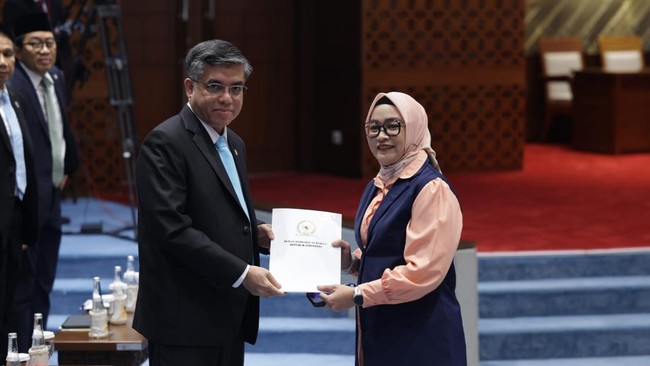
Jakarta, CNBC Indonesia — Commission IX of the House of Representatives (DPR) has outlined the contents of the Labour Protection Law, which was passed on Tuesday, 6 October 2026.
Putih Sari, deputy chair of Commission IX, a Gerindra Party legislator and chair of the working committee on the Labour Protection Bill, said the law differs from the Job Creation Law, including in its provisions on maternity leave.
“Certain guarantees are provided, including stronger protection for workers’ rights. For example, women workers’ rights are regulated, including the right to maternity leave. The law provides for three months, which can be extended to six months if specific circumstances require it,” Putih said in an exclusive interview with CNBC Indonesia, quoted on Thursday, 15 October 2026.
Women workers on maternity leave must not have their wages reduced, she said. “There must be no reduction in pay while a woman worker is on maternity leave,” Putih stressed.
Under the Labour Protection Law, companies will also be prohibited from withholding job applicants’ certificates or personal documents during the recruitment process.
“The withholding of any certificates or personal documents from job applicants during recruitment, up until they obtain a job, will also be prohibited. Such documents must no longer be withheld,” Putih explained.
The law also sets a maximum internship period of six months and provides for interns’ rights and protections.
“We have set a maximum internship period of six months, while ensuring their rights are taken into account in relation to the risks of the internship, including work accident and death benefits,” she said.
Putih said the law must provide certainty for people applying for jobs. She said it requires companies to provide jobseekers and workers with clarity on flexibility and improvements to conditions that could help them secure better employment.
Putih added that the bill was included in the National Legislation Programme following a Constitutional Court ruling calling for a new labour law.
“The reason the Labour Protection Law became one of Commission IX’s legislative priorities is that a Constitutional Court ruling called for the labour cluster to be removed from the Job Creation Law and made into a separate labour law,” she said.
She added that provisions in Law No. 13 of 2003 on Manpower had repeatedly been subject to judicial review and needed to be updated to reflect current conditions. This prompted Commission IX to begin by considering revisions to the existing law.
Those revisions, she said, needed to take account of current conditions in the world of work while providing certainty both on the protection of workers’ rights and for businesses.
“We ultimately decided not merely to revise the old law, but to create a new labour law that can provide certainty, both in protecting workers’ rights and for the business community. That is what we want to set out in the new labour law,” she said.
Source: jawawa.id (https://jawawa.id/newsitem/how-the-labour-protection-law-differs-from-the-job-creation-law-1792043432)
Originally published by CNBC Indonesia (https://www.cnbcindonesia.com/news/20261015111310-4-776398/perbedaan-uu-pelindungan-ketenagakerjaan-ciptaker-ini-penjelasannya), translated from Indonesian