
How the Controversy over Jambean’s ‘Local Wisdom’ Levy on New Residents Began
Reports of a levy on new residents in Pedukuhan Jambean, Triwidadi, Pajangan, Bantul, went viral. Bantul’s Regional Inspectorate said the levy did not constitute illegal extortion. Here is how the controversy over the rule requiring new residents in Jambean to pay for ‘local wisdom’ began.
Viral on social media
Posts circulating on social media said the issue began when a resident complained after being asked to pay Rp300,000 while applying for a certificate of domicile.
“Asked to Pay Rp300,000 for a Domicile Certificate, Suspected Levy in Bantul Exposed on Threads. A post on Threads recounts someone saying that a friend was asked to pay Rp300,000 while arranging a domicile certificate in Padukuhan Jambean, Triwidadi, Pajangan, Bantul. The poster said the incident took place on 16 July 2026. The payment was reportedly transferred to an account in the hamlet chief’s name, without a receipt,” the Instagram account @jogja.vibes wrote, as quoted by detikJogja on Monday (12 October 2026).
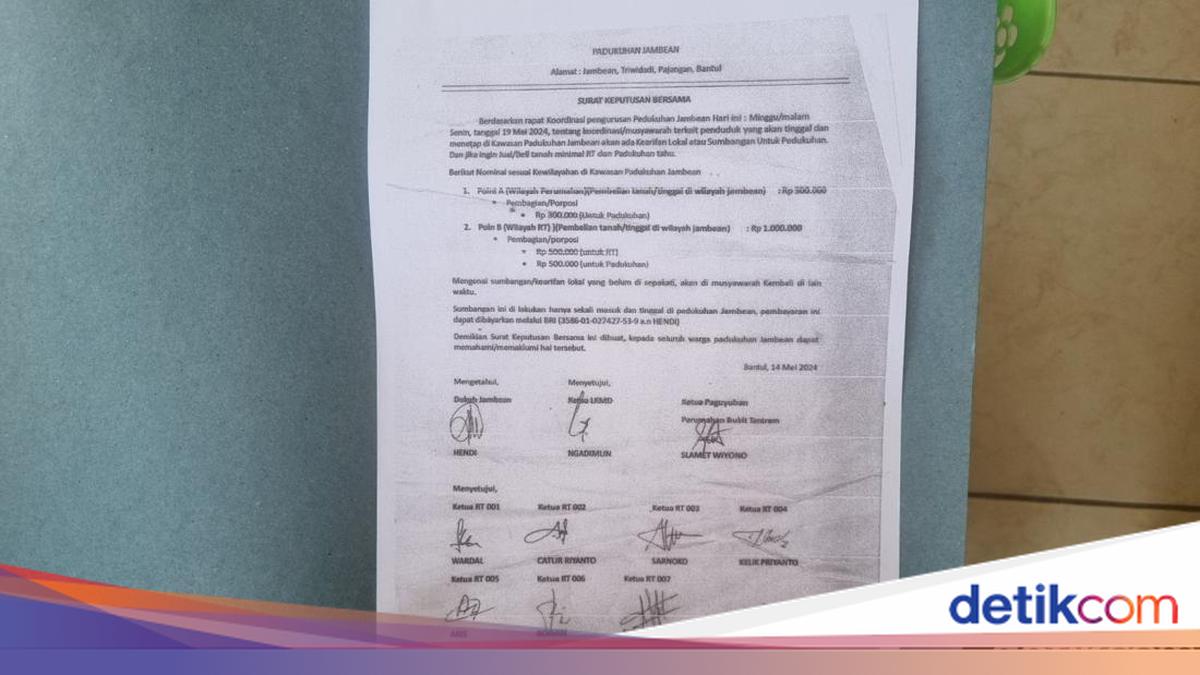
“The post also included a document dated 14 May 2024 concerning an agreed contribution from people buying land or settling in Jambean. It lists Rp300,000 for housing areas and Rp1 million for neighbourhood areas. However, the connection between that document and the payment described has not been verified. There has been no official explanation from the relevant parties about the basis for the payment or the status of the agreement,” the post added.
Triwidadi village head responds
When met by reporters at the Triwidadi Village Office in Pajangan sub-district, Triwidadi Village Head Slamet Riyanto explained the charge, which has been described as a “development contribution”.
“Actually, it is not a charge related to an application for a domicile certificate. It is an agreement made between the community—in this case, Jambean residents—and residents of the housing estate to contribute Rp300,000 towards development in the area,” Slamet said on Monday (12 October 2026).
Slamet said the contribution had been agreed at hamlet level and showed reporters the agreement, which bears the letterhead of Padukuhan Jambean and is dated 14 May 2024.
The letter states that contributions are sought from people who intend to live or settle in Padukuhan Jambean. It sets out two categories. Under point A, residents in housing areas are asked to contribute Rp300,000 to the hamlet.
Under point B, residents in neighbourhood areas are asked to contribute Rp500,000 to their neighbourhood association (RT) and Rp500,000 to the hamlet. The charge applies to people buying land or planning to settle in Padukuhan Jambean.
Slamet stressed that the contribution was unrelated to the domicile certificate. He also said the person who filed the complaint had not paid, and that the certificate was still processed.
“The person concerned has not paid the Rp300,000. Some other residents have paid. We have also issued the domicile certificate, free of charge,” he said.
According to Slamet, the Rp300,000 contribution is used for activities in the hamlet, including events organised by Jambean’s seven RTs, Independence Day celebrations on 17 August, the integrated health post (Posyandu) and the youth organisation (Karang Taruna).
“To make sure, when I called them in, I asked whether any of the money had gone to an individual. They said no. So it was entirely for community activities and contributions to physical and non-physical development in the area,” he said.
Slamet said he had asked the Jambean hamlet chief to provide transaction records to ensure transparency.
“I have also asked the hamlet chief for the administrative documents, and the treasurer has now been asked to provide the financial transaction records,” he said.
Complaint referred to the inspectorate
Slamet said the issue arose in July and that the complainant had reported it to the Bantul Inspectorate.
“The issue dates back to July, and the village administration was notified in August 2026. I received confirmation from Bantul Police and the Bantul Inspectorate. The inspectorate had been investigating it and has now provided guidance, so the process is under way,” he said.
Slamet said he could not yet say whether the contribution would continue, as he was waiting for the inspectorate’s audit report.
“We will evaluate it. We are waiting for the audit report and the inspectorate’s recommendations,” he said.
Slamet said the Jambean hamlet chief would be asked to follow the inspectorate’s recommendations. He added that the rule had been made by the hamlet, not by the Triwidadi village administration.
“If the inspectorate’s report recommends that it be stopped, we will ask the hamlet chief to comply. The village administration knew nothing about the levy,” he said.
Inspectorate says it was not extortion
The Bantul Regency Inspectorate has completed its examination of the levy on new residents in Padukuhan Jambean, Triwidadi, Pajangan. It concluded that there was no element of illegal extortion.
“We have finished. We called in the complainant, the hamlet chief, RT heads, the housing association chair and the village head. Based on the facts we investigated, the statements and the evidence, we did not conclude that it was extortion,” Bantul Regional Inspector Trisna Manurung told reporters at the inspectorate’s office on Tuesday (13 October 2026).
Trisna explained that extortion involves a charge imposed without a regulatory basis and under coercion. It would also mean that someone who refused to pay was denied a service or forced to leave their home.
“After looking into it, we found there was no coercion, and the complainant did not pay. We can debate the regulatory basis, although an agreement does exist. But clearly there was no coercion, and only some people had paid,” Trisna said.
“The payment was not linked to services provided by the RT or hamlet chief, because the person concerned still received a domicile certificate. Nor was there discrimination or any attempt to stop them living there,” he added.
Regarding the levy’s regulatory basis, Trisna said it was covered by a joint decision signed by the Jambean hamlet chief, the heads of the seven RTs and the housing association chair.
“There is a joint decision between the RT heads, the hamlet chief and the housing association chair. The point being debated is that, under the hierarchy of legal rules, the basis should be a village regulation,” he said.
Trisna said the joint decision had been reached by consensus, which he said met democratic principles and was not coercive.
“Perhaps the regulation can be said to be weak, but there was deliberation and consensus, which are part of democracy. There was no coercion, and the complainant did not pay,” he said.
Trisna added that the inspectorate had traced where the money collected from some residents had gone.
“We traced it, and it was indeed distributed to the RTs,” he said.
Bantul Inspectorate’s recommendations
The Bantul Inspectorate issued several recommendations to Padukuhan Jambean over the contribution charged to new residents.
“Given the circumstances, my first recommendation is that, if possible, the arrangement should be placed under a higher-level regulation, such as a village regulation,” Trisna said on Tuesday (13 October 2026).
His second recommendation was that an accountability report (SPJ) be prepared as a way of being transparent with residents.
“There should be an SPJ presented to residents to show that the contribution is also being used for their benefit,” he said.
The third recommendation was to conduct broad public outreach about the levy. Trisna said the most important step was to review the joint decision governing it.
“What is also important? A review of the joint decision they made. If it is not suitable as a rule, then raise it to a higher level, such as a village regulation. Otherwise, people can discuss whether it should continue or be stopped,” he said.
Asked whether the inspectorate thought the levy could continue, Trisna recommended suspending it while it was reviewed, with residents involved in the discussions.
“Our advice is that, if possible, it should be withdrawn and reviewed through discussion. Some may agree and others may not. In general, a levy should be based at least on a village regulation, but deliberation and consensus must also be respected,” he concluded.
Source: jawawa.id (https://jawawa.id/newsitem/how-the-controversy-over-jambeans-local-wisdom-levy-on-new-residents-began-1791877870)
Originally published by detikJogja (https://www.detik.com/jogja/berita/d-8704828/awal-mula-heboh-aturan-warga-baru-jambean-bantul-harus-bayar-kearifan-lokal), translated from Indonesian