
How Stealthy Is China's J-20? Tracing Its Origins from US 'Stealth' Concepts
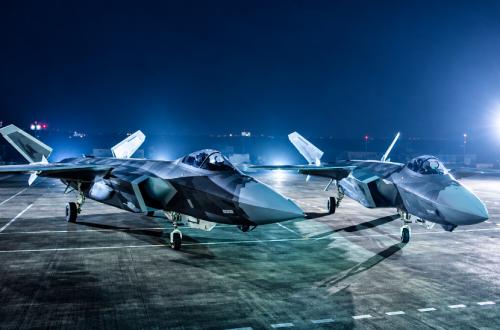
Modern stealth fighter technology was first developed by the United States through programmes such as the F-117 Nighthawk, later refined in the B-2 Spirit, F-22 Raptor, and F-35 Lightning II. China has now applied the same principles to the J-20 Mighty Dragon, a fifth-generation fighter designed to minimise radar detection and enhance survivability in hostile airspace. Despite being touted as one of the world’s most advanced stealth fighters, the Chinese government has never officially published the J-20’s radar cross-section (RCS) value. All circulating figures are estimates from institutions such as Janes, the Center for Strategic and International Studies (CSIS), or assessments by the US Department of Defense, rather than official specifications released by Beijing. The J-20 does not employ an entirely new stealth concept. Defence analysts assess that it adopts the same low-observable principles used by the F-22 and F-35, minimising radar wave reflection through a combination of aerodynamic shaping, specialised materials, and internal weapons carriage. The airframe features specific angles to deflect radar waves away from the emitting antenna. It is coated with radar-absorbent material (RAM) to further reduce signal returns, and its primary missiles and munitions are stored in internal bays rather than on external hardpoints, keeping its radar signature small during missions. This follows the same design philosophy as American fifth-generation stealth fighters. Stealth technology is designed to reduce the probability of detection, shrink the detection range, and slow target lock-on, rather than render an aircraft completely invisible. Detecting a stealth aircraft also depends heavily on the type of radar, the frequency used, and sensor network integration. For instance, the US E-3 Sentry airborne warning and control system still uses AN/APY-1 or AN/APY-2 radars developed during the Cold War, whereas the F-35 Lightning II is equipped with the modern AN/APG-81 Active Electronically Scanned Array (AESA) radar, which is far more capable of detecting low-observable targets. Consequently, US radar capabilities cannot be generalised based on a single system. Some analyses suggest that China’s latest AESA radars, fitted on aircraft such as the J-15B and J-16, have also advanced rapidly. However, several Western analysts maintain that the F-35’s sensor fusion, data processing, and system integration remain among the highest standards in modern air combat technology. In terms of performance, the J-20 is estimated to reach speeds of around Mach 2, according to CSIS and various Western defence publications. The aircraft is currently believed to be powered by the WS-10C engine, while the WS-15 engine is being prepared to provide supercruise capability, allowing sustained supersonic flight without afterburners.