
How SOE Performance Is Transforming Under Danantara
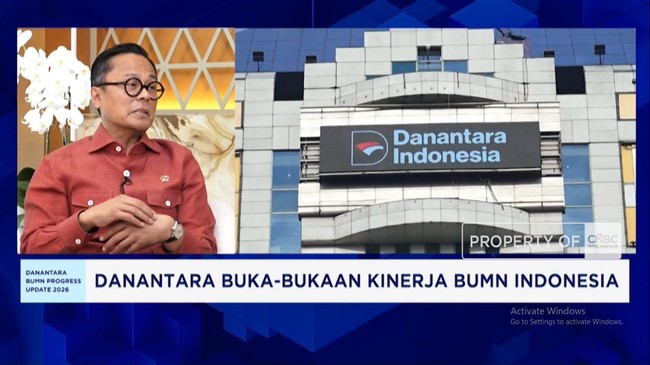
Chief Operating Officer of BPI Danantara and Head of the SOE Regulatory Body, Dony Oskaria, has outlined the various transformations undertaken by state-owned enterprises. These transformation efforts have begun to show positive results for SOE performance up to the first half of 2026.
Dony noted that performance improvements are visible at a number of SOEs, including PT Pupuk Indonesia, PT Pegadaian, PT Timah and PT Semen Indonesia. At Semen Indonesia, there were problems related to a centralised mega-distribution system that made it difficult for the company to access the market directly. As a result, transformation was carried out through a management overhaul to fix issues in the business model, marketing and company operations.
Pegadaian, meanwhile, has transformed through digitalisation and expansion into new market segments in gold products, as well as a reshuffle of its management structure. In this regard, Pegadaian is targeted to achieve a net profit of Rp 12 trillion by the end of 2026.
“This shows that the transformation we have carried out is reflected in the net income. I am optimistic that this year Pegadaian will be able to close with a profit of Rp 12 trillion. We could never have imagined Pegadaian posting a profit of Rp 12 trillion this year,” Dony explained on CNBC Indonesia’s Squawk Box on Monday (24/8/2026).
Transformation has also been carried out at Pupuk Indonesia through changes to its business model, enabling the company to reduce production costs. In addition, Pupuk Indonesia’s productivity has increased, allowing the company to produce goods that are suitable for export.
Dony also said that transformation in the energy sector involves Pertamina, with the merger of PT Pertamina International Shipping (PIS), PT Kilang Pertamina Internasional (KPI) and PT Pertamina Patra Niaga (PPN) into a Downstream Subholding since February 2026.
Danantara is also overseeing the restructuring process at Krakatau Steel. The steel producer has improved its production and finances, allowing it to resume operations and record a profit.
“Most importantly, it is real that we are making improvements on the performance side of other companies. I am very happy to see them one by one. When we took over Krakatau Steel, its debt was Rp 26 trillion, not a single factory was running, its blast furnace was idle, its one HSM had burned down and was not operating, the company was empty with no activity at all. Then we began restructuring Krakatau Steel, helped by an extraordinary president director,” he said.
Kimia Farma has also reportedly managed to turn its financial performance from negative to positive after a thorough overhaul. The benefits of the improved performance of these SOEs will be felt by the wider public.
Dony also explained that the main problems at SOEs have stemmed from three things: excessive investment, financial engineering and fraud. Danantara now requires every investment to calculate its rate of return or return on investment.
Danantara is also continuing to carry out impairment on various assets and companies deemed not to reflect their true condition. Danantara has stressed that SOEs must no longer polish their financial statements merely to appear healthy.
Domestic transformation is certainly not Danantara’s only strategic move. In recent times, Danantara has also been actively encouraging SOEs to expand into global markets. For example, Danantara has formed a strategic partnership with global protein producer JBS. It has also acquired a hotel in Mecca and plans to invest in Medina, Saudi Arabia.
“I am also encouraging Pegadaian to start operating and acquiring, and to try to talk with companies in the Philippines,” he concluded.