
How Resilient is Indonesia's Capital Market to Geopolitical Pressures? OJK's Take
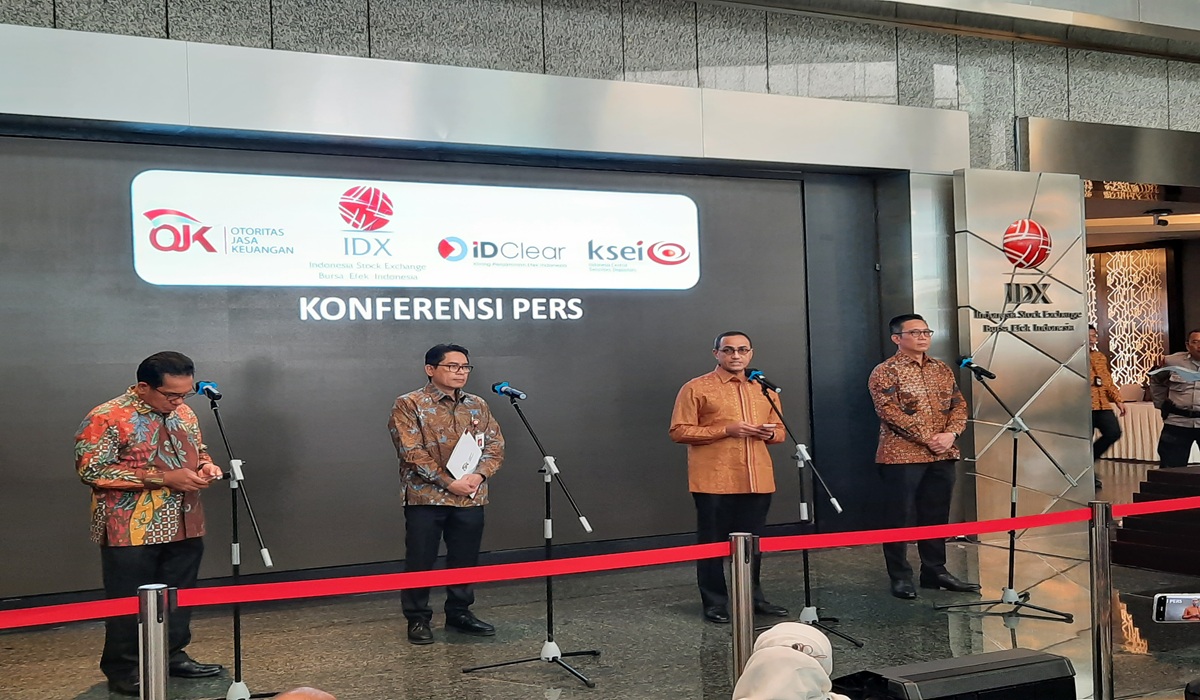
Indonesia’s capital market has experienced quite dynamic movements with high volatility levels due to geopolitical pressures and domestic and global conditions. The Head of the Executive for the Supervision of Capital Markets, Derivative Finance, and Carbon Exchange (PMDK) of the Financial Services Authority (OJK), Hasan Fawzi, stated that this situation is not only faced by Indonesia’s capital market, but almost all exchanges in the region and globally. “This also shows external dynamics rather than responses solely to domestic fundamental conditions,” Hasan said during a Press Conference and Socialisation of the Achievements of the Indonesian Capital Market Transparency Reform at the Indonesia Stock Exchange Building, Jakarta, on Thursday (2/4). As of 1 April 2026, the Composite Stock Price Index or IHSG was at the level of 7,184.44, having experienced a correction of 16.91% year-to-date. Amid these dynamics, he said, they continue to monitor developments day by day to gauge investor reactions. “We confirm that so far, the resilience or endurance of our domestic market remains maintained,” Hasan revealed. He explained that share transaction activities continue to show solid and high figures with an average daily transaction value of Rp20.66 trillion during March 2026. Liquidity in the market is also considered stable with a bid-ask spread range at a relatively good level of 1.55 times. Furthermore, the mutual fund industry amid these conditions continues to grow with net asset value (NAB) reaching Rp695.71 trillion or still up 3.02% year-to-date. In addition, the capital market continues to function as a means to obtain funding sources. Total corporate fundraising reached Rp51.96 trillion by the end of March 2026. On the other hand, Hasan said, OJK has imposed administrative sanctions on no less than 233 parties so far this year up to 31 March 2026. “The total fines amount to Rp96.33 billion. Including handling cases directly related to market manipulation conditions that are often a concern for all parties. This even amounts to Rp29.3 billion,” he stated. “Of course, we will continue these steps and they will become an important part of our efforts to continue bringing market discipline, market integrity, and good market conduct. Ultimately, we hope to restore confidence in our capital market, especially from our investors,” he concluded.