
How rare earth mining in Myanmar threatens Thailand’s rice and fish
How rare earth mining in Myanmar threatens Thailand’s rice and fish
Contamination linked to mining in Myanmar is raising fears over food safety, shrinking incomes and long-term health risks for people in Thailand who depend on the Mekong’s tributaries, CNA’s Insight finds.
CHIANG RAI, Thailand: Thongkham Inprom has been farming for more than six decades, growing jasmine rice and sticky rice in Chiang Rai.
The 71-year-old harvests about 60 tonnes each year and keeps 1 per cent for his family. The rest is sent to a rice mill and eventually sold in central Thailand.
But now he is worried that he might not be able to sell his rice. Government agencies have found arsenic in the soil and water at his farm. It is already affecting his crops.
While his brown rice contains arsenic within the safety limit, his paddy is “right at the safety threshold”, said Somporn Pengkam, the director of the Community-led Health Impact Assessment Platform, who went through the results from tests on the produce.
Thongkham’s polished white rice has less arsenic, but there is still cause for concern.
“Even if the daily intake is within the limit, it still builds up. At first, the body says, ‘I can handle it and flush it out.’ After a week, ‘still manageable’. After a month, it starts to struggle,” said Somporn.
“After six months, ‘I can’t handle this any more’. The kidneys can no longer clear it. That’s when we start detecting it in the body. Arsenic poisoning can eventually cause cancer in many organs, especially the skin and bladder.”
Arsenic has already been found in Thongkham’s urine, with tests done months apart showing that the level has increased to double the acceptable exposure limit.
“I don’t really know what we can do,” he said. “It’s hard to avoid. We eat rice every day.”
It is not only his farm where arsenic — a naturally occurring but toxic chemical element found in soil, water and some minerals — has exceeded the levels expected.
In March, Thailand’s Pollution Control Department detected elevated levels in the sediment of the Mekong River, the lifeblood of a large part of Southeast Asia. More than 65 million people live in the Lower Mekong basin.
The highest reading was 296 milligrams per kilogram of sediment, nine times the 33 mg/kg safety threshold.
In fact, heavy metals including lead and manganese have been detected in the Mekong’s northern tributaries since last year. In some tests, the presence of these substances exceeded Thailand’s safety standards too, with arsenic the prime concern again.
The water that feeds Thongkham’s crops comes from the Sai River. Along with the Kok and Ruak rivers, it begins in Myanmar’s Shan state, across the border. There lies what experts say is the source of the pollution: rare earth mines.
“They’re doing mining without any standards, any laws, spilling all the chemicals and toxins (into) our river system,” said Rivers and Rights Foundation executive director Pianporn Deetes. “These activities are transnational organised crime.”
Myanmar’s civil war and the race for the world’s most critical minerals are at the heart of what is now a looming crisis as pollutants end up in the food Thailand produces, CNA’s Insight finds.
FISH NO ONE WANTS TO EAT
Before arsenic began showing up in rice, fish with unusual growths or lesions were turning up and sparking concern that something was wrong with the rivers.
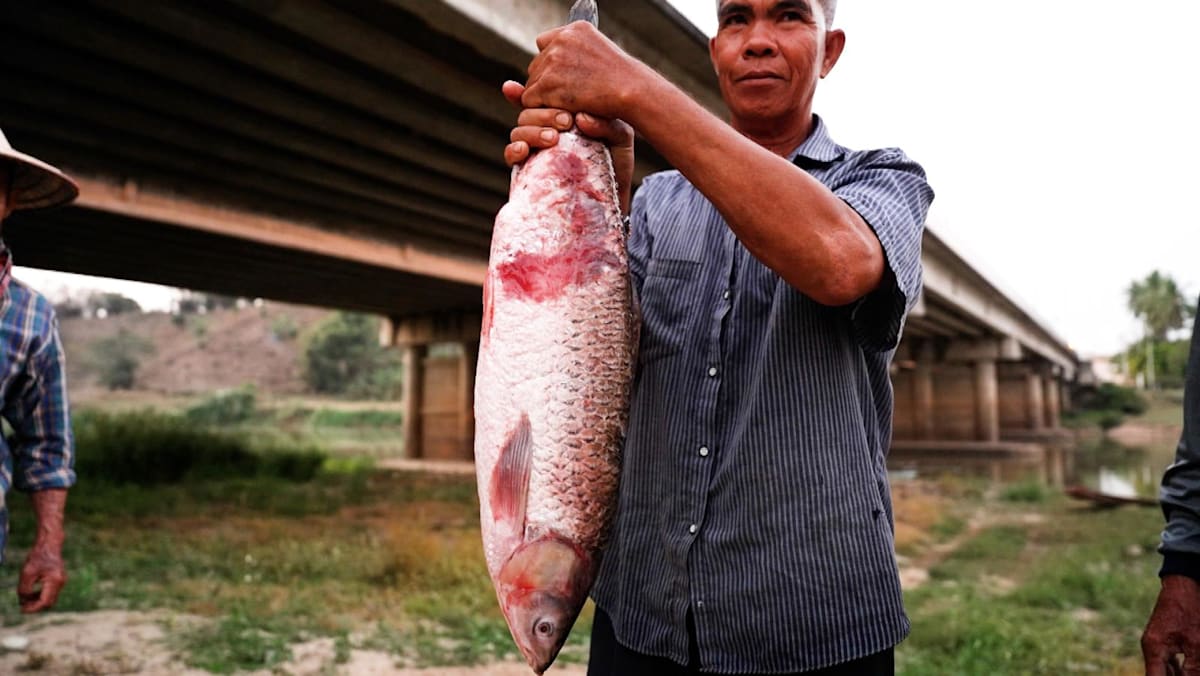
Sukjai Yana, 75, who has fished in northern Thailand for more than five decades, caught “about four or five” deformed fish last year. When that happens, the fish cannot be sold and must be kept for authorities to examine them.
WATCH: Is your food safe? Inside Thailand’s toxic river crisis (45:54)
The fisheries department has established that these are infected fish, said Wan Wiriya, an assistant head at the Chiang Mai University’s Environmental Science Research Centre.
“Heavy metals or chemicals in the water may have weakened the fish’s immune systems, making them more vulnerable to infection,” he suggested.
Take humans. The more chemicals we’re exposed to, the weaker our immunity becomes and the more likely we are to fall ill. It’s the same for fish.”
In fish samples tested by Somporn’s health platform, arsenic was found “mostly in the belly and the head”, she said. “Shrimp tend to accumulate it in the head as well.”
Contamination may not come from mining alone, she added. “In some areas, agricultural chemicals could also be involved, so the water might be getting hit from two sources.”
The Insight team found out for themselves what was in the waters when they took samples from three areas for analysis: at Chiang Rai, Nong Khai and at Tha Ton in Chiang Mai, where the Kok River enters Thailand.
While arsenic was not detected in the sample taken in Nong Khai, which is farther down the Mekong, there was arsenic measuring 0.0159 mg/L — above the 0.01 mg/L safety standard — at Tha Ton.
The chromium level there was within the safety range, “but when they all come together, that’s a high level of heavy metals”, said Wan as he disclosed the results. “They accumulate because we don’t just eat one thing in life, right?”
The sample from Chiang Rai, meanwhile, returned higher values “across the board”, with arsenic measuring about 0.03 mg/L — thrice the safety limit. “Chemicals are piling up there,” he said. “It’s a ticking time bomb.”
Out by the river, people do not need a lab report to know things are not right. “The river used to be clear, not murky like this. It wasn’t yellow,” said Tha Ton resident Mae Ai Insaeng.
“People don’t want to go in or bathe there. … We used to wash our clothes in this river, but now I dare not.”
Fishermen like Sukjai have seen their catches shrink. Anxiety over contamination has also made it harder to sell fish.
“It was so quiet last year. The customers simply disappeared,” said fish seller Sangkham Ganjai. “This year, things are starting to look up, although not (by) much.”
To reassure customers, she has her fish tested and certified by the authoriti