
How Prabowo Plans to Help Indonesian Fishers Move Up the Value Chain, with Annual Fish Production Worth Rp56 Trillion
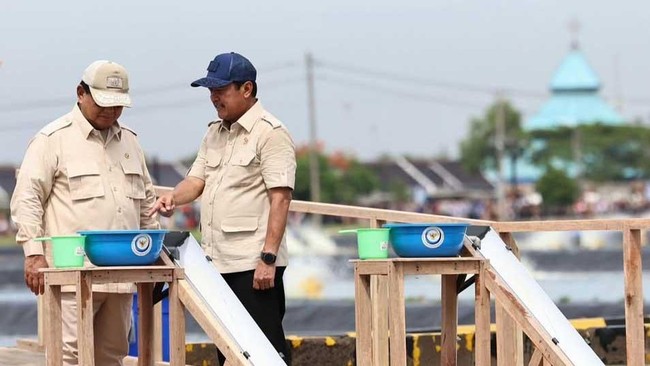
The government led by President Prabowo Subianto, through the Ministry of Marine Affairs and Fisheries (KKP), plans to modernise more than 1,000 fishing villages across Indonesia. The aim is to boost coastal economies and improve the welfare of fishers.
Marine Affairs and Fisheries Minister Sakti Wahyu Trenggono said the ministry would develop 1,369 modern fishing villages. The programme is expected to benefit around 429,000 fishers and 1.7 million members of their families.
“This is how the government develops remote areas that have never previously received government investment,” Trenggono said at a meeting at his office on Thursday (29 October 2026).
Under the programme, called Kampung Nelayan Merah Putih (KNMP), the government aims to make Indonesia one of the world’s largest fish producers, with output of 2.82 million tonnes a year valued at Rp56 trillion, or about US$3.3 billion.
“This will raise fishers’ incomes to Rp7.7 million per month,” he added.
The programme is expected to create 50,000 jobs and, in turn, encourage the growth of microbusinesses in coastal areas, including fish processing and food services.
“It will also increase national exports of wild-caught fish,” he said.
Trenggono described the conditions faced by Indonesia’s fishing communities, whose economic standing the KNMP programme is intended to improve. Indonesia has 2,910 fishing villages, most of which are currently in a poor condition.
Fishing villages are generally densely populated and overcrowded, lack adequate facilities and infrastructure, depend on seasonal catches for livelihoods, and have limited access to technology.
According to ministry data, Indonesia had 3.228 million fishers in 2025, most of whom were poor. This is reflected in the low fishers’ terms-of-trade index, which averaged 104.4 over the past five years.
Will the KNMP programme succeed in strengthening the fisheries sector and improving the welfare of Indonesian fishers?
Trenggono presented the results of a fishing-village development project in Samber-Binyeri village, Biak Numfor Regency, Papua Province.
Statistics Indonesia (BPS) data show that the fishers’ terms-of-trade index in the village rose from 109 to 113.2 after the village was developed. The programme benefited 89 fishers and 445 family members.
As of July 2026, following the village’s development, fishers earned an average of Rp7.73 million per month, a 78% increase from Rp4.35 million.
Fish production also rose sharply, by 103%, from 446kg per fisher per month to 904kg. Fish sales increased by 47%, from Rp9 million per fisher per month to Rp15.87 million.
“Previously, the catch was only enough to meet local needs. Now, fish is also sent to other cities to industrial standards,” Trenggono said.
The government is providing a range of facilities and infrastructure under the KNMP programme, Trenggono said. These include jetties or boat moorings, suitable fishing vessels, cold storage facilities and ice factories, which fishing villages have not previously had.
The government aims to develop 5,000 fishing-village sites to the same standard by 2029.
Source: jawawa.id (https://jawawa.id/newsitem/how-prabowo-plans-to-help-indonesian-fishers-move-up-the-value-chain-with-annual-fish-production-worth-rp56-1793346662)
Originally published by CNBC Indonesia (https://www.cnbcindonesia.com/news/20261030122305-4-780894/cara-prabowo-bikin-nelayan-ri-naik-kelas-produksi-ikan-rp-56-t-tahun), translated from Indonesian