
How Much Foreign Investment Could Flee if MSCI Downgrades Indonesia to Standalone Status?
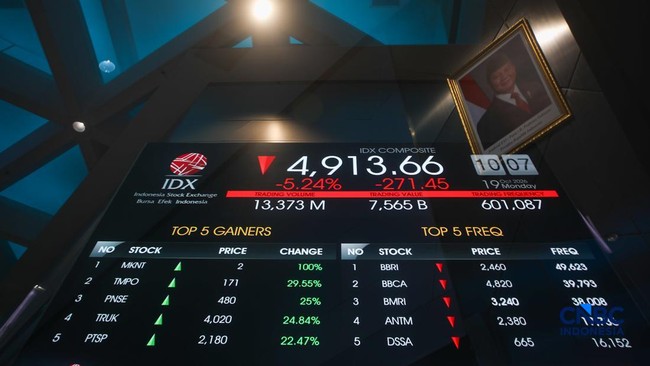
Jakarta, CNBC Indonesia — Indonesia’s stock market faces the risk of selling pressure from global investment funds if MSCI carries out a proposed reclassification of the country from an emerging market to a standalone market.
A compilation of holdings across 34 MSCI index-tracking exchange-traded funds (ETFs) puts their Indonesian shares at US$1,884.05 million, or about US$1.88 billion (approximately Rp34 trillion at US$1 = Rp18,040).
The figure is based on 561 Indonesian share positions reported as at 15 October 2026. It reflects holdings before the market fell on 16 October and does not show the value remaining after that decline.
If all Indonesian share positions in the sample had to be removed following an index change, about US$1.88 billion based on 15 October valuations could be sold.
Actual sales would depend on share prices, exchange rates, changes in holdings, and the terms and timing of any MSCI implementation.
IEMG accounts for nearly half of the exposure
The largest exposure in the compilation is held by the iShares Core MSCI Emerging Markets ETF (IEMG), with US$825.07 million in Indonesian shares.
That amounts to about 43.79% of all Indonesian positions in the sample. Next is the iShares Core MSCI EM IMI UCITS ETF, traded under several tickers including EIMI, EMIM and IS3N, with holdings of US$247.55 million.
EMXC follows with US$141.82 million in Indonesian positions, then EEM with US$133.39 million and IXUS with US$99.89 million.
The five largest ETFs together hold US$1,447.71 million, or 76.84% of the identified Indonesian shares. This concentration makes portfolio adjustments by a handful of major funds an important factor in assessing potential selling pressure.
Total positions potentially facing sale reach US$1.88 billion
Of the funds in the sample, 29 iShares funds hold US$1,841.81 million in Indonesian shares, while five State Street SPDR funds hold US$42.24 million.
Assuming all Indonesian positions had to be sold, shares worth US$1,884.05 million could be affected, based on valuations on the holdings date.
The sampled funds have combined assets under management (AUM) of US$502,671.02 million, or about US$502.67 billion. However, this includes investments across many countries; the relevant figure for assessing the risk of Indonesian share sales is their Indonesian holdings.
The US$1.88 billion total does not cover all global ETFs. Several large products from Xtrackers, UBS and Amundi, as well as institutional index mandates and passive products other than ETFs, are not included.
UBS previously estimated that Indonesia’s potential reclassification as a standalone market could trigger about US$4 billion in passive fund outflows, Reuters reported on 16 October 2026.
That estimate has a different scope from the 34-ETF compilation. The two figures may overlap, so UBS’s US$4 billion estimate should not be added to the sample’s US$1.88 billion.
IDX tightens lower trading limit to 7% through year-end
Amid market pressure, the Indonesia Stock Exchange (IDX) has tightened the lower auto-rejection limit (ARB) from 15% to 7% for shares covered by the rules governing the Regular and Cash Markets.
The measure takes effect on Monday, 19 October 2026, and will remain in place until 31 December 2026. It will be reviewed in line with market conditions.
The change narrows the permitted daily fall in share prices. However, a tighter ARB limit does not in itself remove selling pressure.
If sell orders are not absorbed, a queue of selling may persist and prices may come under further pressure on subsequent trading days. The ARB change therefore governs daily price movements rather than eliminating the risk of fund outflows.
The 7% ARB limit applies to individual share prices under exchange rules; it is not a 7% daily limit on the Jakarta Composite Index (JCI).
How far could the JCI fall if pressure continues?
The JCI closed at 5,185.11 on Friday, 16 October 2026, down 11.57%. That closing level is used as the reference point for the following scenarios, not as the index’s latest level on 19 October.
The potential ETF share sales alone are not enough to determine a JCI target. The impact would depend on which shares are sold, their weight in the index, the pace of selling, market liquidity and other investors’ ability to absorb the supply.
Some of the reclassification risk may already have been reflected in the market decline. Holdings values recorded before the fall therefore cannot be treated as additional outflows that are all still pending.
With the ARB limit currently at 7%, the article states that this corresponds to roughly 5% at index level, and uses successive 5% falls in the JCI as the basis for its calculations.
However, ETF holdings data do not provide a basis for saying that any particular level is certain or most likely to be reached. Such an assessment would require analysis of sales by individual share, index weights, liquidity and the market’s capacity to absorb trades.
MSCI’s consultation is due to run until 30 April 2027, with a decision to be announced no later than 30 June 2027. The consultation, market reforms and investor behaviour will determine the scale of any portfolio adjustments and their effect on the JCI.
Source: jawawa.id (https://jawawa.id/newsitem/how-much-foreign-investment-could-flee-if-msci-downgrades-indonesia-to-standalone-status-1792392626)
Originally published by CNBC Indonesia (https://www.cnbcindonesia.com/research/20261019100328-128-777366/segini-potensi-dana-asing-kabur-jika-msci-turunkan-ri-ke-standalone), translated from Indonesian