
How Kim Jong Un Showed Off Strength to South Korea Through Weapons Tests
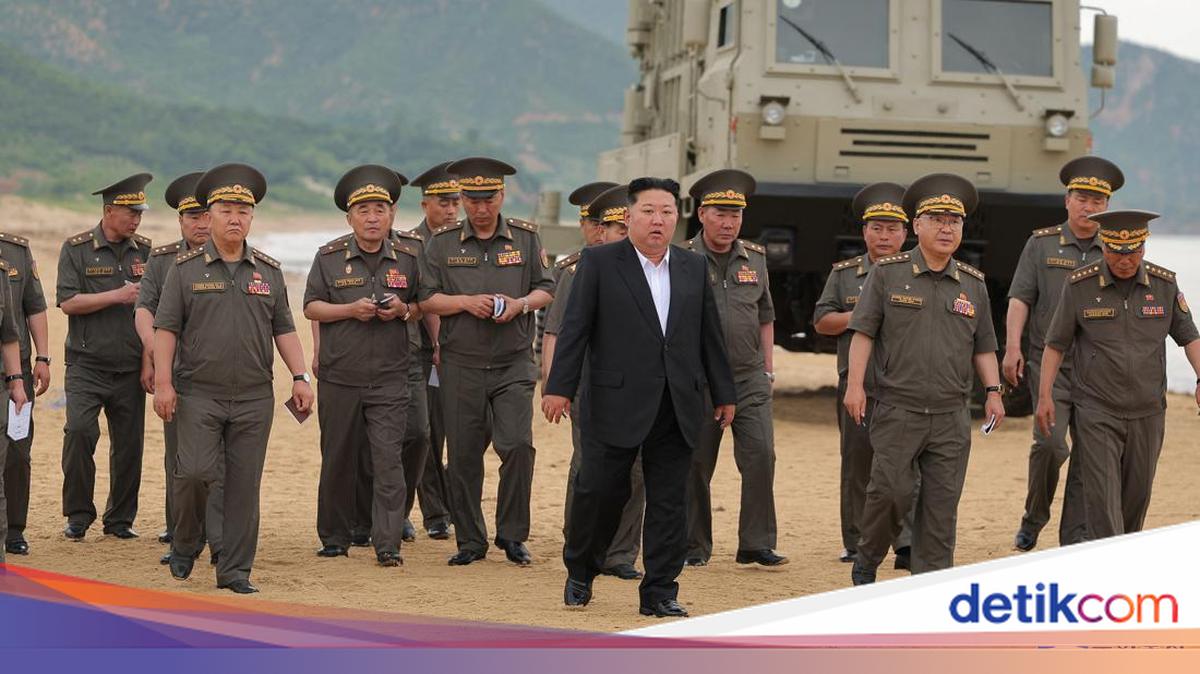
North Korea has once again flexed its military muscle with tests of upgraded artillery and missile systems, which it claims are capable of reaching parts of Seoul, the capital of South Korea. The weapons tests, overseen by leader Kim Jong Un, are being viewed as a show of force against Seoul.
The North’s official Korean Central News Agency (KCNA) reported that Kim Jong Un supervised the test of ‘core weapons’ including a multiple rocket launcher and warheads for tactical ballistic missiles. Kim stressed the need for ‘national defence development’ to ensure ‘no enemy dares to confront’ the North, a country that technically remains at war with its neighbour.
The KCNA report stated the tests ‘analysed and evaluated the combat characteristics for an upgraded 240mm calibre multiple rocket launcher system with 24 barrels, the destructive power of special-mission warheads for tactical ballistic missiles, and the firing accuracy of long-range projectiles from a 155mm calibre self-propelled howitzer.’ Kim expressed satisfaction with the results, saying the tests demonstrated progress in enhancing firepower along the southern border through better automation, longer range, and higher precision.
Kim also emphasised that Pyongyang is not only focused on defence but also on strengthening a ‘lethal and destructive offensive posture.’ KCNA noted the tested rocket launcher system is equipped with a new precision guidance system with self-steered capability, and its firing range has been increased to 90 kilometres. This distance is sufficient to reach parts of the Seoul metropolitan area from positions near the inter-Korean border. The warheads are ‘designed to inflict fatal damage on the enemy’s key targets, including airfields, ports, and power generation facilities,’ KCNA added.
Analyst Yang Moo Jin, a former rector of the University of North Korean Studies, described the details released by Pyongyang as a ‘show of force aimed at the South Korean capital region.’ The specifics included the 90-kilometre range for the multiple rocket launcher, a 65-kilometre range for the howitzer, and the identification of targets such as airfields, ports, and power plants. ‘It is noteworthy that they have revealed their strategic intent by framing provocations that trigger public anxiety and fear, through routine military shows of force, as a form of war deterrence,’ Yang said in his analysis.
North Korea is subject to various United Nations sanctions banning the development of nuclear weapons and the use of ballistic missile technology, provisions it has repeatedly violated. This month, Kim Jong Un vowed to bolster the North’s defence capabilities, citing military modernisation efforts by South Korea and the United States, which he claimed have pushed the region ‘to the brink of nuclear war.’ Days later, the North Korean leader said Pyongyang would equip its navy with nuclear weapons and build larger warships.
Shortly after, South Korea announced plans to expand its drone and anti-drone capabilities to deter the North’s threats. Seoul plans to acquire 20,000 low-cost military drones and train 500,000 ‘drone soldiers’ to operate drones as a ‘second personal weapon.’ The South Korean military also plans to produce 110,000 drones by 2029 for deployment to various frontline military units across the army, navy, air force, and marines, aiming to make drones standard equipment for every soldier.
South Korean Defence Minister Ahn Gyu Back cited lessons learned from the wars in Ukraine and the Middle East as the reason behind the move. ‘Recent conflicts in Ukraine and the Middle East clearly show that drones have emerged as a game changer on the battlefield,’ Ahn told reporters in Seoul. ‘Drones should no longer be just equipment used by a limited number of units, but must become a widely used combat tool.’
Ahn stated that Seoul will rely on 100 per cent domestically produced components, rather than using parts from China, in the production of the military drone systems, in response to security concerns. South Korea technically remains at war with the North after the 1950-1953 conflict ended with an armistice, not a peace treaty. ‘North Korea is also continuously developing various unmanned aerial vehicle capabilities, which pose a growing threat not only to South Korean military facilities but also to vital national infrastructure and civilian targets,’ Ahn said. He added that the South Korean government is seeking to accelerate the deployment of the Korean Long-range Unmanned Combat Strike System (K-LUCAS), a domestically produced munition believed to be similar to the US LUCAS system, which was developed through reverse-engineering of Iranian-made Shahed drones. The South Korean military also plans to acquire more than 20,000 low-cost, disposable drones, though Ahn did not disclose the source of these drones. These include short-range reconnaissance drones and small combat drones.