
How Indonesia Can Grow Like South Korea: Invest in Research
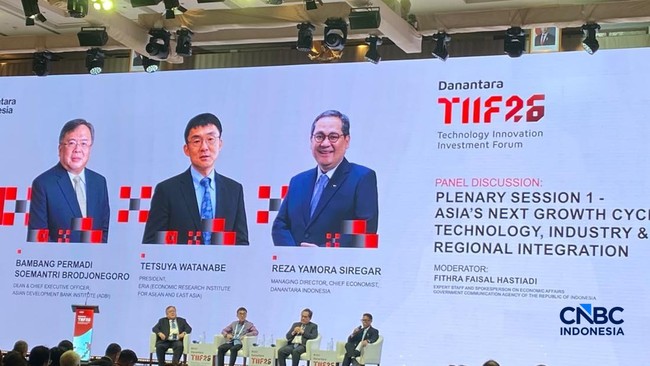
Jakarta, CNBC Indonesia — Former finance minister Bambang P.S. Brodjonegoro has identified one key to helping Indonesia’s economy advance like South Korea’s: increasing investment in research and development (R&D).
Bambang said Indonesia needs to begin investing heavily in research and innovation to increase economic value added and catch up with countries that have achieved high-income status.
Speaking at the Danantara TIIF 2026 event, he highlighted Indonesia’s low R&D investment as a share of gross domestic product (GDP). Based on his experience as research and technology minister, Indonesia’s R&D investment amounted to only about 0.3% of GDP.
That figure is far below South Korea’s, which Bambang said spends around 5.3% of GDP on R&D — among the highest proportions in the world.
“When I was research minister, the figure was only 0.3% of GDP. We need to start investing heavily in R&D,” Bambang said.
He said South Korea’s experience could offer lessons for Indonesia in building the foundations for long-term economic growth. Research investment is needed to drive innovation, improve productivity and generate higher-value products and services.
In the past, Asian economic growth models relied heavily on manufacturing and exports. This strategy helped propel Japan, South Korea and several other Asian countries.
But amid shifts in the global economic landscape and accelerating technological development, manufacturing and exports alone are no longer enough. Asian countries need to develop a new growth model in which technology adaptation and innovation are the main drivers.
“The next Asian growth model must be based on technology adaptation to generate higher value added,” he said.
He stressed that using technology to increase value added applies not only to manufacturing, but also to agriculture and services. Achieving this will require technology adaptation to be backed by strong investment in research and development.
AI makes research investment more urgent
Bambang also warned that the development of artificial intelligence (AI) will bring major changes to people’s lives and the economy in a relatively short time.
He said AI could have a far-reaching impact in less than a decade. Indonesia must therefore prepare itself to avoid falling behind in global technological competition.
He contrasted the development of AI with the internet and computers, which took longer to have a broad impact on people’s lives.
Indonesia cannot simply remain a user of technology, he said. It needs to strengthen its ability to adapt technology to domestic needs, raise productivity and generate innovation so that the benefits reach different sectors of the economy.
Bambang also noted that R&D investment across ASEAN remains relatively limited. Singapore, one of the region’s highest spenders on R&D as a share of GDP, invests around 1.5% — still far below South Korea.
He said this underscored the importance of Indonesia paying greater attention to investment in research and innovation.
Bambang considers higher R&D investment an important step towards building a high-value-added economy and improving competitiveness amid global technological change.
By strengthening research, technology adaptation and innovation, Indonesia could develop new sources of economic growth, relying less solely on manufactured exports while also raising productivity in agriculture and services.
Source: jawawa.id (https://jawawa.id/newsitem/how-indonesia-can-grow-like-south-korea-invest-in-research-1792997440)
Originally published by CNBC Indonesia (https://www.cnbcindonesia.com/news/20261026114740-4-779450/cara-ekonomi-ri-bisa-tumbuh-kayak-korsel-investasi-di-riset), translated from Indonesian