
How Hackers Made Hundreds of Supermarket Fridges in Europe Heat Up and Melt
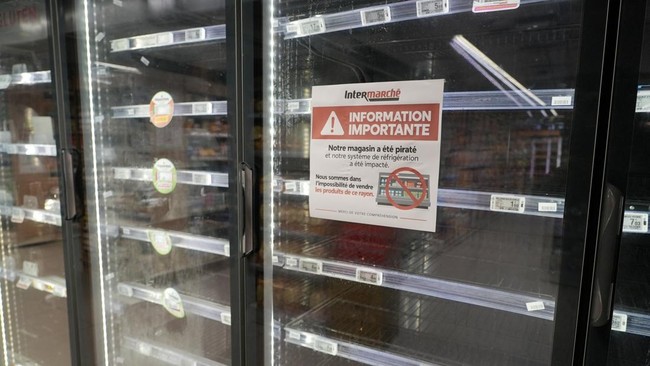
Jakarta, CNBC Indonesia — Cyber-attacks on supermarket refrigeration systems have struck again. After targeting hundreds of supermarkets in France last October, hackers have now caused fridge and freezer temperatures to rise in several European countries.
As a result, some food retailers have had to discard products that spoiled because they were no longer kept at the correct temperature.
The attacks exploit industrial refrigeration systems that are increasingly connected to the internet. Previously, industrial equipment such as refrigeration systems largely operated offline.
Antoine Hautin, secretary-general of cybersecurity consultancy Almond, said internet connectivity allows industrial systems to be monitored and managed remotely. However, it also creates openings for attackers to disrupt physical systems through digital networks.
In the attack in France last October, hackers targeted the temperature-control systems of fridges made by Danish company Danfoss. The systems are used by many shops.
Kevin Tellier, a cybersecurity engineer at Synacktiv, explained that fridge temperature settings can generally be accessed through a web interface using a password.
“Most of the time, this is done through a web interface. You log in with a password and can then choose the temperature inside the fridge,” Tellier was quoted as saying by France 24 on Wednesday (4 November 2026).
He said the systems should be on a closed network and inaccessible via the internet. However, some devices are exposed and can be accessed by anyone with basic knowledge.
“Normally, these systems are on a closed network and should not be accessible from the internet,” he said.
Zscaler cybersecurity expert Olivier Daloy warned that, without adequate protection, various factories and internet-connected equipment could face similar risks.
The threat is not limited to the food industry; it also affects carmakers and electricity and transport infrastructure.
How did the hackers do it?
Another cybersecurity expert, who asked to remain anonymous, said industrial infrastructure is highly vulnerable because it connects information technology (IT) systems with physical devices that are often outdated.
By infiltrating IT systems, hackers can take control of that infrastructure and cause disruption in the physical world.
Daloy identified two main risks attackers could exploit: technical vulnerabilities in systems and compromised credentials used to gain access to devices.
He cited the Stuxnet virus in 2010, which caused a series of failures in Iran’s fleet of centrifuges used for uranium enrichment.
In the French attack, Vincent Strubel, head of France’s National Cybersecurity Agency, said last October’s incident was caused by fundamental weaknesses in the security systems.
He specifically highlighted fridges connected directly to the internet without special protection and secured with weak passwords.
The identity of those behind the cyber-attacks remains difficult to establish.
Daloy said identifying the perpetrators of the attack in France would be extremely complicated. Tellier also said the attack could have been carried out by anyone.
“Anyone could do it. The attack was not very sophisticated, so we cannot tell whether the hackers had substantial resources or not,” Tellier said.
Source: jawawa.id (https://jawawa.id/newsitem/how-hackers-made-hundreds-of-supermarket-fridges-in-europe-heat-up-and-melt-1793839877)
Originally published by CNBC Indonesia (https://www.cnbcindonesia.com/tech/20261104121237-37-782208/cara-hacker-buat-ratusan-kulkas-supermarket-di-eropa-panas-meleleh), translated from Indonesian