
How Far Will the Rupiah Strengthen? These Data Points Are the Benchmark!
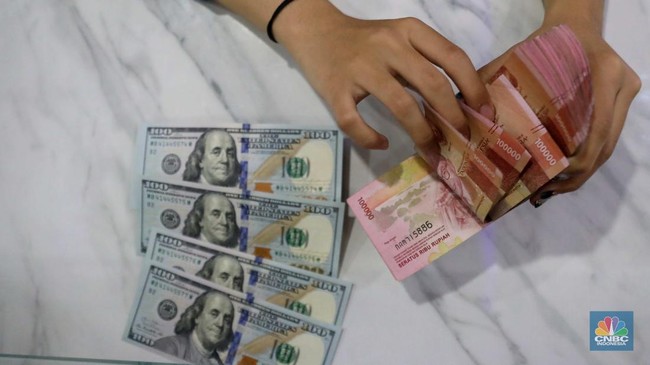
Jakarta, CNBC Indonesia - Economic observers have weighed in on the future of the rupiah, as the Garuda currency has become a massive topic of public discussion after briefly touching the Rp18,000 level against the United States (US) dollar.
Senior economist Raden Pardede stated that the factors influencing the strength or weakness of the rupiah can be seen from the condition of foreign exchange reserves and the balance of payments (BOP).
“So, if we look at the rupiah, the factors that determine whether it rises or falls can actually be seen from whether the foreign exchange reserves are sufficient or not. Then, the next factor is the condition of the balance of payments,” Raden said during CNBC Indonesia’s KONEKSI programme, quoted on Friday (12/6/2026).
Raden continued that if the balance of payments still shows a positive figure, then national foreign exchange reserves are also still strong, meaning the government still has strong ammunition to stabilise the rupiah.
“If the balance of payments remains positive, then our foreign exchange reserves will rise and remain strong. This means we still have ammunition to fight every attack against the rupiah or to counter every demand for US dollars that worsens the rupiah,” he added.
According to him, the balance of payments components consist of the current account and the capital account. From the current account, there are components such as the trade balance and the services balance.
“Now, our trade balance is still positive. But it has already declined due to imports, because of rising oil prices. Then, in the services balance, we are always negative. So, both of these are now making our current account negative,” Raden explained.
He continued that Indonesia’s capital account was actually positive at one point. However, it has now begun to decline because foreign investor portfolios are increasingly shrinking.
“Meanwhile, our financial account was positive. The financial account mainly consists of foreign direct investment (FDI), and the other is portfolio investment. The problem is, this portfolio account is now negative and quite large,” Raden said.
As a result, Indonesia’s balance of payments, when calculated between the current account and the capital account, has turned negative.
The Balance of Payments (BOP) in the first quarter of 2026 recorded a deficit of 9.1 billion US dollars. The current account recorded a deficit of 4.0 billion US dollars (1.1% of GDP). The capital and financial account in the first quarter of 2026 recorded a deficit of 4.9 billion US dollars.
“If these two are now added together, our balance of payments becomes negative, meaning it is declining. So, if we look at our balance of payments, our foreign exchange reserves are now falling. If I am not mistaken, at the beginning of 2026 they were still at US$154.6 billion, now (May 2026) they have dropped to US$144.9 billion. This means Bank Indonesia has tried to take action, but it continues to fall, as a result of capital outflow,” he added.
Not only due to continuously declining foreign exchange reserves, the persistent budget deficit also influences the strength or weakness of the rupiah.
“Not to mention the budget deficit, because if the deficit is large, there are also parties holding this money abroad, that also has an effect. So, the combination of these factors is primarily what determines the exchange rate,” he said.
In addition, political factors, including global geopolitical conditions and domestic politics, also influence the rupiah’s movement.