
How Commission XI of the DPR Will Ensure the 2026 State Budget Deficit Does Not Exceed 3%
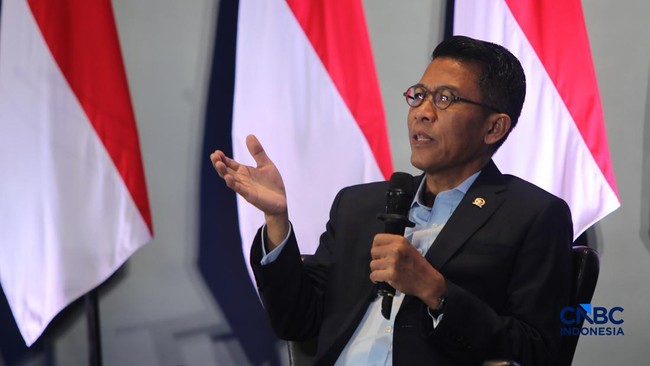
Jakarta, CNBC Indonesia - Commission XI of the DPR has assured that it will continue to monitor the government’s fiscal management to ensure the state revenue and expenditure budget (APBN) deficit does not exceed 3% of GDP, as stipulated in the State Finance Law.
To this end, a number of policy schemes required by the government are ready to be supported by parliament to keep the deficit only slightly above this year’s target of 2.68%, at around 2.88% to 2.9%.
This support includes, among others, the issuance of new laws to secure the fiscal deficit below 3%, such as laws supporting the policy to stop refunds and the imposition of windfall taxes.
“It won’t (reach 3% of GDP). I’m confident it won’t yet. The government hasn’t opted to widen it beyond 3%,” said Chairman of Commission XI of the DPR, Mukhamad Misbakhun, on the CNBC Indonesia programme Squawk Box, Wednesday (8/4/2026).
“Because the President’s directive to the Minister of Finance, conveyed to the DPR, states that the deficit should be kept at 3%, and 3% could be 2.88% or 2.9%,” he emphasised.
Misbakhun explained that government policies that could be supported by the DPR include tightening refund policies or the return of overpaid taxes claimed by corporate taxpayers to the state.
In a situation that could potentially drive a global crisis, such as the current one due to fluctuations in global energy prices triggered by warfare in the Middle East, he said the refund policy could be temporarily halted to support the government’s fiscal resilience.
“We could generate receipts of up to Rp500 trillion just from holding back refunds. Or if necessary, we can state that refunds will not be paid,” said Misbakhun on the CNBC Indonesia programme Squawk Box, Wednesday (8/4/2026).
Misbakhun assured that the DPR could even use various regulatory instruments to support the temporary suspension of refunds, particularly through the enactment of laws. At the technical level, political support could also be provided by the DPR if a Minister of Finance Regulation (PMK) related to the refund suspension policy needs to be issued.
“If the cushion is through a law, we can do it via a law. If the cushion is at the ministerial regulation level, we can issue a different ministerial regulation,” said Misbakhun.
He also claimed that businesses are essentially willing to postpone the return of overpaid taxes. Since the aim is solely to safeguard the economic growth climate.
“Of course, it must be discussed. With all stakeholders, with the business community. Because in a situation like this, togetherness, mutual cooperation, and mutual understanding of the situation as national solidarity are very important,” explained Misbakhun.
“Businesses certainly won’t think only of themselves as long as they can pay their employees, pay taxes, make profits, and sustain their businesses. I’m confident they won’t mind contributing to the nation and state,” he added.
In addition, Commission XI of the DPR is urging the government to begin implementing a windfall tax scheme amid the significant potential rise in prices of Indonesia’s key export commodities in the global market due to the effects of the Iran-US and Israel war in the Middle East region.
Misbakhun said that the war is not only driving up global crude oil prices, which is one of Indonesia’s main import commodities. But also Indonesia’s main export commodities, such as crude palm oil (CPO), nickel, coal, aluminium, copper, gold, coffee, and rubber prices.
“Of course, we can prepare the government for a windfall tax scheme,” said Misbakhun.
Misbakhun stated that the windfall tax scheme, applied to tax the windfall profits of commodity exporters, is important as a support for state revenues from the tax side.
Especially since the state’s revenue needs are currently even higher to compensate for spending pressures from the energy subsidy side, because subsidised fuels like Pertalite have been set by the government not to rise despite soaring global crude oil prices, in order to protect people’s purchasing power.
“Of course, this must be discussed together with business associations, sectorally, partially, that at a certain price level, when it’s called windfall and then how much percentage is imposed. This also creates potential beyond the normal,” explained Misbakhun.
Through the windfall tax policy scheme, the Ministry of Finance, he said, will have room to keep the APBN deficit within the safe limits of the State Finance Law, namely 3% of gross domestic product (GDP). He said the APBN deficit will only rise by 0.2 percentage points, from the 2.68% target throughout this year to 2.88%.
“Well, this will certainly provide reinforcements to state revenues that can offset the impact of the fuel price rise, and then we cover it from revenues from sectors experiencing price surges that we usually call windfall,” he explained.
“If we can exercise this well, I’m confident our APBN will have stronger resilience and there will be no need for excessive worries that we will face pressures,” he emphasised.
It is important to note that windfall tax is not a new term in the taxation world. Based on an article on the Directorate General of Taxes (DJP) website of the Ministry of Finance titled “Windfall Tax: Its Impact on the Coal Industry”, windfall tax is a special form of tax imposed on unexpected or beyond-estimate income obtained by a particular industry or company.
The implementation of this tax aims to capture excessive profits obtained from sudden favourable changes in commodity prices or market situations. By imposing tax on this unexpected profit, the government can obtain additional funds for various development needs, infrastructure, or other purposes.