
How a national security threat label has reignited Indonesia's LGBTQ debate
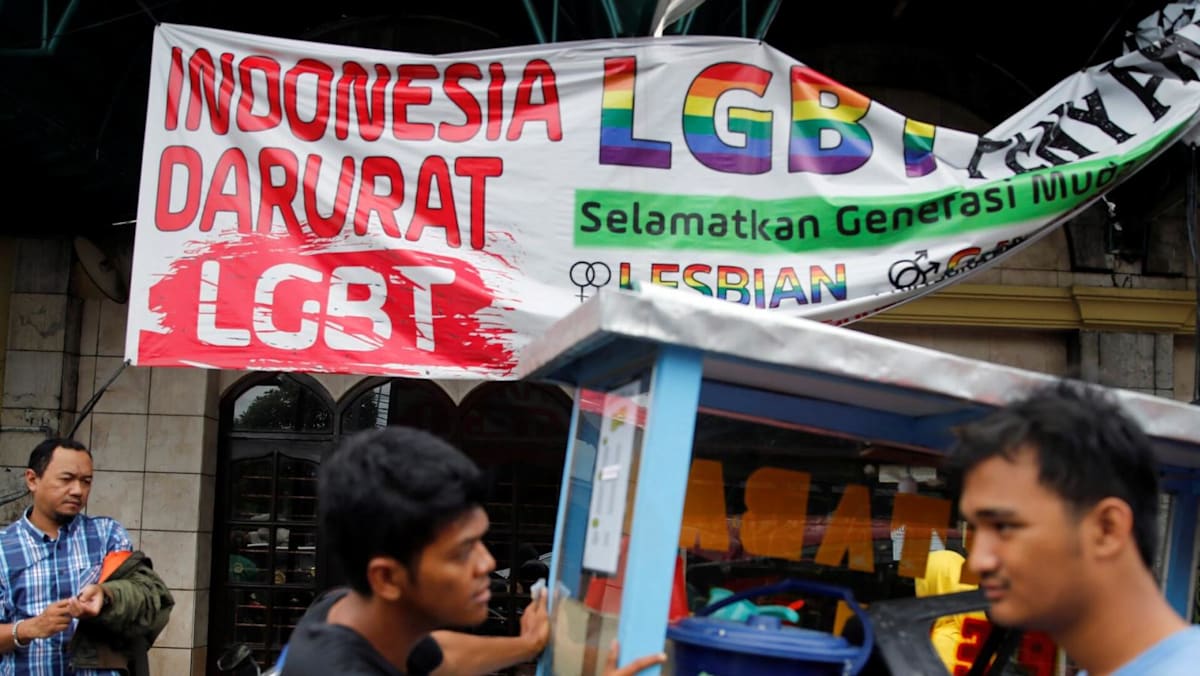
How a national security threat label has reignited Indonesia’s LGBTQ debate
Indonesia last October classified the “spread of LGBTQ culture” as one of the country’s non-military threats. A series of developments thrust the provision into the public eye this month, sparking a debate.
SINGAPORE: For more than eight months, a provision tucked away in an Indonesian presidential regulation on national defence drew little public attention.
In an appendix to Presidential Regulation No. 111/2025 on the General National Defence Policy signed in October last year, the government classified the “spread of LGBTQ culture” as one of the country’s non-military threats.
The clause, referring to lesbian, gay, bisexual, transsexual and queer culture, appeared alongside a range of other threats deemed capable of affecting national resilience. They included illegal trafficking, natural resource theft, terrorism, atheism and radicalism.
A presidential regulation is a legally binding regulation published in the State Gazette, while General National Defence Policy documents are highly technical and usually attract little public attention outside government and defence circles.
But a series of developments thrust the provision into the public eye this month, sparking a debate on the place of LGBTQ issues in state policy and the extent to which social issues should be framed within Indonesia’s defence strategy.
The issue quickly spread beyond social media into mainstream Indonesian media with national outlets including Antara, Kumparan, and Tempo examining the regulation and prompting public responses from senior government officials.
Some observers and activists say the clause could heighten discrimination against LGBTQ individuals in society, even as Indonesian ministers have defended the regulation while saying the government has no intention of curtailing the fundamental rights of citizens.
“As Indonesian citizens, LGBTQ people are entitled to education, employment, healthcare and other public services without restrictions, segregation or discrimination,” Indonesia’s Human Rights Minister Natalius Pigai told CNA in a phone interview.
But he added that Indonesian society is not ready to accept the LGBTQ community, even as the state remains obliged to respect, protect and fulfil every citizen’s rights to education, employment, healthcare and public services.
“The time has not yet come to formally recognise them as an official group because society is not yet ready to accept them,” he said.
HOW THE CLAUSE CAME TO PUBLIC ATTENTION
While it remains unclear what first drew widespread attention to the provision, it resurfaced amid a series of developments involving LGBTQ issues. One was a Pride Month-themed social media post in mid-June by Suara Mahasiswa, a student publication at the University of Indonesia.
The post had led to a heated online debate, with critics arguing it was inconsistent with Indonesia’s religious and social norms. They questioned why it invoked the Pancasila national ideology to defend the LGBTQ community. Pancasila comprises five principles: Belief in one God, civilised humanity, national unity, democracy and social justice.
The backlash prompted the university to publicly distance itself from the post and launch an internal review.
Then in late June, the Indonesian Ulema Council (MUI) said it was preparing an academic paper and a draft bill to criminalise LGBTQ-related conduct for Parliament’s National Legislation Programme.
MUI deputy chairman Muhammad Cholil Nafis argued that moral appeals alone were no longer sufficient to curb what he described as the growing activities and campaign surrounding LGBTQ culture.
“If there are no legal penalties at all, it eventually becomes normal. We should not normalise it. Punishment helps people understand that it is not normal,” he said.
“Deviant activities, such as same-sex parties, are now increasingly being displayed openly in public without any sense of shame,” he added.
Scrutiny then shifted to the new regulation that had previously gone largely unnoticed.
The belated attention came as no surprise to Agus Wahyudi, head of the Inter-Religious Studies Programme at Gadjah Mada University (UGM) in Yogyakarta.
Documents such as the General National Defence Policy typically circulate within government bureaucracy and rarely become the subject of public debate, he said.
But a provision can take on political significance when a series of events – in this case, the Pride Month-themed social media post and the MUI’s planned bill – draws the public’s notice, said Agus.
“What changed was not necessarily the policy itself, but the public attention it attracted,” Agus said.
WHY WAS IT PLACED IN A NATIONAL DEFENCE DOCUMENT?
Asked whether the presidential regulation represented the first national policy to explicitly mention LGBTQ, human rights lawyer Asfinawati said Indonesia’s 2008 Pornography Law referred to “lesbian” and “homosexual” acts in its explanatory notes to a provision banning the production, distribution and sale of pornographic material.
It defined what the law described as “deviant sexual intercourse” for the purposes of pornography offences, rather than creating a standalone offence based on sexual orientation or gender identity.
Presidential Regulation No. 111/2025 goes further by classifying the “spread of LGBTQ culture” itself as a non-military threat, argued Asfinawati, the former chair of the Indonesian Legal Aid Foundation.
“This regulation no longer links it to sexual conduct. Simply having a particular sexual orientation or gender identity is placed within a threat framework,” she said.
Experts have questioned whether a national defence framework was an appropriate instrument for addressing issues such as sexual orientation and gender identity.
In principle, national defence should focus on military threats, said Tangguh Chairil, a lecturer in security studies at the Department of International Relations at Binus University, Jakarta.
Indo