
Houthis Block Red Sea Gateway, Cut Off Saudi Access
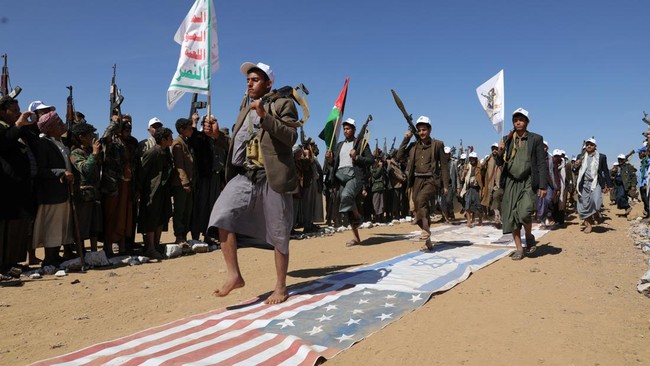
Jakarta, CNBC Indonesia – The Iran-aligned Houthi militia in Yemen has officially announced the imposition of a total maritime blockade against Saudi Arabia. The aggressive move risks opening a new front for the United States (US) in its war against Tehran, and threatens global trade routes and energy supplies beyond the Strait of Hormuz.
Citing a Reuters report on Tuesday (21/07/2026), the Houthi Armed Forces stated that they were enforcing a maritime embargo against Saudi Arabia under the principle of ‘an eye for an eye’, effective immediately. The action was claimed as a direct response to what the group views as an unjust and oppressive siege of Yemen by the Saudis, as well as Riyadh’s cooperation with the group’s rival, the ousted Sana’a government.
“We declare a maritime embargo against the criminal enemy Saudi Arabia, based on the equation of ‘an eye for an eye’, effective immediately,” the Houthi armed forces said in an official statement.
The threat immediately sent shipping insurance costs for goods passing through the Red Sea soaring as security risks for commercial vessels rise. Iran is reported to be continuing to press the Houthis to close the Bab el-Mandeb Strait, the gateway to the Red Sea, entirely if the US persists in attacking its electricity infrastructure.
A full closure of the strait is predicted to cut global oil supplies by up to 7%, as much of Saudi Arabia’s oil exports would be unable to leave the region, worsening a global energy shortfall that had already been reduced by 10% due to the Gulf war.
In response to the manoeuvre, Riyadh said it condemned the steps taken by the Houthis. The Kingdom claimed it had committed no criminal acts against Yemen, and that it would only cooperate with the legitimate Yemeni government.
“The Kingdom affirms that we are cooperating with the legitimate Yemeni government to end the suffering of the Yemeni people by continuing development projects, supporting the legitimate government’s funds, and providing petroleum derivatives for power plants,” the Saudi Foreign Ministry said, as quoted by Arab News.
Diplomatic Efforts to Restore the Ceasefire
Behind the maritime escalation, international mediators are reported to be moving quickly to propose a 10-day ceasefire in order to save an emergency deal to end the war that broke out on 28 February. Iran’s Interior Minister, Eskandar Momeni, is even reported to have arrived in Islamabad to ask Pakistan to resume its mediation role in the conflict.
The diplomatic push follows the ninth consecutive night of US air strikes on several Iranian cities, which were answered by the Islamic Revolutionary Guard Corps (IRGC) pounding US military assets in Jordan, Kuwait and Syria using ballistic missiles and drones.
Meanwhile, US President Donald Trump, facing domestic political pressure due to rising petrol prices following Iran’s closure of the Strait of Hormuz, defended the successive air strikes as decisive action to honour the deaths of three US military personnel.
“Every time Iran kills an American Soldier, they will pay for that killing many times over! This instruction has been given to Secretary of War Pete Hegseth, Chairman of the Joint Chiefs of Staff Daniel Caine, and every Leader in the Military,” Donald Trump wrote in his official post on the social media platform Truth Social on Monday.
The large-scale armed conflict has killed thousands of people, the majority in Iran and Lebanon. To discuss a regional diplomatic way out, Lebanese President Joseph Aoun is scheduled to meet Trump at the White House on Tuesday to present a plan to disarm the Tehran-aligned Hezbollah group and secure the withdrawal of Israeli forces.
Meanwhile, on the Palestinian front, the militant group Hamas on Monday announced the appointment of its master negotiator, Khalil Al-Hayya, as the organisation’s supreme leader, replacing the previous leadership. A number of observers believe the change at the top is a signal that Hamas will take a much harder and more rigid stance towards all international demands calling on it to disarm in the Gaza Strip.