
Houthis Become Iran's Most Feared Ally: What Is Their Strength?
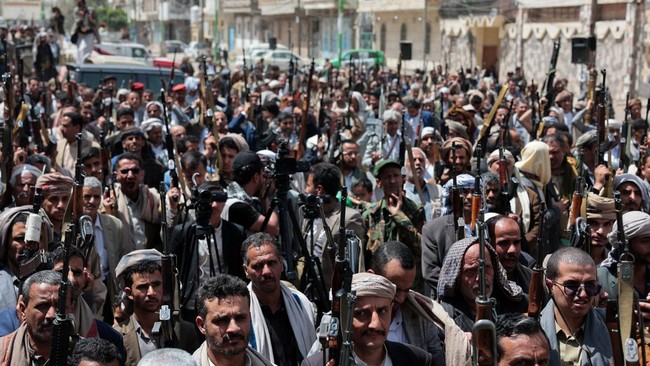
The war in Yemen has heated up again after a ceasefire that lasted around four years began to crack. The Houthi group, an Iran-backed militia, has resumed missile and drone attacks, including against ships linked to Saudi Arabia in the Red Sea.
Since mid-July, almost no Saudi tankers have passed through the Bab al-Mandab Strait.
On land, the Houthi position is far from weak. The group controls northwestern Yemen, including the capital Sanaa and most of the western coast. Around 70% of Yemen’s population lives in territory under their control.
This combination of territorial control, military capability and geographical position makes the Houthis more than just a local armed group.
The Houthis have begun targeting the Red Sea. On 15 August, a Houthi missile struck Mokha Port, which lies near the Bab al-Mandab Strait. The attack caused around US$16 million in damage and forced the port to close.
Mokha also serves as a base for the National Resistance Forces, a fighting group backed by the Yemeni government. By attacking the port, the Houthis can pressure their opponents on land while expanding their influence in the coastal region.
Attacks on shipping serve another purpose. The Houthis want to pressure Saudi Arabia into paying the salaries of Yemeni civil servants and easing restrictions on flights and shipping.
But the Houthis’ capabilities do not stop at pressure on sea lanes.
Initially, the group relied heavily on finished weapons supplied by Iran. Now, its supply network is increasingly dispersed. Small components are smuggled through Oman and the United Arab Emirates, or brought in using dhows from the Horn of Africa.
Some Houthi drones can even be built almost entirely without Iranian components.
This network means that strikes on their weapons do not automatically halt their military capability. Peter Salisbury of Columbia University says the Houthis are able to restore damaged or destroyed capabilities far faster than many expected.
Their technological capabilities are also developing. The Houthis are said to possess fibre-optic-guided drones that are harder to disrupt through jamming.
When the United States attacked them in 2025, the Houthis claimed to have shot down seven American Reaper drones and come close to hitting several fighter jets. Last month, the group also claimed to have downed a Turkish-made Bayraktar drone operated by Saudi Arabia.
The mountains serve as a fortress. The highland territory controlled by the Houthis is relatively easy to defend. The group also took over cave systems and bunkers formerly used by the Yemeni military when it seized territory in 2014. Satellite evidence shows several of these underground facilities continue to be expanded.
The Houthis also have experience facing larger military campaigns.
In the summer of 2025, Israeli strikes killed most of the group’s civilian government, including its prime minister. However, the Houthis rebuilt their organisational structure.
Even if their leader, Abdul-Malik al-Houthi, were killed, the group would not necessarily be paralysed. He himself rose to leadership after his brother, Husayn, died in battle in 2004.
This resilience is one of the factors that sets the Houthis apart from several other Iran-aligned groups.
The Yemeni government is now trying to rebuild its strength to confront the Houthis. Groups that previously fought each other are beginning to show greater coordination, while their drone capabilities are also improving.
Saudi Arabia and the United States have far greater military resources. But the Houthis have shown that this superiority does not automatically produce a quick victory.
Abdul-Malik al-Houthi has said Yemen has a reputation as the “graveyard of invaders”.
With around 70% of Yemen’s population living in territory they control, an increasingly self-sufficient supply network, continuously developing weaponry and natural fortresses in the mountains, the Houthis’ strength does not lie only in their ability to attack.
What makes them dangerous is that the Houthis do not have to keep winning.