
Houthi Missiles Reach Riyadh: Is Saudi Arabia’s Advanced Defences Not Strong Enough?
Jakarta, CNBC Indonesia — Saudi Arabia is once again facing deadly aerial attacks by the Yemen-based Houthi group.
Missiles and drones have continued to be directed at various parts of the kingdom, including the capital, Riyadh, hundreds of kilometres from Yemen.
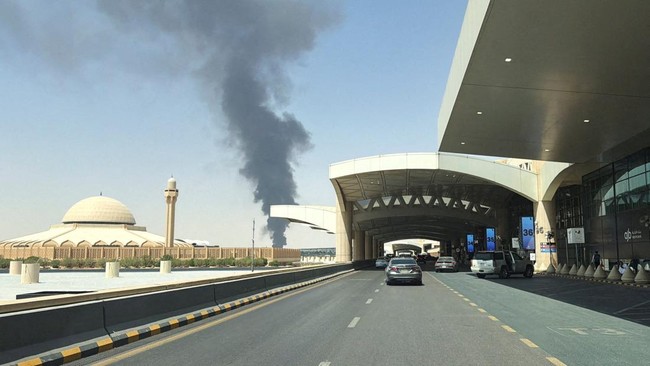
One of the largest attacks took place on Saturday (10 October 2026), when Houthi forces claimed to have targeted King Khalid International Airport in Riyadh.
The attack killed at least 13 people and injured more than 300. Reuters reported that those killed included Saudi citizens and several foreign nationals.
Before the damage had been dealt with, the same airport was hit again on Sunday (11 October 2026). A projectile struck Terminal 4 and caused a fire. One person was killed and 11 others were injured.
Across the attacks on Riyadh airport during the week, the reported death toll had reached 18.
An attack also took place at King Fahd International Airport in Dammam, eastern Saudi Arabia. A witness said a projectile hit the runway area near several parked aircraft and caused a fire.
The impact was not limited to casualties and damage to buildings. Air traffic was disrupted, with some flights cancelled or diverted, and the United States’ aviation authorities issued a warning to airlines operating in Saudi Arabia.
Local authorities also temporarily shifted in-person schooling in Riyadh to remote learning.
The Houthis have also claimed to have attacked several Saudi Aramco facilities. However, the extent of the damage and any effect on oil production have not been independently confirmed in full.
The series of attacks has raised a major question: how can Saudi Arabia, known for its modern weapons and substantial defence spending, still struggle to prevent attacks by an armed group in a neighbouring country?
Ballistic missiles, cruise missiles and drones are among the Houthis’ weapons
To understand the issue, it is necessary first to look at the weapons used by the Houthis.
The group, which controls parts of Yemen, does not have a conventional air force like Saudi Arabia. It does not rely on fighter jets to attack its adversary’s territory.
Instead, the Houthis use various types of missiles and drones capable of striking targets at long range.
In the recent series of attacks, the Saudi military said it had intercepted a cruise missile near King Khalid Airport, destroyed a drone in the east of the country and intercepted a ballistic missile aimed at Khamis Mushait.
However, based on the information available, it has not been possible to determine the type of projectile that struck the Riyadh airport terminal on 10–11 October.
The Houthis’ arsenal is built around three main types of weapons:
Ballistic missiles
Cruise missiles
Drones
Data from the Wilson Center indicate that the Houthi arsenal includes Quds-4 cruise missiles, with a reported range of up to 2,000 kilometres, as well as Samad-4 and Waid-2 drones, whose claimed range is up to 2,500 kilometres.
How did Saudi Arabia’s air defences get breached?
On paper, Saudi Arabia’s military is far stronger than the Houthis.
According to the Stockholm International Peace Research Institute (SIPRI), Saudi Arabia’s military spending reached US$83.2 billion in 2025, making it the world’s eighth-largest military spender.
That budget is used to build a modern armed force, including through the purchase of fighter jets, armoured vehicles, radar and various air-defence systems.
To counter aerial threats, Saudi Arabia has the Royal Saudi Air Defense Forces, equipped with weapons systems made in the United States and Europe.
One of the best-known systems is Patriot. Made in the United States, it is designed to detect, track and intercept aerial threats, including tactical ballistic missiles, cruise missiles and aircraft.
Saudi Arabia has also brought its first Terminal High Altitude Area Defense (THAAD) unit into operation. The system is designed to destroy ballistic missiles during the final stage of their flight at high altitude.
According to inventory data from Gladius Defense & Security, Saudi Arabia also has various short- and medium-range air-defence systems.
These systems have different roles. THAAD focuses on intercepting ballistic missiles at high altitude; Patriot provides protection against a range of aerial threats; while systems such as Crotale, Shahine and VL-MICA are used for closer-range defence.
With this range of air-defence weapons, Saudi Arabia has several layers of protection.
However, having multiple defence systems does not automatically ensure that every part of a country is protected from every attack.
Advanced weapons do not guarantee complete security
The Houthi attacks are a reminder that a large military budget and sophisticated weapons do not necessarily guarantee that a country’s entire territory will be safe from aerial attacks.
Saudi Arabia has Patriot, THAAD, various short-range missile systems and hundreds of military aircraft. However, every weapon has limitations in dealing with particular types of threats, ranges and numbers of incoming attacks.
This does not mean that all Saudi defences have failed. A number of Houthi missiles and drones have been intercepted. But the fact that some projectiles reached their targets shows that the available protection has not been able to prevent all damage and casualties.
Saudi Arabia’s experience also offers a lesson for other countries seeking to strengthen their air defences.
Buying advanced missile systems alone is not enough.
Countries must also ensure that radar is available, systems are coordinated, ammunition supplies are sufficient, personnel are ready and forces can respond to different types of attack.
Moreover, advances in drone and missile technology allow actors with fewer resources to reach targets that were previously difficult to strike.
Ultimately, the strength of an air-defence network is determined not only by how expensive its weapons are, but by how effectively the entire system works together when an attack comes.
Source: jawawa.id (https://jawawa.id/newsitem/houthi-missiles-reach-riyadh-is-saudi-arabias-advanced-defences-not-strong-enough-1791813077)
Originally published by CNBC Indonesia (https://www.cnbcindonesia.com/research/20261012125009-128-775325/rudal-houthi-tembus-riyadh-pertahanan-canggih-arab-saudi-kurang-kuat), translated from Indonesian