
Houthi Launch Massive Attacks on Saudi Arabia, Putting Global Oil Supplies at Risk
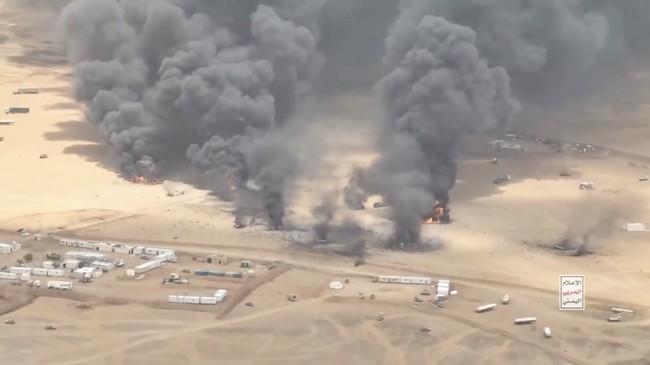
Concerns regarding global energy supplies have intensified following recent attacks in Saudi Arabia and incidents involving vessels in the Gulf region. These developments follow strikes on Saudi oil pipelines and advancements by the Houthi group in Yemen, which threaten to exacerbate global energy supply disruptions caused by ongoing conflict.
According to Reuters, oil traders expect prices to rise as markets open on Monday (14/9/2026). Developments over the weekend have threatened supplies from Saudi Arabia, the world’s largest oil exporter.
The UK Maritime Security Centre (UKMTO) reported on Sunday (13/9/2026) that a vessel was struck by a projectile while traversing the Strait of Hormuz, triggering a fire and forcing the evacuation of the entire crew. Iran also reported one fatality and four injuries after an Iranian commercial vessel was attacked off its coast.
In Saudi Arabia, state media broadcast footage of damage to homes and a mosque resulting from cross-border attacks believed to be carried out by the Houthis in the Jazan Province, in the southern part of the country. Separately, the Houthis claimed to have attacked a Saudi military base in a neighbouring province.
Several towns in southern Saudi Arabia have been under periodic attack warnings since last week. The situation culminated on Friday when drone attacks disabled a 1,200-kilometre oil pipeline stretching from east to west across the Arabian Peninsula. This pipeline has long served as a primary route for transporting Middle Eastern oil to global markets without having to pass through the Strait of Hormuz.
On the same day, the Houthis also seized Perim Island, located in the middle of the Bab el-Mandeb Strait. This strait, known as the ‘Gate of Tears’, controls access to and from the Red Sea.
Global oil prices surged past US$100 per barrel last week, for the first time since July. In the United States, politically sensitive retail diesel prices hit a record high on Sunday, exceeding US$6.2 per gallon.
Saudi oil traders told Reuters that Riyadh holds enough oil reserves at the port of Yanbu, on the Red Sea, to maintain exports for five to seven days if the pipeline attacked on Friday remains non-operational. Once these reserves are depleted, approximately 4% of the world’s oil supply could be at risk, a figure beyond the millions of barrels per day already lost due to shipping disruptions in the Strait of Hormuz.
Saudi Arabia has not yet provided full details regarding the extent of the pipeline damage or how long the route will remain out of service. Sources speaking to Reuters provided varying estimates for repairs, ranging from a few days to several weeks. Satellite imagery showed large plumes of smoke rising from several locations along the pipeline route.
These developments occur after Middle Eastern oil flows had begun a slow recovery in August. However, in the last two weeks, the war involving the United States and Israel, which began six months ago, has escalated once again. Since the temporary agreement collapsed in June after only a few weeks, no peace negotiations have been held.
In a rare diplomatic effort, Iranian officials previously stated they would attend a meeting with Gulf Arab nations in Oman on Monday. The meeting was intended to discuss an agreement that Iran claims was reached with Oman regarding future shipping routes through the Strait of Hormuz. However, Omani Foreign Minister Sayyid Badr Albusaidi stated on Sunday night that the regional meeting was postponed ‘in the interest of consensus’.
‘We remain committed to promoting dialogue that supports stability and long-term cooperation in our region,’ he wrote on X. The Iranian news agency Fars, quoting an Iranian Foreign Ministry official, reported that the delay was made at the request of several regional nations, following a mutual agreement between Tehran and Muscat.
According to Fars, the official stated that Iran would coordinate with Oman to determine a suitable date for the meeting. Iraq previously indicated it would send a delegation, and a Gulf official told Reuters that Saudi Arabia and Qatar would be represented by their respective foreign ministers. A senior Iranian official told Reuters that officials would discuss the Strait of Hormuz and other issues, though he added that the meeting is unlikely to result in a signed agreement to reopen the strait. Bahrain, however, stated it would not meet with Iranian officials.
In an interview with the London-based pan-Arab media outlet Al-Arabi Al-Jadeed, Iranian Foreign Minister Abbas Araqchi stated that despite the agreement with Oman, Iran would not reopen the Strait of Hormuz until the US meets Tehran’s demands.
The Houthi advancements in Yemen present a new dilemma for Washington. The United States seeks to support its ally, Saudi Arabia, and protect shipping lanes, while simultaneously being cautious not to be drawn into another theatre of war. Houthi advances also place Gulf nations in a difficult position: facing increasing economic impacts or forging closer ties with Iran.
Source: jawawa.id (https://jawawa.id/newsitem/houthi-launch-massive-attacks-on-saudi-arabia-putting-global-oil-supplies-at-risk-1789343536)
Originally published by CNBC Indonesia (https://www.cnbcindonesia.com/news/20260914052758-4-767555/houthi-serang-arab-saudi-habis-habisan-minyak-dunia-di-ujung-tanduk), translated from Indonesian