
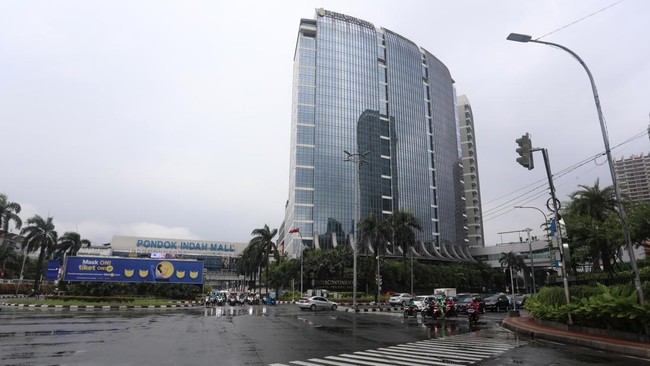
Houses in Pondok Indah Not Necessarily in Decile 10, Here is Why
The statistical metrics used to group society into deciles 1-10 are currently a subject of public debate, following concerns from individuals who do not consider themselves wealthy yet find themselves classified in decile 10 within the National Single Socio-Economic Data (DTSEN).
Deciles are statistical terms used to group the population based on estimated welfare levels, derived from observable routine expenditure measures.
The Vice Chairman of the Statistical Society Forum, Turro Wongk_aren, stated that expenditure itself is not the sole calculation in determining deciles within statistical concepts, as it involves all social elements, ranging from education and asset ownership to family composition.
Therefore, even if an individual owns a residence in the Pondok Indah area—an elite neighbourhood—but their education is recorded only up to junior high school, they may not necessarily fall into the highest decile, decile 10.
“Suppose your house is in Pondok Indah, but you are only a junior high school graduate. It does not mean you will be in decile 10. Because the combination of all these factors determines which decile you fall into,” Turro said when contacted by CNBC Indonesia.
This situation, according to Turro, is what occasionally confuses the public when a neighbour with a larger house than theirs is categorised within the decile eligible for government social assistance. This is because, once again, the decile measurement does not consider a single aspect in isolation.
“This is why I can understand why people are confused. Budi’s house is nicer than mine. Why does he get assistance? I don’t. Because perhaps Budi is only a junior high school graduate, while I am a university graduate,” said Turro.
It is important to note that the decile data source within the DTSEN is the result of processing various datasets by BPS (Statistics Indonesia). These include the Regsosek (Socio-Economic Registration) dataset, DTKS (Social Welfare Data), and P3KE (Targeting for the Acceleration of Extreme Poverty Eradication).
This data is then enriched with various administrative data and synchronised periodically with population data managed by the Directorate General of Population and Civil Registration (Dirjen Dukcapil) under the Ministry of Home Affairs.
Furthermore, Turro reminded that the decile is merely social data, or a social registry recorded by BPS, and is not the social beneficiary data processed by Ministries or Agencies (K/L).
According to him, the decile is merely a grouping of estimated public welfare levels measured using the Proxy Means Test (PMT) statistical method. This method is used to estimate family welfare levels based on observable characteristics.
Consequently, when deciles are used by Ministries or Agencies as a measurement tool for recipients of social protection programmes, the criteria for recipients are determined by each respective agency according to the specific programme requirements.
He provided an example: for the Family Hope Programme (PKH), even if two families fall into the same decile, if one does not meet the specific PKH requirements, they will not receive government assistance through that programme.
“So, you could be poor—for example, in decile 1—but if you do not have a pregnant wife or a child in school, you will not receive PKH,” he explained.
Similarly, for the low-income housing programme (MBR) under the Ministry of Housing and Residential Areas (PKP), individuals in the same decile might receive similar allocations because the criteria are based solely on income.
“Therefore, I say that the decile is only a basic foundation. Once it enters a government programme, each Ministry or Agency should determine the eligibility, which is why each agency has its own specific measurement criteria,” he concluded.
Source: jawawa.id (https://jawawa.id/newsitem/houses-in-pondok-indah-not-necessarily-in-decile-10-here-is-why-1788515686)
Originally published by CNBC Indonesia (https://www.cnbcindonesia.com/news/20260904144403-4-765011/rumah-di-pondok-indah-belum-tentu-masuk-desil-10-kok-bisa), translated from Indonesian