
House Renovation Budget Absorbs IDR 1.15 Trillion; West Java Receives Most
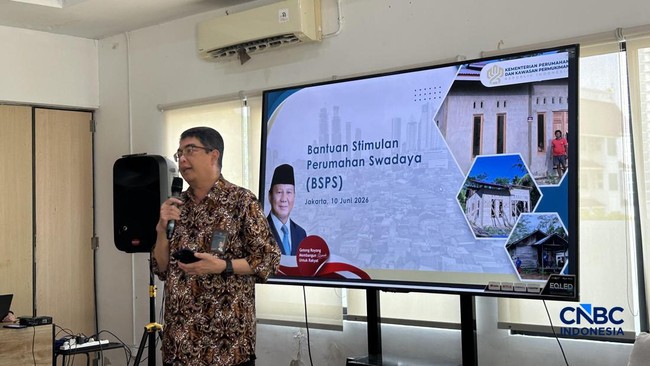
The government, through the Ministry of Housing and Settlement Areas (PKP), is continuing to push the priority Self-Help Housing Stimulant Assistance (BSPS) programme. The amount of assistance provided to beneficiaries ranges from IDR 20 million to IDR 70 million. Fitrah Nur, Director General of Settlement Areas at the PKP Ministry, said the budget prepared from the State Budget (APBN) for the programme would reach IDR 8.3 trillion in 2026. This amount is targeted to renovate 400,000 uninhabitable housing units throughout the year. Based on data as of 10 June 2026, the realised house renovation budget was recorded at IDR 1.15 trillion, or 13.5% of the total budget ceiling. This figure is calculated once the funds enter the beneficiaries’ accounts. ‘Meanwhile, the construction implementation process stands at 30% once the first disbursement stage is completed. Then, once the second stage is disbursed, it means it is 60% complete, up to 100% upon finishing. So it’s not calculated like a regular project,’ he stated during the 2026 BSPS Programme Media Briefing on Thursday (11/6/2026). In addition, Fitrah explained that the budget usage is aimed at repairing uninhabitable houses through a direct community assistance scheme. In this context, the regular assistance value is IDR 20 million per unit, with details of IDR 17.5 million for purchasing building materials and IDR 2.5 million for labour wages. Furthermore, for regions such as Papua and North Maluku, the regular budget provided is IDR 25 million per unit. For other areas in Papua and North Maluku, such as small islands, remote areas and mountainous regions, the assistance value is set at IDR 40 million per unit. Fitrah further mentioned that the house renovation aid was predominantly received by West Java Province. This is influenced by West Java’s population, which is among the largest in Indonesia. ‘So the order is West Java, East Java, Central Java, North Sumatra, and another is Makassar. Based on the population ranking, we filtered, and it turns out to be parallel with the number of uninhabitable houses,’ he disclosed. Beyond population figures, the government also considers several poverty indicators, including the number of poor people, the poverty percentage, the inequality rate and the depth of poverty. From these indicators, Fitrah noted that Bogor Regency is one of the areas in West Java with the highest poverty percentage.