
House Prices Collapse! Chinese Property Tycoon Sentenced to Life in Prison
Jakarta, CNBC Indonesia - Former billionaire Hui Ka Yan, once a symbol of the rise and fall of China’s property market, was officially sentenced to life imprisonment by a local court last week. However, the collapse of the property sector, now in its sixth year, remains a heavy burden for the world’s largest economy.
Citing Reuters on Monday (24/08/2026), the deadly crisis has become a point of prolonged suffering for millions of households and has forced China to rely heavily on export-driven growth, triggering global trade frictions. Analysts warn that there is still no clear sign of when this systemic crisis will end.
Many angry homeowners and creditors have vented their frustrations on Chinese social media. The topic of the sentencing garnered more than 370 million views and 72,000 discussions on the Weibo platform on Thursday. The public openly questioned why Hui Ka Yan, founder of China Evergrande who was once the richest person in Asia, was not sentenced to death after being found guilty of various serious crimes ranging from misappropriation of funds to bribery.
A 38-year-old homeowner, Jason Wang, expressed his frustration. The value of his house in Shandong province, one of the areas worst hit by the crisis, has been devastated and has plunged 25% since he bought it in 2019.
“The pain is unbearable. When people can barely feed themselves, who can afford to buy a house?” he said.
Economic Devastation and Export Threat
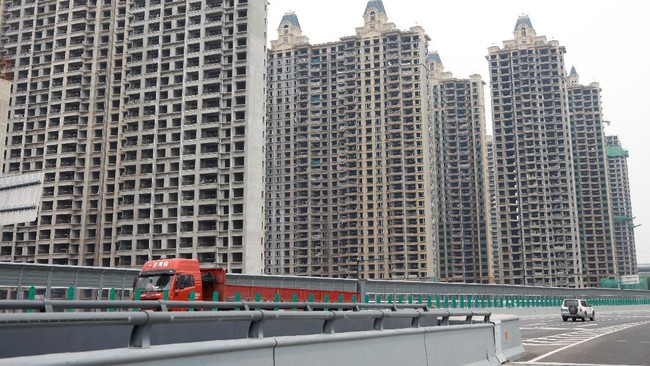
Six years after Chinese financial regulators cracked down on the debt-laden property sector, millions of half-built properties now sit abandoned across China. The recovery of new home prices in major cities such as Beijing and Shanghai has completely stalled, land sales continue to decline, and the pace of decline in property sales and construction is accelerating. In smaller inland cities, second-hand home prices have plunged by almost 25% from 2020 levels, directly slamming the brakes on consumer purchasing power.
The devastation in this pillar sector has left China’s economy able to grow by only 4.3% in the quarter ending in June compared with the same period last year. This figure represents the slowest growth rate in more than three years.
With its domestic demand engine damaged, China has pivoted and is increasingly relying on exports for growth. China’s trade surplus, which has more than doubled since 2019, has heightened trade tensions with the European Union and the United States. This has triggered panic over the threat of “China Shock 2.0”, in which cheap Chinese export goods displace local industries in trading partner countries, including in the Global South.
President Xi Jinping has sought to redirect bank credit flows and state support from the real estate sector to strategic technology industries, such as robotics and semiconductors. However, these emerging sectors are still too small to offset the burden of the housing slump. Senior Economist at Conference Board Asia, Max Zenglein, highlighted this issue.
“Growth and the benefits of growth are distributed far more narrowly across the economy. That is the main reason why consumption is not picking up,” he said.
State-Owned Enterprises Dominate the Market, Prices Must Fall 40%
In the corporate landscape, Evergrande defaulted in 2021 and began liquidation in 2024. Its competitor, Country Garden, also defaulted in 2023 and has not made any land purchases since then, while China Vanke is working to extend some bond payments and has replaced most of its top management with executives from state-owned enterprises (SOEs).
Given that most private developers have been destroyed, state-owned property companies now dominate the market completely. A loan officer at a large state-owned bank revealed the reality of current financing.
“The main consideration is who is behind it - whether it is a central or regional state-owned enterprise. In practice, banks have long stopped lending to private developers,” he explained.
Chief Executive of real estate consultancy Enhance International, Sam Radwan, stressed that there is no quick fix for this problem. He estimates it will take 18 months just to clear housing inventory. House prices would need to fall a further 40% from 2025 levels to reach an equilibrium point, a painful process that could take up to a full decade.
“The problem is systemic, and there is not much you can do. You have more houses than households - second homes are used as investments by more than a third of the population,” he said.
“Chinese people are very smart people. They know full well that they are nowhere near the bottom but they cannot see the bottom,” he asserted.
Meanwhile, Deputy Director of China Research at Gavekal Dragonomics, Christopher Beddor, assessed that the worst may have passed.
“We do not expect substantial deterioration from here. However, the most likely path is a persistent, slow price correction that eventually clears the market and paves the way for some improvement,” he concluded.
Source: jawawa.id (https://jawawa.id/newsitem/house-prices-collapse-chinese-property-tycoon-sentenced-to-life-in-prison-1787619058)
Originally published by CNBC Indonesia (https://www.cnbcindonesia.com/news/20260824132009-4-761896/harga-rumah-ambruk-bos-properti-china-dipenjara-seumur-hidup), translated from Indonesian