
House of Representatives Reveals Direction of State Finance Law Revision — Here Are the Key Points
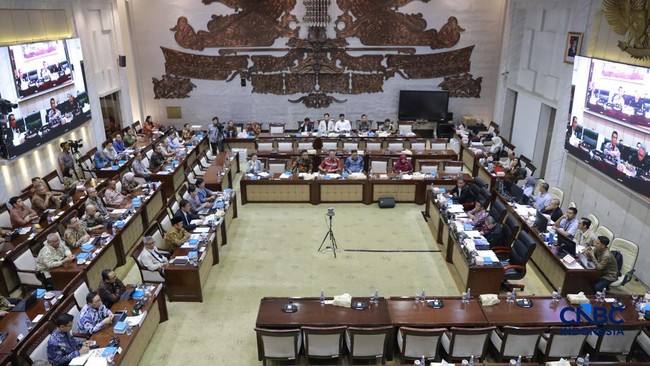
Jakarta, CNBC Indonesia — Commission XI of the House of Representatives (DPR) has set in motion deliberations on the revision of the State Finance Law. Yesterday, the DPR held a public hearing (RDPU) with four economists as part of public participation in drafting the new State Finance Bill.
Chair of DPR Commission XI, Mukhammad Misbakhun, said the revision of Law Number 17 of 2003 on State Finance is a moment to re-evaluate the system of state financial management. According to him, the deliberations should not focus solely on technical aspects, but must also consider the philosophical and constitutional foundations underpinning the management of state wealth.
“Now we have the opportunity to return this law to a purely nationalist orientation and our national interest, no longer leaning on foreign interests,” said Misbakhun in a statement quoted on Tuesday (15/9/2026).
He argued that Article 33 of the 1945 Constitution must serve as the footing for reinterpreting state control over branches of production that are important to the state and dominate the livelihood of the many. According to him, the management of natural resources must take into account the state’s limitations in terms of capital, technology and processing capability, while ensuring the benefits return to the people.
“Branches of production that are important to the state and dominate the livelihood of the many are controlled by the state and used for the greatest prosperity of the people. This is what we must reinterpret, including how large the state’s role in the market should be,” he said.
Misbakhun also questioned the ideal limits of state involvement in business activities. In his view, after 81 years of Indonesian independence, there needs to be an evaluation of which sectors must still be managed by the state and which can be provided by the private sector.
Furthermore, Misbakhun emphasised the importance of consistency in managing separated state wealth. According to him, separating state wealth from the state budget (APBN) must be accompanied by clarity of responsibility and recognition, so as not to create uncertainty when problems arise.
“At a certain point we separate state wealth in terms of responsibility and recognition, but when a problem arises we pull it back again. We must maintain this consistency, because this law will also connect to the cluster of state financial accountability,” Misbakhun explained.
Meanwhile, member of DPR Commission XI, Anis Byarwati, highlighted the state’s position in the management of state-owned enterprises (SOEs), particularly regarding state responsibility for debts and the contribution of SOE dividends to state revenue in the deliberations on the State Finance Bill.
Anis said the regulation of separated state wealth needs to clarify the relationship between the state as the provider of capital and SOEs as business entities managing that wealth. According to her, this clarity is important so that SOE management remains professional, while the state’s responsibility does not become blurred when problems occur.
“Once the state has handed over management to the SOEs, the state receives shares and the SOE is managed with good governance, it is as if the state becomes passive and simply waits for dividends. Yet when problems emerge, the state still has to bear them,” Anis said at a meeting of the bill’s special committee (Panja) with experts as part of meaningful participation, on Monday (14/9/2026).
She said this situation deserves attention because SOE capital comes from the APBN, while the contribution of SOE dividends has not yet become significant revenue within the structure of non-tax state revenue (PNBP). According to her, this shows that the management of separated state wealth still needs to be evaluated.
“The state capital injections (PMN) given to SOEs come from the APBN, most of which is still sourced from taxes. But after so many decades, SOE dividends have not become a significant contributor, let alone a main contributor, to PNBP,” she said.
Anis also highlighted the condition of a number of SOEs still facing debt problems and requiring state support. According to her, this situation shows that the state cannot be entirely passive in SOE management, even though professional governance must be maintained.
“If SOEs are considered responsible for their own debts, that should be consistent. But in reality, many SOE debts are still borne by the state. Because their capital comes from the state, the state is still regarded as the owner,” explained the legislator from the PKS faction.
Furthermore, Anis said the presence of Danantara needs to be positioned clearly in the revision of the State Finance Law. According to her, the regulation must clarify Danantara’s position in the management of separated state wealth, while ensuring the relationship between the state’s authority and responsibility remains consistent.
“With Danantara now established and operating, its position in this revision of the law must also be placed more firmly. We need to see how the positions of the state, SOEs and Danantara are regulated so that no ambiguity arises,” she said.
Source: jawawa.id (https://jawawa.id/newsitem/house-of-representatives-reveals-direction-of-state-finance-law-revision-here-are-the-key-points-1789447888)
Originally published by CNBC Indonesia (https://www.cnbcindonesia.com/news/20260915100833-4-767957/dpr-ungkap-arah-revisi-uu-keuangan-negara-ini-poin-poinnya), translated from Indonesian