
House of Representatives Passes 2027 State Budget Law, Parliamentary Factions Highlight Key Issues
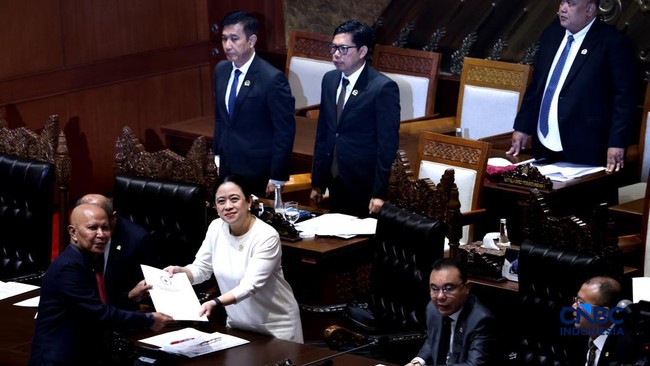
The House of Representatives (DPR RI) has officially ratified the Draft Law on the 2027 State Budget (APBN) as Law during the 7th Plenary Session of the first session of the 2026-2027 period.
In the session led by Speaker of the House Puan Maharani, all factions expressed their approval and acceptance of the 2027 APBN Bill to become Law.
“The PDI Perjuangan Fraction, Golkar Party Fraction, Gerindra Party Fraction, Nasdem Party Fraction, National Awakening Party Fraction, Prosperous Justice Party Fraction, National Mandate Party Fraction, and Democratic Party Fraction approve or accept the Bill on the 2027 Fiscal Year APBN to proceed to the second-level discussion for decision-making in today’s plenary session to be enacted into law,” stated the Chairman of the DPR Budget Committee, Said Abdullah, during the session.
Brief Views from the PDI Perjuangan Fraction
The PDI Perjuangan Fraction reminded that the APBN is the people’s money. In implementing the 2027 APBN Law, the government must maintain the budget’s credibility by operating with order, compliance with laws, good governance, efficiency, effectiveness, economy, transparency, and accountability, while also considering fairness and propriety. The implementation of the APBN must pave the way for prosperity for all citizens, demonstrate progress in all sectors, and achieve developmental governance across all regions of Indonesia.
Brief Views from the Golkar Party Fraction
The Golkar Party Fraction expressed appreciation and support for the government’s commitment to continuing the downstreaming and industrialisation agenda, as well as strengthening food and energy sovereignty as a foundation towards ‘Indonesia Emas 2045’.
The Golkar Party views the continuity of supply and the stability of domestic energy prices as vital components in maintaining national economic activity. Regarding the APBN structure, the Golkar Party requested that the government continue to strengthen the implementation and supervision of the Coretax system, measure the effectiveness of regional transfers, increase local taxing power, and strengthen financing management strategies.
Brief Views from the Gerindra Party Fraction
The Gerindra Party Fraction fully supports increasing the tax ratio to 10.4 per cent of GDP in 2027 to ensure it consistently remains above double digits. The Gerindra Fraction encouraged the government to expand the tax base and seek new revenue sources cautiously without burdening the business sector.
Additionally, the Gerindra Party appreciated the targeted increase in tax expenditure by 9.6% to Rp632 trillion in 2027 to maintain purchasing power, the investment climate, and MSMEs. The Gerindra Party also supports the government’s plan to resolve revenue sharing fund (DBH) shortfalls through a payment mechanism via government investment operators to finance priority infrastructure projects proposed by local governments. Through this programme, it is hoped that regional development can be accelerated through measurable, targeted, and impactful DBH distribution.
Brief Views from the Nasdem Party Fraction
The Nasdem Party believes that the essence of the APBN’s success lies not in the magnitude of fiscal figures, but in its real impact on economic growth, job creation, strengthening purchasing power, and the equitable distribution of public welfare. Furthermore, regarding the 2027 mandatory education spending of Rp824 trillion, the Nasdem Fraction believes that mandatory education allocation must be strictly oriented towards the human capital index, rather than mere physical absorption of funds.
Brief Views from the National Awakening Party (PKB) Fraction
The PKB Fraction argued that achieving the Gini ratio target of 0.360-0.365 in 2027 depends on whether the government can ensure that growth in high-value-added sectors is not concentrated in specific regions or capital groups. The PKB Fraction urged the government to strengthen the rural economy through active National Strategic Policy instruments and to manage urbanisation flows so they do not disrupt the capacity and economic resilience of rural areas, while also strengthening the urban lower-middle class through enhanced social assistance and protection for informal sector workers.
Brief Views from the Prosperous Justice Party (PKS) Fraction
The PKS Fraction argued that the 6 per cent economic growth target must be qualitative, inclusive, just, and sustainable, by directing the 2027 APBN to increase public purchasing power, the investment climate, productivity, and resource optimisation to ultimately increase prosperity and welfare. To achieve this, meeting the tax revenue target of Rp2,911 trillion is key to fiscal health. Therefore, the government needs to expand the tax base, reduce dependence on volatile commodity prices, and strictly combat practices such as illegal transfer pricing, under-invoicing, and tax evasion.
Brief Views from the National Mandate Party (PAN) Fraction
The PAN Fraction fully supports the government’s agenda to realise food sovereignty, strengthen the village economy, and improve the quality of education and health. For the PAN Fraction, the APBN is a public mandate; therefore, 6 per cent growth must provide decent jobs, increased farmer incomes and value, and room for small businesses to grow.
The PAN Fraction emphasised that taxes must not pressure small businesses, subsidies must be targeted, the free nutritious meal programme must absorb local farmers’ produce, and the ‘Red and White’ village cooperatives must not burden village finances. PAN will oversee the budget to ensure every rupiah of the APBN truly works for the welfare of the people.
Source: jawawa.id (https://jawawa.id/newsitem/house-of-representatives-passes-2027-state-budget-law-parliamentary-factions-highlight-key-issues-1790672054)
Originally published by CNBC Indonesia (https://www.cnbcindonesia.com/market/20260929140122-17-771802/dpr-tetapkan-uu-apbn-2027-partai-di-dpr-sorot-persoalan-ini), translated from Indonesian