
House of Representatives Member Supports Formation of National Economic System Law
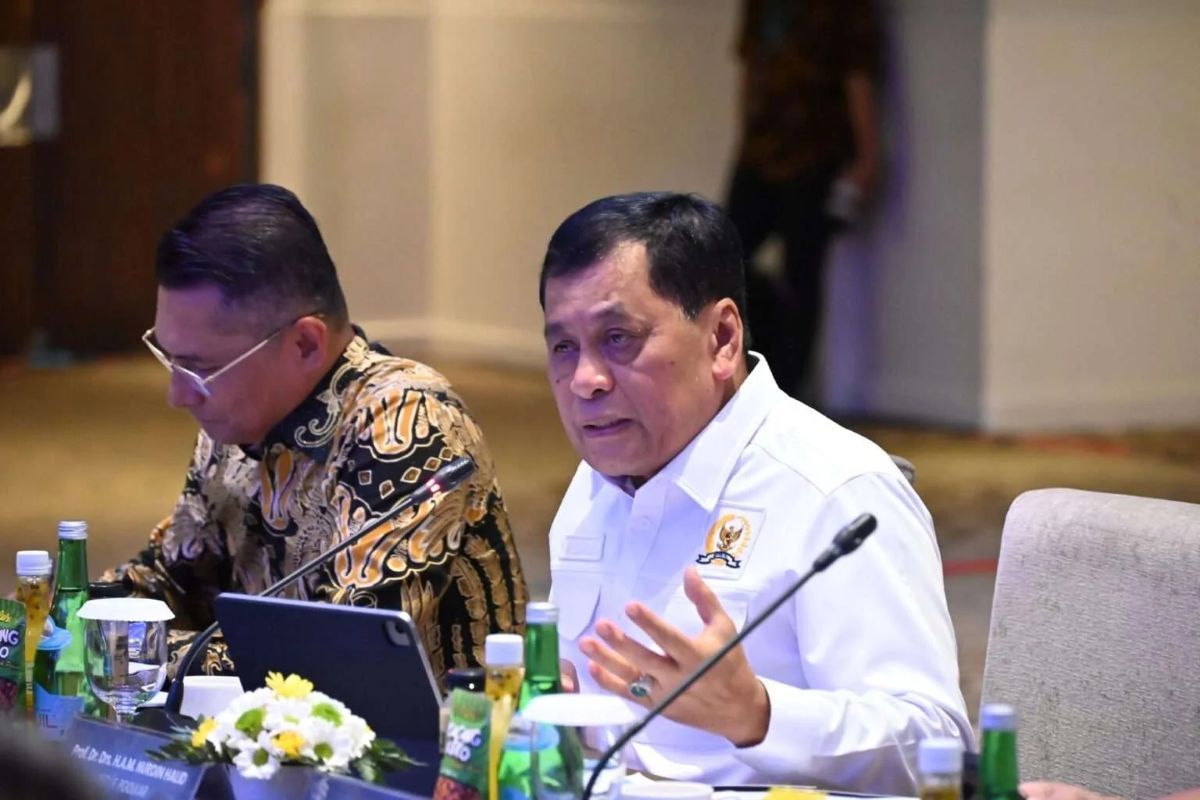
Jakarta (ANTARA) - Member of the Indonesian House of Representatives (DPR RI), Nurdin Halid, supports the formation of a National Economic System Law to strengthen the regulatory framework in realising ‘Pancasila Economics’, which is a commitment of President Prabowo Subianto.
According to his statement in Jakarta on Sunday, this strengthening is in accordance with the constitutional mandate of the 1945 Constitution, Article 33, paragraph (5), and the MPR Decree XVI/1998 regarding Economic Politics and the Framework of Economic Democracy.
“For me, President Prabowo Subianto’s firm statement regarding Pancasila Economics on the Birth of Pancasila Day, 1 June 202öss, is a declaration to uphold the economic ideology of the Republic of Indonesia. It is logical that Pancasila, as the state ideology, is translated into the state’s economic ideology. Thus, the Pancasila Economic ideology is the ‘offspring’ of the state ideology,” he said.
Nurdin fully supports the grand vision and strong commitment of the Prabowo Subianto-Gibran Rakabuming Raka administration, which is actively pursuing economic transformation based on the values of Pancasila Economics.
He noted that the fundamental values of Pancasila Economics, including its systems and achievement strategies, were established by the nation’s founders in Article 33 of the 1945 Constitution.
He also appreciated the institutional transformation and several flagship programmes of the Prabowo-Gibran administration as strategies to implement Pancasila Economics based on the constitutional mandate of Article 33. In accordance with Article 33, Paragraph 1, the Red and White Village/Sub-district Cooperatives (KDKMP) are being formed as socio-economic organisations for grassroots communities across 83,000 villages and sub-districts throughout Indonesia.
“This aligns with Bung Hatta’s ‘broomstick’ philosophy: a single stick is easily broken, but a bundle of sticks in the form of a broom is difficult to break. Therefore, the lower-class economy, which is vast yet limited by capital, human resources, technology, management, networks, and market access, needs to be gathered and mobilised within a collective business vehicle, namely cooperatives (KDKMP),” he said.
However, Nurdin repeatedly reminded the Ministry of Cooperatives and PT Agrinas Pangan, which have been tasked with building outlets, that KDKMP must be operated based on universal cooperative principles and values.
“KDKMP automatically belongs to all residents of the village and sub-district because KDKMP utilises Village Funds from the State Budget (APBN). Therefore, KDKMP must uphold the basic principle of cooperatives: ‘from members, by members, and for members.’ Otherwise, KDKMP risks failing to become a dominant economic actor in villages, similar to the experience of KUD during the New Order era,” Nurdin said.
Economic Drivers
The cooperative practitioner explained that the government is forming the Investment Management Agency (BPI) Danantara as the primary super holding company for all State-Owned Enterprises (SOEs), serving as the strategic engine for the national economy to effectively implement Article 33, paragraph (2), including the management of natural resources.
Most recently, the government issued Government Regulation (PP) Number 19 of 2026 concerning the Organisation and Governance of BPI Danantara to strengthen the institutional capacity of state investment in managing national assets more productively, professionally, and accountably.
He added that the government’s main strategy for implementing the constitution of Article 33, Paragraph 3, is the downstreaming programme for natural resources, which currently includes 28 flagship commodities. The downstreaming strategy aims to add value to Indonesia’s natural wealth, thereby driving resource-based industrialisation and creating national self-sufficiency that leads to the prosperity of all Indonesian people.