
House of Representatives’ Legislative Body says Copyright Bill will provide a legal framework to protect creative works
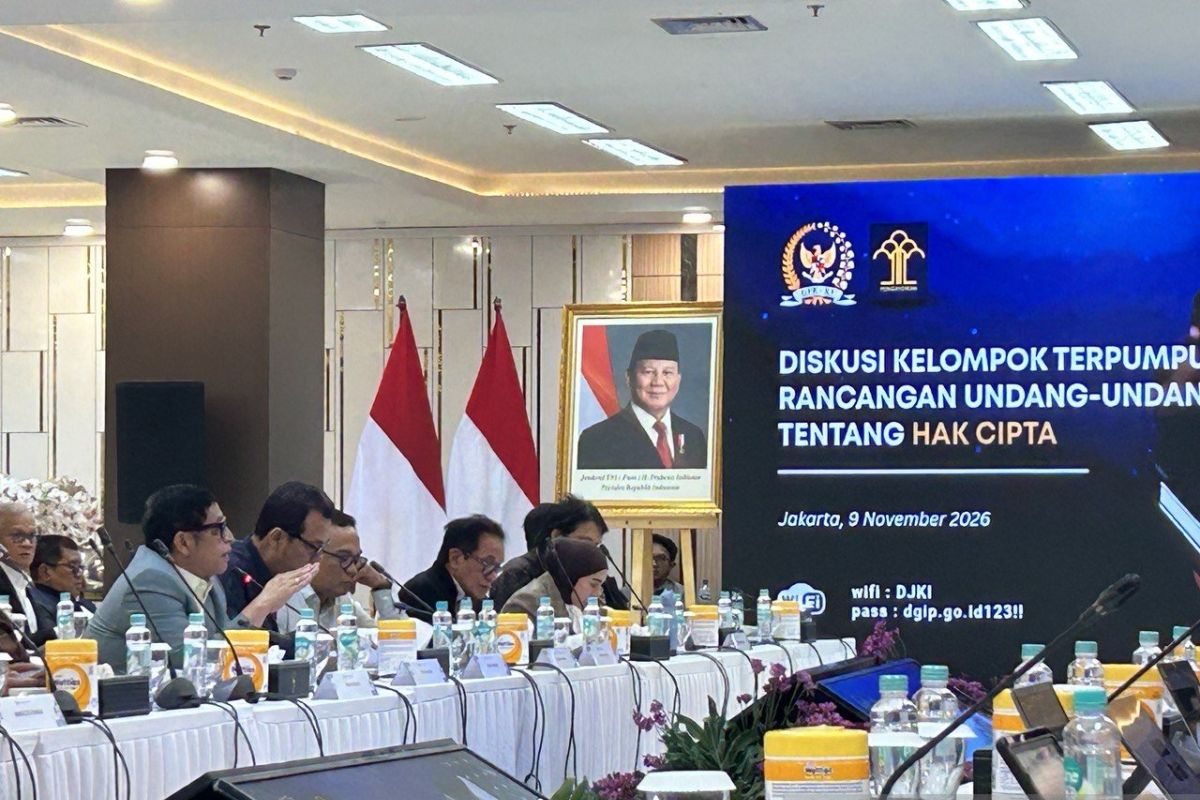
Jakarta (ANTARA) – The House of Representatives’ Legislative Body (Baleg) has stressed that the drafting of the Copyright Bill is intended to create an umbrella law ensuring comprehensive protection for creators’ fundamental rights.
Baleg chair Bob Hasan said at a focus group discussion on the bill in Jakarta on Monday that the law should regulate general and fundamental matters, while technical implementation details would be delegated to derivative regulations, such as government regulations.
“With the Copyright Law, we should keep things simple and not make them complicated, because this is an umbrella law, not a technical regulation. The technical regulations will be formulated later,” Bob said in front of Baleg’s working committee and government representatives.
Bob said the plan to establish an overarching legal framework was in line with the DPR’s ongoing efforts to reform the process for drafting legislation under the Law on the Formation of Legislation (UU P3).
He said the reform was intended to prevent parent laws from generating too many overlapping implementing regulations as a result of institutional and sectoral interests.
“One law should not end up with five to eight implementing regulations, leading to disputes. So let us set aside sectoral interests for the sake of protecting creative works,” he said.
Bob highlighted three fundamental rights belonging to creators of music, literature and other creative works, none of which should be separated or diminished: moral rights, exclusive rights and economic rights.
“These three rights are inherent and not one of them should be lost. We must not allow economic rights to be secured while exclusive rights are not,” he said.
On the bill’s deliberations, the DPR has received 1,117 government-submitted lists of issues (DIM), most of which concern the substance of individual articles.
Bob said Baleg was accustomed to reviewing thousands of issues in accordance with the principle of public transparency. He guaranteed that the public, from Aceh to Papua, would be able to follow discussions of every provision, down to the commas and full stops, and said there would be no inserted provisions or closed-door negotiations.
Concluding his remarks, Bob discussed the possibility that doctrines for enforcing criminal law may shift in the digital era. He said digital infringements, such as unauthorised reproduction or piracy, could potentially be dealt with under a monistic doctrine, similar to that applied to wiretapping offences.
Under a monistic doctrine, he said, the material act (actus reus) of copying or taking a work in the digital sphere would automatically be considered to meet the element of criminal intent (mens rea).
“There is a possibility that future law enforcement will move towards the monistic concept because of digitalisation,” he said. “Anyone who plagiarises may be considered to have acted in bad faith, whatever their initial intentions.”
Source: jawawa.id (https://jawawa.id/newsitem/house-of-representatives-legislative-body-says-copyright-bill-will-provide-a-legal-framework-to-protect-1794253820)
Originally published by Antara (Indonesian) (https://www.antaranews.com/berita/5842871/baleg-dpr-nyatakan-ruu-hak-cipta-jadi-payung-hukum-perlindungan-karya), translated from Indonesian