
House of Representatives Invites Labour Unions to Provide Input on Draft Labour Law
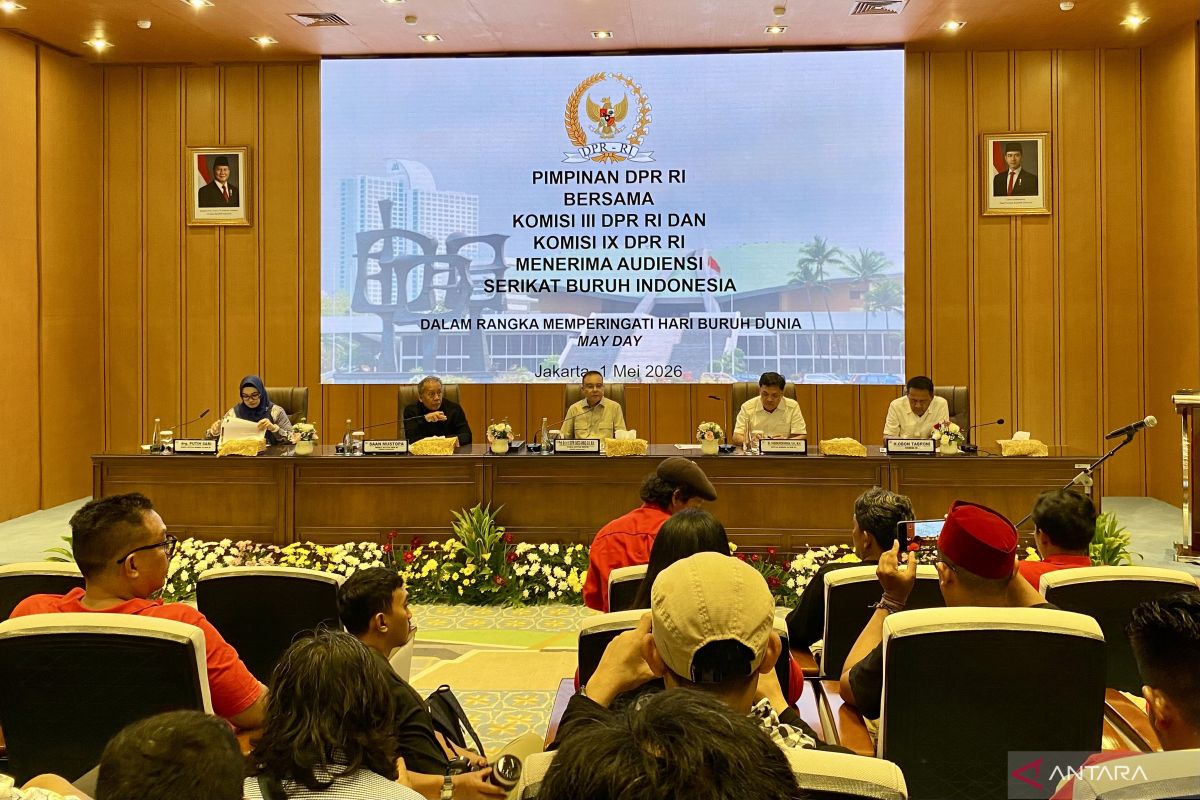
Jakarta (ANTARA) - Deputy Speaker of the House of Representatives Sufmi Dasco Ahmad has invited labour unions to provide input in drafting the Bill on Labour.
Dasco, while receiving an audience from labour unions on the occasion of International Labour Day or May Day 2026 at the parliamentary complex in Senayan, Jakarta, on Friday, stated that input from workers is essential so that the resulting law is comprehensive.
“So that the law is not wasteful and not challenged again at the Constitutional Court (MK), please, fellow workers who are ‘cooking’ it, we will discuss it together with the government and the DPR here,” he said.
According to Dasco, the DPR and the government, as the law-makers, have agreed that the new Labour Law can be enacted at the latest by the end of 2026.
This step aligns with the Constitutional Court’s decision, which ordered the DPR and the government to draft a new Labour Law at the latest two years from the pronouncement of the decision in October 2024.
“This is us turning it around; the ingredients are actually requested from fellow workers on what must be regulated. This is a new law, after all; we are not revising the old law because the mandate from the Constitutional Court’s decision is that we must create a new Labour Law,” he explained.
Meanwhile, Deputy Chair of Commission IX of the DPR Putih Sari stated that the Labour Bill is currently being processed in Commission IX. She emphasised that her side is committed to completing the bill before the deadline set by the Constitutional Court.
“And we have also been continuously implementing meaningful public participation by inviting various parties,” she said on the same occasion.
Meanwhile, member of Commission IX of the DPR Obon Tabroni explained that Commission IX, which handles labour affairs, has invited several associations on Tuesday (14/4) to gather input related to the Labour Bill.
He also stressed that the Labour Bill cannot be deliberated by the DPR alone because the policy involves other stakeholders, both labour groups and business circles.
“Yesterday, Apindo (Indonesian Employers Association) and Kadin (Indonesian Chamber of Commerce and Industry) officially submitted input,” Obon said.
The demand to enact a new labour law is one of the demands put forward by labour unions in that audience.
Meanwhile, General Chairman of the Indonesian Labour Union Alliance Confederation (KASBI) Unang Sunarno urged the DPR to immediately discuss the pro-labour Labour Bill by involving labour union elements.
“Because if labour union elements are not involved, we believe that substantively it will certainly not align with the demands of the working class so far,” he said.
Workers, according to Sunarno, do not want the law to be wasteful and end up being questioned again before the Court.
“If the law is enacted, for example, at the same time demonstrations, waves of protests, even possibly lawsuits at the Constitutional Court will certainly proceed,” he said.
It is known that the Constitutional Court ordered the law-makers to immediately create a new Labour Law and separate it from Law Number 6 of 2023 on Job Creation.
The Constitutional Court gave a maximum time of two years. The Constitutional Court also reminded that its creation must involve active participation from worker and labour unions.
The substance of the new Labour Law, as per the Constitutional Court’s order, must accommodate the material of Law Number 13 of 2003 on Labour and the Job Creation Law, while also incorporating the substance and spirit of several Constitutional Court decisions related to labour.
The order to form a new Labour Law is contained in Constitutional Court Decision Number 168/PUU-XXI/2023 regarding the material examination of the Job Creation Law.
At that time, the Constitutional Court partially granted the petition from the Labour Party, the Indonesian Metal Workers Federation (FSPMI), the All-Indonesian Labour Confederation (KSPSI), the Indonesian Labour Unity Confederation (KPBI), and the Indonesian Workers Confederation (KSPI).